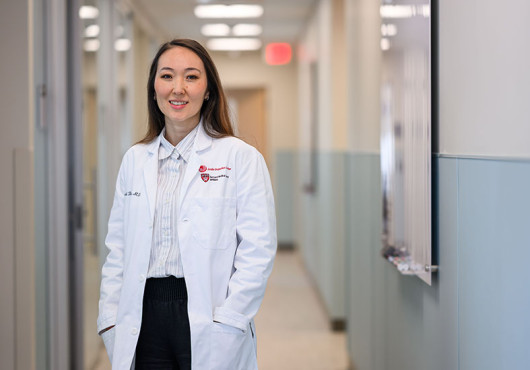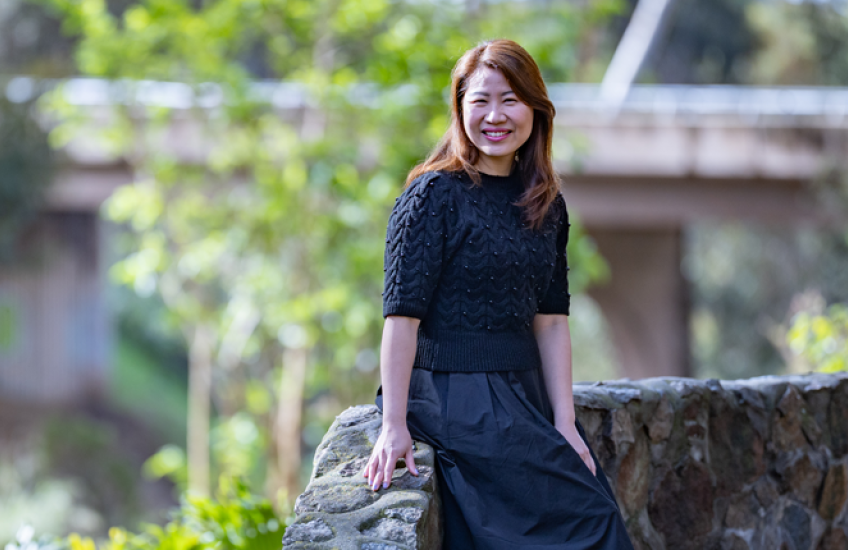
Judy Sng earned her PhD in neuroscience more than 20 years ago and has been teaching neuropharmacology at the National University of Singapore (NUS) since 2009. A leader in educating educators at the NUS Yong Loo Lin School of Medicine, she began developing artificial intelligence-powered teaching tools in the late 2010s.
But she appreciates that learning is a lifelong process, so when she wanted to refine those tools, gain deeper insights into how AI can improve the medical education experience, and brush up on modern teaching philosophies, she looked to Harvard Medical School’s Master of Medical Sciences in Medical Education program.
Sng, set to graduate this spring, approached the experience with an open mind determined to learn.
“I came to Harvard for a reason: to engage with top leaders in the field,” she said. “I put myself in a mindset of a student, to receive.”
Sng is poised to apply her new expertise by helping create a master’s program at her home university, ensuring that educators are equipped with the latest strategies and technologies as they train the next generation of medical professionals to navigate an evolving health care landscape.
Toward effective AI integration
At HMS, Sng’s research focused on how students perceive AI in medical education and how it can be effectively integrated into curricula.
That included evaluating one of the tools she co-developed, called the Virtual Integrated Patient or VIP, to study its use, impact, and efficacy in medical and nursing education.
The VIP started as a chatbot that gave nursing students opportunities to practice natural conversations with AI “patients” experiencing symptoms of mental illnesses such as schizophrenia or depression. Traditionally, teachers have to hire actors to come in once or twice per semester, limiting the number of times students can practice what they’re learning.
Being at HMS gave Sng broader perspective on how to assess and implement VIP and other AI technologies.

“My mentors asked me to take a step back and think in terms of how AI is perceived in medical education,” she said. “Everybody says it’s great to use and stuff like that, but how do you actually adopt it, and how do you actually implement it in class?”
The program validated her understanding of the need to reinforce any learning done through technology with face-to-face interactions with teachers.
“With ChatGPT, it feels like somebody’s talking to you, so personalized, yet we are trying to also teach them how to decipher what is right from wrong with these chat-based tools,” she said.
She also learned that “you need to have harmony in AI tool use across the people who are teaching with you,” she said. “Students do not like to be thrown five to ten different tools. We need to help to curate for them as facilitators.”
Putting lessons into practice
Sng has been a co-facilitator for the Harvard Macy Institute course “Transforming Your Teaching Using Technology” in her second year — a class she took in her first year. The course engages mid-career educators in newer, technologically informed teaching methods.


The experience expanded Sng’s understanding of educational leadership and curriculum transformation.
“Co-facilitating sessions at HMI has given me insights into how medical educators worldwide are innovating in teaching and assessment, particularly in AI-driven and technology-enhanced education,” she said.
Sng is building on her HMS thesis by advancing VIP to incorporate voice and visuals that can help students identify even more diagnostically significant cues.
What Sng learned at Harvard will have ripple effects beyond her own classroom. She has been tapped by her university to launch a new master’s in medical pharmacology program this August.
One track will focus on teaching pharmacology — empowering educators and students through the integration of neuroscience, AI, digital transformation, and modern pedagogic frameworks, she said.
Interdisciplinary approach
Sng earned her bachelor’s from the National University of Singapore and her PhD in neuropharmacology from Kanazawa University in Japan before refining her skills through fellowships at Japan’s RIKEN Brain Science Institute and at what is now Boston Children’s Hospital.
Pharmacology is an inherently interdisciplinary field, a fact that excites Sng.
“You need to be very good across different fields, understanding anatomy, physiology, pathophysiology. When I teach drugs used in infectious diseases, I need to know microbiology. So it is very integrative,” she said. “For the new program, we are working with clinical pharmacists, doctors, and nurses, so it works well for students and they become safe practitioners.”
Sng believes her neuroscience background has helped her harness the power of AI.
“Understanding the circuitry of how things work as a whole is similar in the brain and in the programming of an artificial intelligence,” she said.
Sng is leaving HMS motivated to further shrink the gap between science and teaching.
“I am very glad that I got to explore many aspects of the education of educators here,” she said. “I’m very grateful for the mentorship of the faculty. Over the last 20 years, I have always been giving, but now I am receiving feedback on my work for a change. That’s pretty nice.”
Singular Paths to Improving Health
Celebrating the accomplishments of the Class of 2025