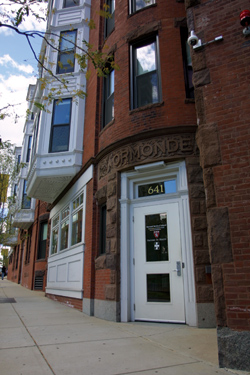
 The renovation of the HMS office building at 641 Huntington Avenue has earned LEED Gold certification from the U.S. Green Building Council, which promotes building standards that support human health and the natural environment. The council’s LEED, or Leadership in Energy and Environmental Design, rating systems are recognized internationally. Originally two separate but attached 19th-century masonry buildings, the integrated space now houses the HMS Department of Global Health and Social Medicine, Partners In Health and the HMS Education and Global Program administration.
“This is the first Harvard project in the Longwood Medical Area to be certified under the LEED rating system for new construction and major renovations,” said Richard G. Mills, HMS executive dean for Administration, a vigorous proponent of the “green” project. “It represents an important step in the School’s effort to move toward sustainability, reduce our carbon footprint and create a healthy environment—both inside and outside our walls.”
“This building is the result of a remarkable collaboration,” said Global Health and Social Medicine chair Paul Farmer. “We are grateful to the staff of the Office of Engineering and Construction for taking this project from vision to reality. Working with them throughout the renovation process, we were able to hold true to the department’s values of promoting human health, resource stewardship, and social responsibility. We have not only provided a healthy space for those who work in the building, but we also are proud to play a role in creating the equitable and sustainable future that drives our work here and elsewhere in the world.”
To earn LEED Gold, the project scored points for efficiency, environmental impact, and human health and comfort. Features include energy-saving systems and appliances; the automated management and metering of heating, ventilation and air conditioning; and integrated control panels that regulate lighting and projection systems. Materials used inside are recycled and low in volatile organic compounds, while the design maximizes natural light.
The project represents an important step toward Harvard President Drew Faust’s goal of reducing greenhouse gas emissions by 30 percent below 2006 levels by 2016, including all new construction. The building is expected to use 33 percent less energy than a typical code-compliant building and 37 percent less domestic water, saving nearly 100,000 gallons per year.
Work on the four-story, 29,000-square-foot building, begun in June 2008, was completed in September 2009. Other key players in the project were the Harvard Office for Sustainability and an outside design and construction team including Winter Street Architects.