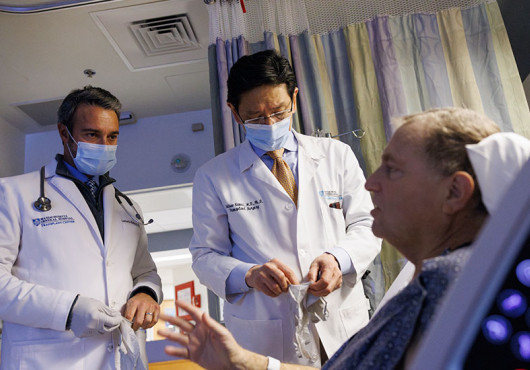
Shortly before his death on Sept. 15, Leon Eisenberg talked with Focus about the establishment of affirmative action at the Medical School. Among his many extraordinary accomplishments, Eisenberg was proudest of his role as a leader of this initiative. We are running this story in honor of Eisenberg, his colleagues, and their legacy at HMS.
Three days after Martin Luther King Jr. was assassinated, a small group of young HMS faculty members assembled to address something largely missing from the HMS student body: minority students.
Ed Kravitz and Jon Beckwith, the founders of this ad hoc committee, had been talking about how to get HMS involved with the black community before MLK’s assassination. But the shocking events of April 4, 1968, spurred them into action. In just a few days, they gathered a group of nine sympathetic faculty members who were similarly moved by King’s death.
Though HMS was noted for admitting three black students in 1850, a time when the number of black graduates from U.S. medical schools could be counted on one hand, this early openness had consequences.
“Students thought their credentials would be weakened, and there was a student revolt, and [the black] students were asked to leave,” said Leon Eisenberg, a member of the committee and a longtime champion of diversity.
After that, few black students were admitted to the School. By the time Kravitz, the George Packer Berry professor of neurobiology, and Beckwith, the American Cancer Society professor of microbiology and molecular genetics, held their first meeting in Kravitz’s home, the makeup of the student body was entrenched, and the average number of black students graduating from HMS was less than one per year.
“It was so commonplace that nobody thought twice about it, and it took a tragedy to bring attention to it,” said Eisenberg, who was among those at that first meeting, along with David Potter, the Robert Winthrop professor emeritus of neurobiology, and Ed Furshpan, the Robert Henry Pfeiffer professor emeritus of neurobiology.
The group drew up a proposal to increase the enrollment of minorities by at least 15 students, a number that reflected the percentage of the population at large. “We recognized with these proposals that we were requesting a substantial change in the student population at HMS,” Kravitz later wrote. They brought the proposal to Robert Ebert, then dean of HMS, who expressed his support and advised them to garner the backing of the heads of all the clinical and preclinical departments. In three weeks there was a faculty meeting, at which the proposal could be put to a vote.
“All science and all other work stopped,” said Kravitz, as they drafted the proposal and met with the department heads. In the end, they were able to get the support of every department chair, along with a handful of more established faculty members who they felt would lend credibility to their cause.
The faculty meeting was well attended due to another item on the agenda: salary caps for clinical faculty. It was in this contentious environment that the affirmative action initiative was introduced, after most of the meeting had been devoted to the salary concerns. While most faculty members expressed their support for the proposal in general, they were divided over the recommendation that at least 15 minority students be enrolled. Some argued that this would have the effect of instituting a quota and suggested the language be changed to “a substantial number.”
Eisenberg later said he felt strongly that the number was important, because “substantial” could mean as few as five students. “These were floors, not ceilings,” he said, dismissing the notion of a quota. “We wanted no less than, not no more than.”
Dean Ebert called an end to the debate by appointing a committee, chaired by Potter, to investigate further. Eventually, the dean secured support for the number by deciding to increase the size of the class.
Though the proposal passed, the hard work had just begun. The committee knew that while there were plenty of talented minority students across the nation, it would take a special recruitment effort to convince them to come to HMS and not one of the traditionally black medical colleges. Potter traveled the country on his own dime, visiting colleges and speaking with prospective students to ensure that the committee would meet its enrollment goal of 15 students.
His efforts paid off, and the number of minority applicants to the Class of ’73 increased by sixfold over the previous year. Sixteen enrolled.
While ushering in a new era of inclusiveness, another lasting legacy of the initiative was the hiring of Alvin Pouissant, who celebrates his 40th anniversary at HMS this year. One of his tasks was to see that the School was a welcoming place for all who attended.
“The success of the program is not only due to faculty and students who were recruited, but that we made sure students were comfortable,” said Eisenberg.
HMS continues to broaden its outreach, with programs for faculty development and for students of all ages. But, said Kravitz, “affirmative action is always going to be necessary. There’s a constant threat.” He added that while HMS has greatly improved its diversity among students and faculty in the MD program, there is still work to be done in the graduate departments.
Nevertheless, the HMS student population of the 1960s would hardly be recognizable today. “One of the things that makes me so proud is that there are now so many black graduates of HMS,” said Eisenberg, “we can’t go backward.”