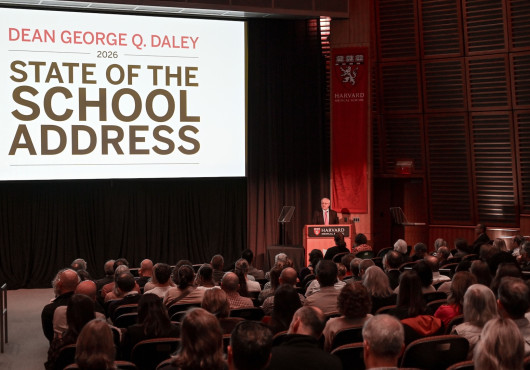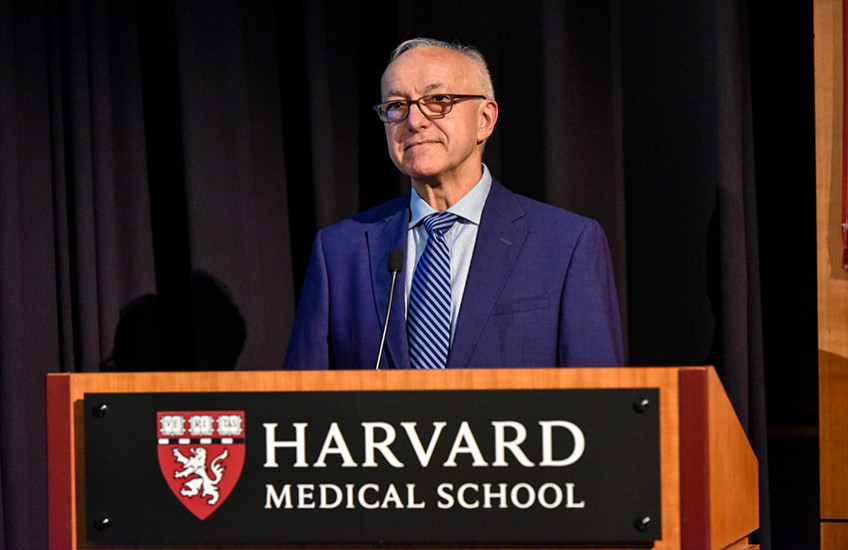
Harvard Medical School has become a powerful magnet of innovation and opportunity that brings people together to solve society’s most pressing health-related challenges through fundamental and clinical discovery, academic rigor, and a culture of excellence, said HMS Dean George Q. Daley in his annual State of the School Address on Sept. 17.
Daley highlighted examples of this shared creative force from the past year and provided an overview of the School’s financial, professional, and social health for hundreds of community members gathered in the Joseph B. Martin Conference Center and watching online.
“HMS is a magnet that brings people together to reignite urgency around areas of escalating concern,” he said. “Here, hope is born from novelty, and reward arises from calculated risk. Our ability to bring collective resources to bear on seemingly intractable problems is unparalleled.”

The draw of ambitious research
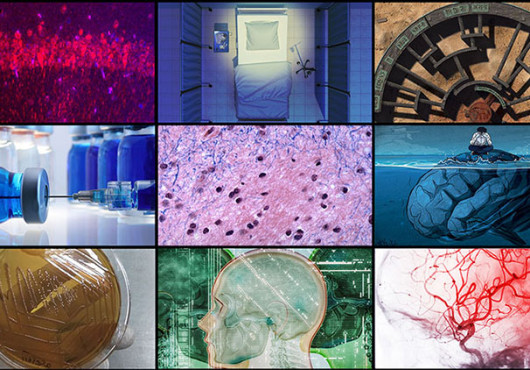
One such problem is the global threat of antibiotic resistance, and this year the attractive power of HMS drew in more than $100 million in funding from the Advanced Research Projects Agency for Health (ARPA-H) to lead a 25-institution consortium in tackling this so-called slow-moving pandemic, Daley said.
Led by Johan Paulsson, professor of systems biology in the Blavatnik Institute at HMS, the academia- and industry-spanning team is working to develop new technologies to rapidly and accurately identify bacteria and understand their behavior with the goal of driving the development of more effective treatments for life-threatening bacterial infections.
Daley credited HMS being entrusted with this leadership to the School’s ability to summon “some of the world’s greatest minds” and its “prodigious resources and collaborative energy.”
The dean pointed to the convening power of other new research endeavors, such as the Gene Lay Institute of Immunology and Inflammation, which is sparking interdisciplinary studies across Brigham and Women’s Hospital, Massachusetts General Hospital, and HMS into the role inflammation plays in common diseases, and the Paul Farmer Collaborative, an alliance between HMS and the University of Global Health Equity in Rwanda formed to catalyze the development of sustainable health systems that improve care delivery to underserved populations.
“HMS is a magnet for fundamental research and clinical care locally and health care delivery globally,” Daley reiterated.
The power of partnership — and AI
The quality of the School’s science both invites and is strengthened by collaborations with biotechnology, pharmaceutical, robotics, and artificial intelligence companies, Daley said.
This year HMS continued to integrate therapeutics discovery into its research and education efforts. Daley called attention to standouts such as the School’s new master’s program in therapeutic sciences, set to start next fall, and the Blavatnik Harvard Life Lab Longwood, now operating at an industry standard 70 percent capacity.
Cautious and creative use of artificial intelligence offers another avenue for HMS to recruit and retain top talent and augment the best science, patient care, and education and training, Daley argued.
“In the past year, we’ve been gearing up to make the most of this remarkable inflection point in history,” he said. “We are capturing the gravitational power of AI and harnessing it as our own.”
The inaugural Dean’s Innovation Awards for the Use of Artificial Intelligence granted a total of $2.2 million to 33 projects exploring applications of generative AI to research, education, and administrative efficiency.
To further equip biomedical leaders of tomorrow, the School developed a PhD track on AI in medicine, a class on AI in medicine for entering students in the Harvard-MIT Program in Health Sciences and Technology, and a course in natural language processing that more than 800 members of the HMS community took for free.
And the latest AI-related research across the HMS community spans efforts to illuminate basic biology and the mechanisms of disease, identify new drugs and drug targets, and enhance clinical care and health equity.
The potency of HMS partnerships extends to strengthening the health of communities, the dean said.
He cited as one example a joint grant that the Institute for Health Equity Research, Evaluation, and Policy of the Massachusetts League of Community Health Centers received this July from the Harvard & The Legacy of Slavery Initiative’s inaugural Reparative Partnership Program. The HMS Office of Diversity Inclusion and Community Partnership is the designated Harvard partner for the grant and will collaborate with the Institute, as well as Brockton Neighborhood Health Center and Codman Square Health Center, to invest in community-led scholarship that addresses health inequities among people descended from those harmed by slavery.
Community partnerships have also been key to endeavors such as the Sexual and Gender Minority Health Equity Initiative that ensure HMS students and clinicians are equipped to provide the highest quality care for LGBTQ+ and other underserved patients, he said.
Financial forces
Daley noted that in his eight years as dean, he and his administrative team have helped HMS reverse its trend of budget deficits. However, he said, the School joins other institutions across the country in confronting new economic challenges.
These include inflation, weak endowment growth, shrinking NIH budgets, and ballooning costs and income uncertainty in the post-pandemic era, he noted.
Thus the School faces a shortfall in its discretionary spending budget for the upcoming fiscal year, the dean said. He reiterated the need for the community to serve as responsible stewards of HMS’ still-significant resources and outlined several strategies in play for reducing spending, controlling growth, and increasing revenue.
Daley emphasized that the School remains committed to internal investment. HMS provided more than $300 million in subsidies to support research, education, and service this year, he showed.
The dean took an optimistic approach to the sober scenario.
“We have weathered more than our fair share of financial challenges at Harvard Medical School, and I have confidence we will do so again,” he said.
The push and pull of community
HMS also generates a magnetic force through the conviction of its own dedicated and diverse individuals, Daley said.
“The state of our school is only as strong as the state of our community,” Daley asserted, “and our community is strong.”
He praised community members’ resilience, palpable spirit of inquiry, and drive to pursue inclusive excellence.
This year, he said, an impressive 75 percent of admitted HMS MD students accepted the call to pursue their training at the School. However, the percentage of entering students from backgrounds traditionally underrepresented in medicine was lower than the recent average. Whether or not that represents a consequence of the Supreme Court’s rejection of race-conscious college admissions programs, he said, the result underscores the need to bolster recruitment so the exceptional doctors who graduate from HMS better represent the patients they serve — something that has been shown to improve health outcomes.
Daley acknowledged that, also like a magnet, opinions within a vibrant community can become polarizing, as Harvard most notably experienced with the latest Israel-Hamas war. He cited new and evolving opportunities for constructive dialogue at both the University and School levels.
“We must be able to speak freely and disagree safely,” he said. “We must find ways to turn the diversity of our convictions into growth and advance mutual understanding.”
In line with the theme of community, the speech was followed by a School-wide celebration on the HMS Quad.