Female faculty at eight HMS-affiliated hospitals received fewer grant dollars than their male colleagues over a three-year period. But gender per se was only part of the reason, according to a recently published study by a faculty subcommittee of the HMS/HSDM Joint Committee on the Status of Women.
After controlling for academic rank, the researchers discovered that grant success rates were not significantly different between women and men. Gender disparities in academic rank turned out to be the key factor in success rate disparities since, in the study sample, women were underrepresented in the higher ranks, and researchers at these ranks had higher success rates. The study showed that women at the highest academic rank attained parity with men in both the dollar amount and years requested.
“What we found was that hidden biases that inhibit women in the promotion process may be the same as those at work in their quest for research grants,” said lead author Susan Waisbren, HMS associate professor of psychology in the Department of Psychiatry at Children’s Hospital Boston and a member of the Division of Genetics in the hospital’s Department of Medicine. In academic medicine, women are disproportionately entrenched in the lower levels of academic rank, noted Waisbren.
The study, “Gender Differences in Research Grant Applications and Funding Outcomes for Medical School Faculty,” is the first in the United States to analyze grant success in biomedical research after controlling for academic rank. It appears in the March 2008 Journal of Women’s Health.
“The importance of the paper lies in introducing rank as a critical variable in the analysis,” Lotte Bailyn, a professor at the MIT Sloan School of Management, wrote in an accompanying editorial. “The point of these questions is not to make recommendations, but to shift the discussion from ‘fixing’ the women to a consideration of the institutional norms and practices that create their problems in the first place.”
The study looked at research grant applications submitted by full-time faculty from 2001 through 2003 at eight HMS-affiliated institutions representing 91 percent of the total full-time faculty. Data on 6,319 grant applications submitted by 2,480 faculty applicants were analyzed by gender and faculty rank of applicant, source of support (federal or nonfederal), funding outcome, amount of funding requested, and amount of funding awarded.
Significant gender differences were found in the mean number of submissions per applicant, success rate, number of years requested, mean number of years awarded, and median annual amount awarded. The median annual amount requested—women $115,325, men $150,000—was consistent with the other gender disparities. When successful, both men and women received over 90 percent of the dollars requested.
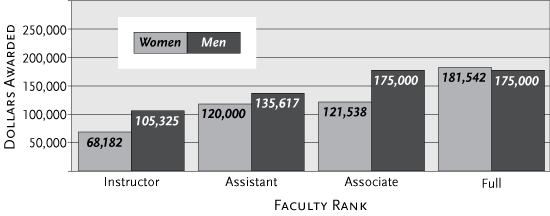
A significantly lower percentage of women than men submitted grants at the rank of instructor. At the academic ranks of associate and full professor, however, a significantly higher percentage of women than men submitted grants.
More research is needed to understand why junior women ask for less funding than their male peers and to propose prescriptive strategies for enhancing support for women’s scientific research, Waisbren said.
The researchers are conducting a qualitative study to further explore the supports available to women, their motivations to apply for research funding, and the challenges they face.
The original study was supported by the HMS/HSDM Joint Committee on the Status of Women and Harvard’s Kennedy School of Government.