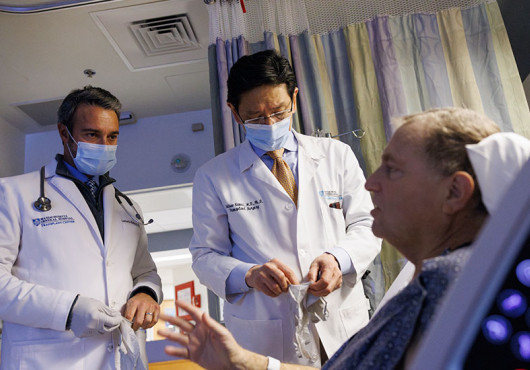
Effectively communicating with family members of hospitalized patients is an important skill for doctors to have. It heavily influences the course of a patient’s care and invariably molds the family’s experience with the hospital. Most medical interns and residents receive little to no formal training in this area, but the role it plays in clinical care has become increasingly clear to me as this year—my first in the hospital—has progressed.
Moreover, the variability in approach taken by physicians and the corresponding difference in the families’ understanding and acceptance of their loved ones’ care has left me with the impression that more explicit attention should be paid to this area.
Mr. S was one of the first patients who taught me the power and importance of effective communication. A 65-year-old man from the Boston area, he suffered from multiple, chronic medical problems, including asthma, kidney failure and gout. I met him in the intensive care unit shortly after he was admitted to the hospital for an asthma exacerbation. His course had been rapid and tumultuous: within hours of admission, his breathing acutely worsened, and he was transferred to the ICU for respiratory distress. Shortly afterward, when things appeared to be headed in the right direction, he suffered an acute and unexpected cardiac arrest. Fortunately, the medical team was able to resuscitate him, but he required intubation during the process, and the extent of organ injury suffered as a result of the cardiac arrest—including to his brain—remained unclear.
I spoke to Mr. S’s closest family members, his son and niece, later that day when they visited him in the hospital. They had first become aware of his hospitalization only that morning and were shocked to learn of his rapid decline. As I spoke with them about Mr. S, I tried to model my approach after a more senior resident whose communication style was simultaneously clear, compassionate and supportive. I was relieved to see the countenance of understanding settle on their faces while we spoke, since I had never had to share so much unfortunate news with family members I had just met. As our conversation progressed, I gained the sense that I had answered their questions in a manner that clarified their uncertainties about Mr. S’s condition while emphasizing the absolute gravity and tenuousness of his situation.
According to Joyce Sackey, HMS assistant professor of medicine at Beth Israel Deaconess Medical Center, communication with family is especially important when patients are critically ill: “When patients are not in a position to make decisions or cannot speak for themselves, it is particularly important we make ourselves available to their families and ensure that they are heard.” My sense was that, by establishing clear and lucid lines of communication, Mr. S’s family members were better able to support him as well as each other.
A few hours later, Mr. S suffered a second cardiac arrest, and we were unfortunately unable to resuscitate him. Calling his son to tell him that his father had died was difficult, and I can only imagine how much more difficult it would have been for him—and for me to break the news—without the precedent of open, sincere communication we had established earlier. Moreover, because we had discussed the critical nature of Mr. S’s condition, I suspect that he had already considered the possibility that his father might ultimately not survive. It was sad news to deliver, but I was appreciative that our conversation was built on an already-established foundation of mutual trust and understanding.
According to Mark Aronson, HMS professor of medicine and associate chief of the Division of General Medicine and Primary Care at BID, establishing open and clear communication with families in the clinical care setting is not only critical but also germane to the role of the physician. “A smart medical student taught me something once about communication with patients and their families,” he said. “She had been a teacher and was concerned that as a physician she would no longer gain the fulfillment that she once had. While she was taking her clerkships and began interacting with patients and families, she had an insight: doctors are teachers. That’s part of the job. That’s part of what makes treatment work, and it is just as important to communicate well as it is to identify the correct diagnosis or choose the appropriate treatment.”
Joseph Ladapo, HMS ’08, is an intern in internal medicine at Beth Israel Deaconess Medical Center.
The opinions expressed in this column are not necessarily those of Harvard Medical School, its affiliated institutions or Harvard University.