As I stand here today, I’m thinking of a patient of mine who I’ll call Alayna. I met Alayna when she was 10 years old, the kind of little girl who is a little shy when you first meet her, but full of bubbly energy when you get to know her. She loved watching cartoons on her iPad, she taught me a secret handshake that we did every time I came into the room, she had a big, toothy smile that stretched from ear to ear, and she had blood that sickled in her veins, leaving her with excruciating pain in her hands, in her legs and in her chest. The first time I saw her, she was suffering through one of these episodes. She was lying on her hospital bed, stiff as a board. Fists clenched by her side, she breathed slowly through pursed lips. Her eyes were closed, and tears streamed silently from the corners of her eyelids.
Over the next three days, our team managed to control Alayna’s pain. She slowly regained her strength and became again the silly girl with whom we all fell in love. We discharged her from the hospital, and my heart soared as she walked off the floor hand in hand with her father. Two days later, as I was rounding on patients at the crack of dawn, I saw Alayna again. She was lying in the same stiff pose, taking the same slow and pained breaths and crying the same tears that I’d seen her crying days before. My heart shattered into a million pieces.
Around that time, I read an article describing experimental treatments for patients like Alayna. Sitting alone in my room, reading about a procedure to replace the marrow in her little bones, I felt something stirring within my soul: hope. Hope that patients like Alayna could be free from pain forever. Hope for a day when patients like my own cousin—whose blood sickled in his veins—wouldn’t have to leave this world before their time.
This is the promise of science. This is why we seek to unlock the mysteries of the natural world for patients like Alayna, afflicted with so many different conditions. And for families like hers, who find strength in the hope that a day will come that brings relief from the burden of disease.
This promise is what is at stake today. In a world where research funding dwindles with each new federal budget, we scientists form a potentially large and powerful constituency that has yet to be activated. But if we are to maintain the pursuit of discovery for the betterment of humankind, we must make our voices heard in the halls of power. For the students here, that means seeking and connecting with your colleagues who are organizing and advocating in defense of our collective work. For those more senior, that means lending your hands and your voice to the work of advocates in our community, calling your elected representatives or adding your name to a petition.
It is time for us to step off the sidelines and into the fray. Let us be fervently engaged at every level of the political process, making lawmakers know that scientific research is not a line item to be slashed in moments of budgetary constraint—it is among the fundamental pillars of our society.
Some of you have never been involved in advocacy; you may be uncomfortable with engaging in the political process. But this is bigger than politics. This is a fight for progress. Cynics may see our work and say that we are fighting to defend our own livelihoods. To them, I say this is not a fight for our livelihoods. It’s a fight for human lives. My question for you today is: Are you ready to fight?
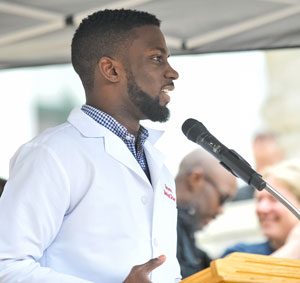
Adapted from a speech delivered by HMS student Elorm Avakame at the HMS March for Science rally on April 22, 2017.