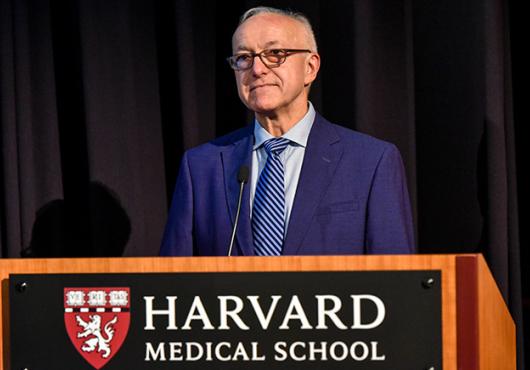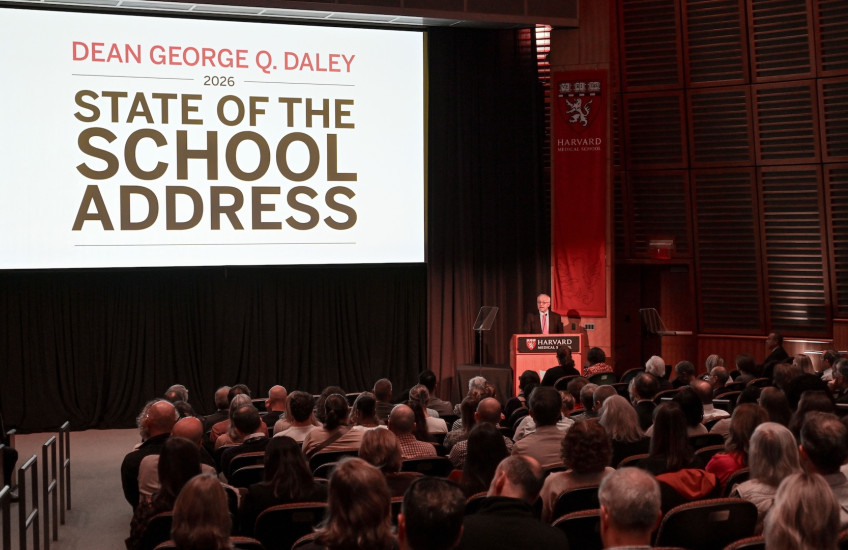
The past year has been one of contradictions for Harvard Medical School and for academic medicine in general. Therapeutic breakthroughs are transforming the lives of patients and next-generation technologies are accelerating biomedical science, even as disruptions in federal funding, changes in science and education policies, and distrust from segments of the public and the U.S. federal government create barriers to the important work of advancing medical education, scientific discovery, and patient care, said HMS Dean George Q. Daley.
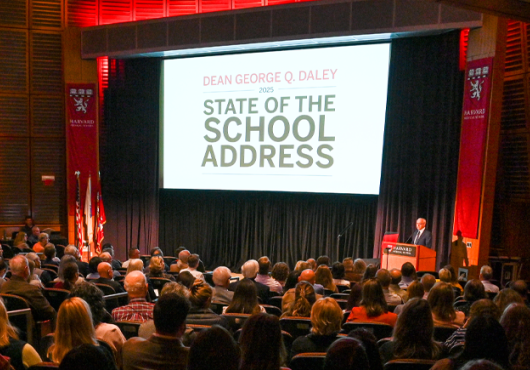
“It was the best of times, it was the worst of times,” Daley said, quoting Charles Dickens’ A Tale of Two Cities in the annual State of the School address on Sept. 16.
But HMS is strong, durable, and resilient, Daley told community members gathered in the Joseph B. Martin Conference Center Amphitheater and attending online.
In the face of numerous external pressures, HMS is maintaining its focus on research, education, and clinical care for the benefit of humanity, Daley said. “That is how we remain accountable to ourselves, our patients, and our world.”
Daley laid out the institution’s response to recent challenges from the federal government and described a path forward that increases HMS’ partnerships with industry, emphasizes leadership in the development and responsible application of AI tools, and leans into the existing strengths of the School’s vast research and clinical community.
“Even as we face an unpredictable and parlous future, we remain steadfast in our collective pursuit of excellence, and we remain poised to tackle whatever that future brings,” Daley said. “Bring it on.”
Funding research amid uncertainty
“Rarely have we seen such uncertainty and insecurity in science and medicine,” Daley said. “I am heartened, however, by what can happen when we band together.”
Voices from across Harvard University joined more than half a million other individuals and research institutions providing public comment on the White House Office of Management and Budget’s proposed changes to the federal research awards process — which include requirements that grants be approved by nonexpert political appointees — and succeeded in delaying the proposal’s implementation.
The university will use this temporary reprieve to continue advocating to members of Congress, Daley said. “Discovery science should not be dictated by partisan politics — and that’s a notion with bipartisan support.”
The University also won its lawsuit to restore research funding that had been terminated by the federal government. However, the federal funding landscape is no longer as stable as it once was. Harvard’s federal revenue, which had been rising steadily in previous years, is down by over 15 percent — a number that matches the experiences of comparable universities.
Daley expressed gratitude to departments across the School for reducing their budgets but acknowledged that in some cases this necessitated difficult decisions for positions and people. Despite forecasting an almost $200 million operating loss in FY26, the School ended the fiscal year with a shortfall of only $8 million. HMS was able to tap into its strategic reserves and balance its budget of unrestricted discretionary funds for the fifth year running, he reported.
“This is a success story, but it is a painful one,” Daley said. “I want to commend all of you for acting selflessly in a time of financial strain.”
HMS received generous philanthropic gifts, including a large number of unrestricted gifts, that helped to make up the deficit this year. Daley cited an anonymous gift of $6 million that helped to restore some of the lost federal funding for PhD students, as well as a $6 million gift from Lisa and Mark Schwartz that allows five additional fully funded MD-PhD students to join the Harvard-MIT Health Sciences and Technology (HST) Program — growing the program’s class by 33 percent.
HMS is also working to diversify its sources of revenue by pursuing new partnerships with industry. The School recently announced the Bristol Myers Squibb Collaborative Research Fellowship and has formed partnerships with Lilly, Northpond Ventures, and other companies. Daley also hinted at a soon-to-be-announced collaboration with Roche/Genentech.
“There is no other ecosystem on Earth that can match the depth and range of our science,” Daley said. “Industry doesn’t need our help making a drug — what they need is our excellence in foundational science and understanding the mechanisms of human disease.”
The promises of AI
Artificial intelligence also appears to promise both the best and the worst of times, Daley said.
Foundation models, AI scientists, and other AI-based tools, some of which are being developed by HMS researchers such as Associate Professor of Biomedical Informatics Marinka Zitnik, are creating new possibilities in research and accelerating the pace of discovery.
In the classroom, AI tools are enhancing medical education. Citing one example, Daley described virtual patient avatars designed by MD-PhD student Arya Rao and colleagues that are helping HMS students identify bias, test for safety, and learn cultural dexterity during clerkships and residency.

The University needs to stay at the leading edge of these technologies and is actively investing in AI for use in research, education, and clinical care, Daley said.
“At the same time, we have to proceed with caution,” he said, referencing recent reports of AI company executives sounding the alarm about the technology’s risks. “Our interdisciplinary expertise across Harvard readies us to muster our resources to establish ethical principles and advocate for reasonable regulation.”
Multiple groups at HMS are exploring AI’s potential ethical and security concerns. Daley highlighted the Human Values Project, run by Zak Kohane, the Marion V. Nelson Professor of Biomedical Informatics in the Blavatnik Institute at HMS. The project, which includes collaborators around the world, is working to ensure that AI systems in health care are designed to serve patients first, reflecting the values that clinicians use in medical decision-making.
“We will advance our AI capabilities in service of our mission while remaining vigilant and proactive about the unintended consequences we might face,” Daley said.
One Harvard Medical community
“We represent the greatest concentration of medical talent on Earth,” Daley said. “We need to lean into our strengths as one community.”
The HMS ecosystem includes educators, scientists, staff, and students based on the HMS Quad, more than 13,000 faculty with homes in 15 affiliated hospitals and research institutes, and numerous community service organizations that extend support to students and patients in Boston and beyond.
It is the breadth and depth of knowledge across this community that makes HMS a global leader in medical and biomedical training, Daley said, and it is imperative that everyone in the community can thrive. He pledged that HMS will continue to invest in faculty, trainees, and staff both on and off the Quad.
HMS will be reintroducing assessments for medical students beginning in 2028 that reward exceptional achievement with honors and distinctions in their core clerkship year.
Daley also reaffirmed the School’s commitment to open inquiry and civil discourse. These vital skills help future leaders in medicine and science navigate nuance, wrestle with uncertainty, and advocate for patients. Starting this year, the Daniel D. Federman Medical Education Awards will include recognition for faculty members who have excelled at promoting civil discourse.
Daley also celebrated the creation of a new professorial title, professor of clinical excellence, which recognizes deep clinical expertise and will highlight faculty members who have meaningfully advanced the practice of medicine beyond the walls of HMS. He also emphasized the importance of clinical faculty as educators and mentors who help inspire the next generation of physicians.
“Our people are what make this community the embodiment of Harvard excellence,” Daley said. Referencing a quote from Martin Luther King Jr. via the late HMS global health leader Paul Farmer, he said, “Through all of your good work, HMS bends the long arc of the moral universe toward justice and toward health and well-being for all.”