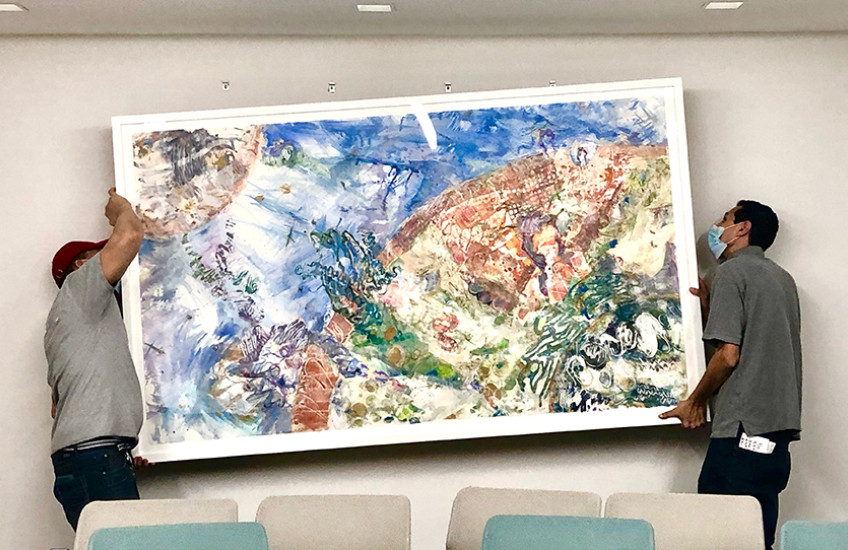
It began with a desire to liven up the walls in the rooms where members of the Harvard Medical School Department of Biological Chemistry and Molecular Pharmacology work, eat, and meet.
Two years and a pandemic later, the idea blossomed into a trio of abstract artworks evoking some of the department’s most notable scientific discoveries over the decades.
Adding even more meaning to the pieces that now hang in two conference rooms is that they were created by the spouse of a BCMP researcher in collaboration with faculty and staff.
Artist Erin Palazzolo Loparo’s work caught department chair Stephen Blacklow’s eye when her husband, Joseph Loparo, professor of biological chemistry and molecular pharmacology in the Blavatnik Institute at HMS, included in a seminar presentation an illustration she’d made that was inspired by his work on DNA repair.
“It was representational and beautiful,” Blacklow recalled. “Our team thought it would be terrific if Erin were willing to design a similar art installation for the department.”
“We are delighted that she accepted,” he said, “and that, after the installation had to be delayed because of COVID, her work is now on display for all to enjoy.”
The mixed media pieces conjure three areas that BCMP has historically focused on and made significant contributions to: DNA replication, transcription, and translation; viral entry; and cell signaling.
-
Generation
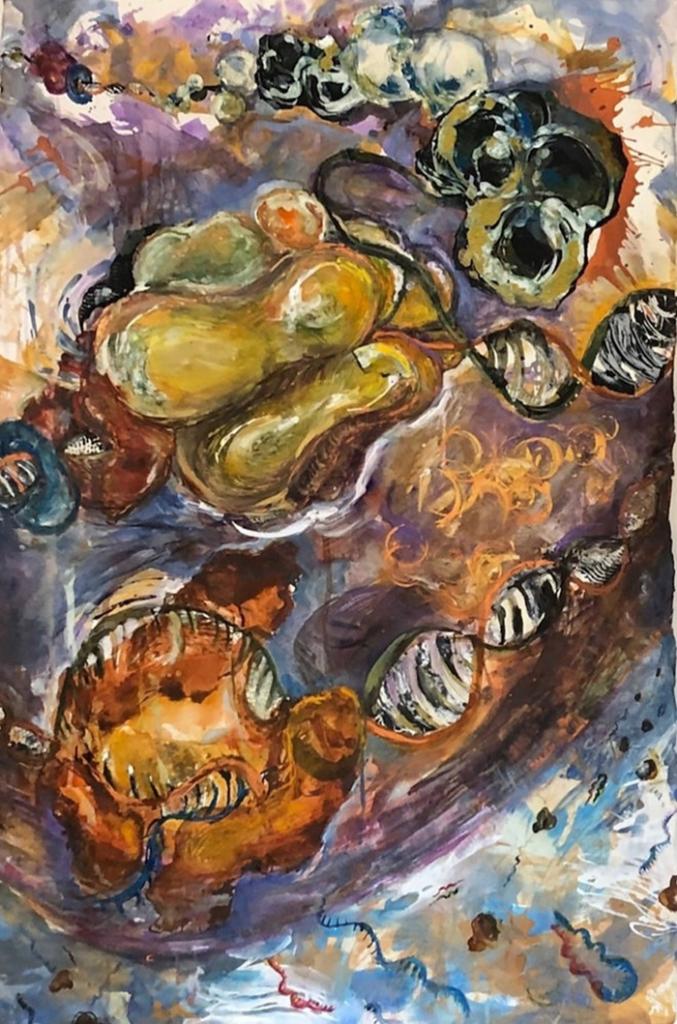
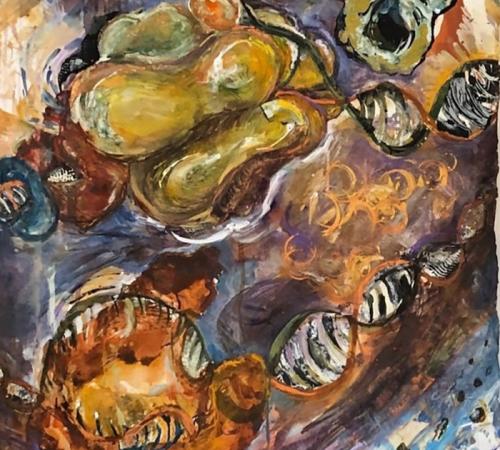
In the top half, a molecular complex known as a replicative helicase—here resembling a green pepper—unwinds the DNA double helix so it can be replicated. One strand passes through the helicase while the other travels toward the top, coated with orbs representing DNA-binding proteins.
Then, moving downward, a burnt orange RNA polymerase forms a bubble in which the DNA gets transcribed to RNA.
Toward the bottom, messenger RNA exits the nucleus, painted here in purple, and enters the cytoplasm, represented in sky blue, where the RNA is processed and translated into protein.
The work draws special inspiration from research done in the labs of Karen Adelman, Stephen Buratowski, Kevin Struhl, Gerhard Wagner, Johannes Walter, and emeritus professor Charles Richardson, the namesake of the conference room in which “Generation” is mounted.
-
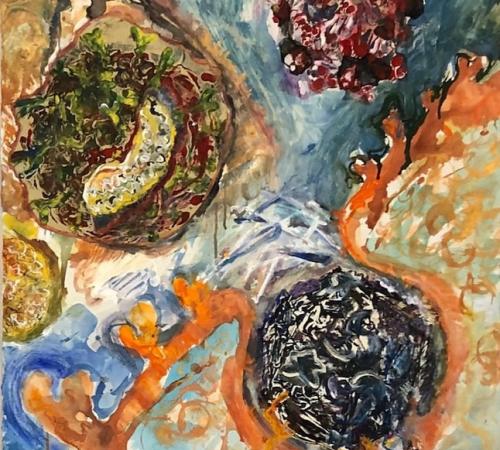
Immersion
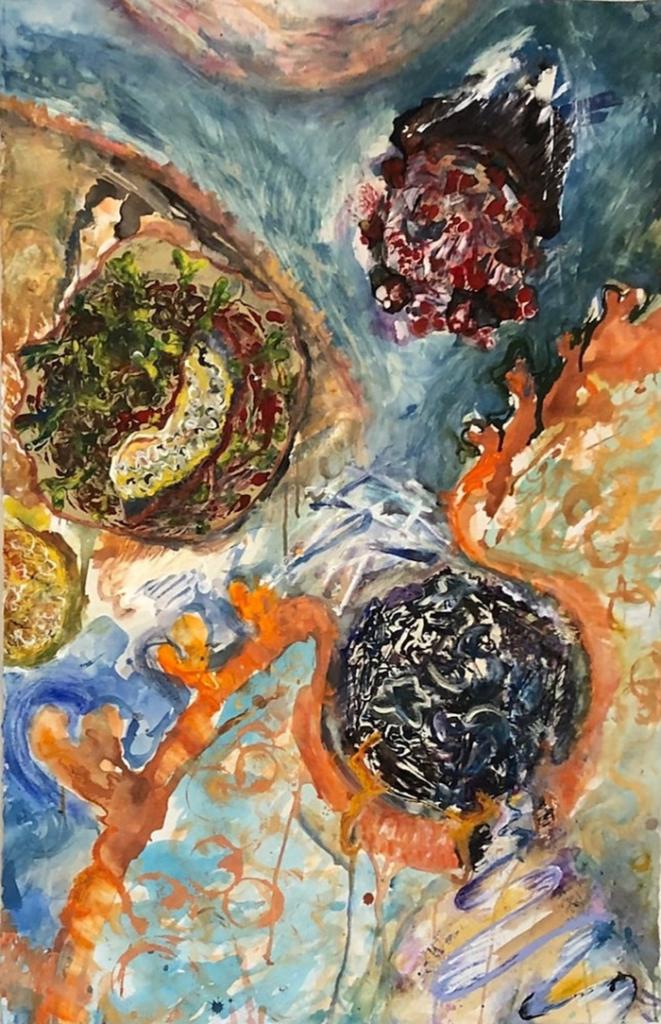
The piece also honors department members’ findings about innate immunity, including those from the labs of Sun Hur and Hao Wu.
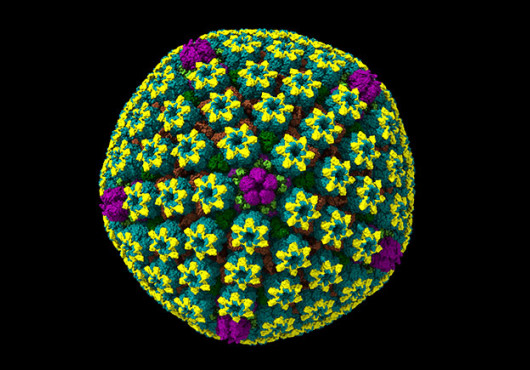
Three viruses are shown either fusing with or approaching a cell, whose membrane appears in orange. Poliovirus appears in the foreground, a nod to emeritus professor James Hogle, who first uncovered its structure.
To the left is rotavirus, representing Stephen Harrison’s revelations about how its surface proteins interact with cells to successfully penetrate the membrane.
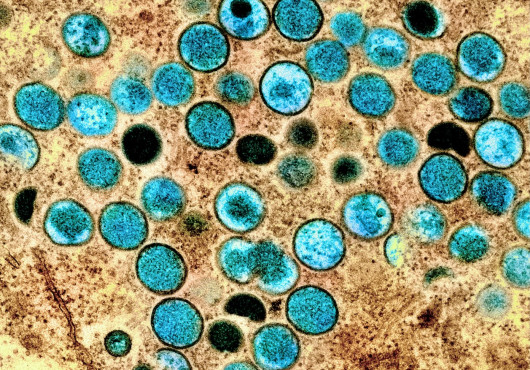
Finally, “coming in like a meteor” in the upper right, said Loparo, is SARS-CoV-2, capturing this moment in history when many department members, along with colleagues across HMS, dropped everything to study the virus and provide a foundation for combating it.
“I had the unique challenge and privilege of imaging SARS-CoV-2 in real time while we were living it, while my children were lovingly swarming me in the house on their remote learning and I set up a makeshift studio in the dining room,” said Palazzolo Loparo. “I got to grapple in my own way with the virus and how it’s impacting all our lives. It was cathartic.”
-
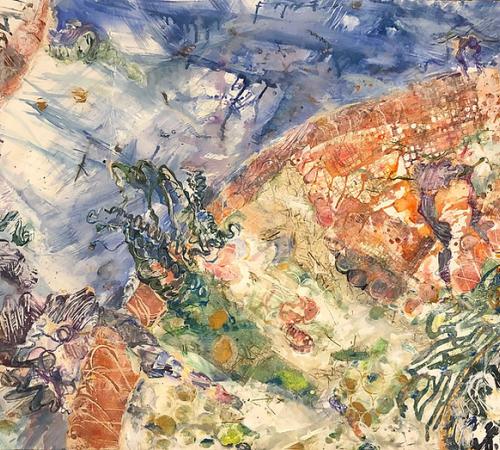
Signaling
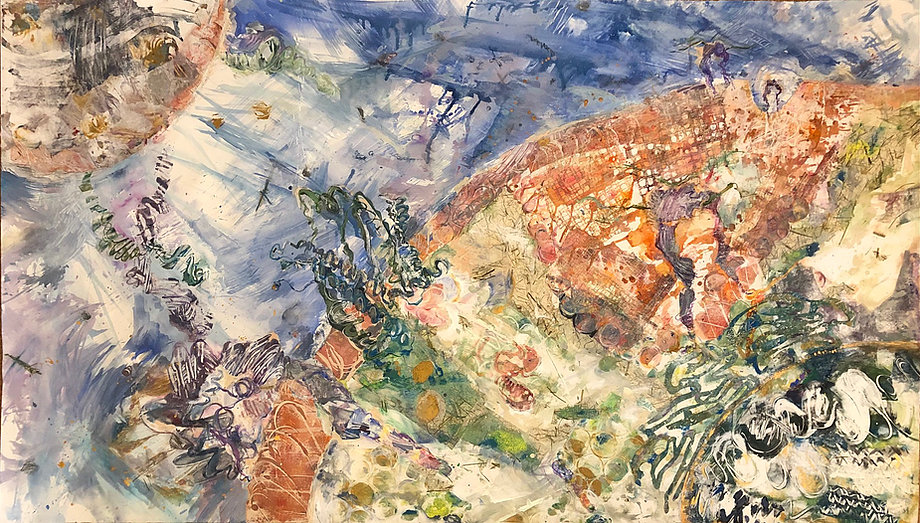
The work shows a cell receiving signals from other cells and from its environment via receptors on the cell’s surface. On the left is the Notch receptor, a major research area of the Blacklow lab.
To its right is a member of the vast G protein-coupled receptor, or GPCR, family, targets of an estimated one-third to one-half of all medicines on the market today and a specialty of faculty member Andrew Kruse.
Moving across the composition reveals integrins, a group of force-sensing and force-exerting receptors involved in everything from blood clotting to immune function that form a major focus of Timothy Springer’s lab.
When the receptors activate, they trigger a cascade of changes inside the cell that stimulates a response.
Art and science
Palazzolo Loparo developed and executed the large pieces—the biggest measures six and a half feet across—while Loparo served as scientific advisor and cheerleader. The project underscored the couple’s passion for the similarities between the scientific method and the artistic process.
As with any HMS scientist embarking on a new project, first came a brainstorm about the best approach to take. Discussions that included Blacklow and Mabel Duyao, then director of BCMP’s research administration, led to the goal of “bringing alive the three broad areas of research and scholarship in our department: molecular, structural, and chemical biology,” Blacklow said.
Palazzolo Loparo then had to figure out which research areas to cover, which labs and discoveries to feature, and which discoveries suggested visuals that both fit well into a composition and paid the sort of tribute Blacklow envisioned.
Next came another step familiar to researchers: background reading. Palazzolo Loparo pored over abstracts from faculty members’ scientific papers, listened to some of their lectures online, and studied the imagery associated with their work.
“I had to steep myself in the science. The last time I did that was AP biology in my senior year of high school,” said Palazzolo Loparo. “It was an enlightening and humbling experience.”
Hands-on experimentation followed. In art as in science, the process involved a combination of formal methods and an openness to pursuing unexpected results wherever they might lead.
Arguably the biggest surprise was COVID-19, pronounced a pandemic barely two months after the project began. Palazzolo Loparo had already decided to feature poliovirus and rotavirus in “Immersion,” and Blacklow suggested incorporating SARS-CoV-2 to round out the group.
“I think the responsiveness of the scientist and the artist is key to breakthroughs,” said Palazzolo Loparo. “Something beyond your initial vision happens and maybe surprises you and bears fruit. I think the parallels are huge.”
Impressions
The final products aren’t meant to serve as textbook figures depicting precisely how biological processes work. But neither are they so removed from the biology that an expert would be perturbed by the interpretations, Loparo said.
“The pieces are primarily intended to be artistically moving,” he said, “but they’re also meant to be close enough to reality that if you have inside knowledge of the science, which most of the people entering these rooms will have, it shouldn’t get in the way of you enjoying the artwork.”
The team hopes that HMS community members will enjoy the works on different levels, from scientific and aesthetic appreciation to welcoming a splash of abstract color alongside the typical portrait imagery that adorns many campus walls.
Palazzolo Loparo derived satisfaction from deepening her experience in science-inspired art and evolving her working relationship with her husband and his colleagues.
“I’m grateful to explore this unintended niche,” she said. “It’s an adventure to be part of something larger than yourself and your self-expression.”
Related stories
The Art of Medicine
Harvard Medicine magazine
Art historians tell us of the strong connections between painters and physicians. This issue of Harvard Medicine is devoted to exploring art and medicine.