The recent explosion of genetic screens fostered by RNA interference imbues scientists with new responsibilities when it comes to sharing information. After researchers use RNAi to knock down hundreds of genes and troll for players in key biological processes, they are blessed—and burdened—with massive piles of data, more than a single lab could ever process.
Research teams generally follow up on a few hits and then either ignore the other data or relegate it to the supplemental tables of papers, which are difficult to mine. But Joan Brugge’s lab took a different approach.
 “After screening for genes that influence cell migration, we validated all of the hits through extensive secondary screens and quantification of the knockdown, and then we developed a user-friendly, interactive database, granting unprecedented access to the resulting information,” explained Brugge, who is chair of the Department of Cell Biology. The database—available at www.cellmigration.org/pubs/wound_rnai.htm—complements a paper published in the September issue of Nature Cell Biology.
Brugge is also a member of the Cell Migration Consortium, which fosters collaboration among seemingly disparate labs from more than 20 institutions. The new database embodies the group’s ethos, bringing participants closer to understanding a biological process that is key to both normal development and cancer progression.
“We need to move beyond supplemental tables to fully capitalize on RNAi screens and advance our understanding of complex processes such as cell migration,” said Brugge. “The new online database fosters data sharing, dialogue, and follow-up studies.”
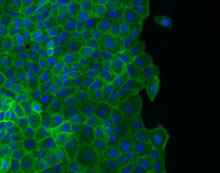
Postdoctoral researcher Kaylene Simpson laid the foundation for the database at the ICCB-Longwood Screening Facility by knocking down 1,081 genes—one at a time—in human breast cells. She then analyzed the ability of each population of cells to repair a wound, which shed light on the missing gene’s role in cell migration. She identified genes that seemed to increase or decrease cell migration and conducted additional experiments to validate those hits.
“I knew that other labs would use my data as a resource, so the validation was critical, and we conducted numerous experiments to be sure of our hits,” said Simpson.
She populated the database with information from each experiment. She even included some time-lapse movies of wounds healing. “Researchers can see exactly how these cells move when we inhibit particular genes,” explained Simpson. “Based on all of our data, we’re highly confident that at least 66 of the 1,081 genes influence cell migration. Many of these promising candidates surprised us, and they deserve more attention.”
“This exceptionally systematic and stringent screen has advanced the study of cell migration by identifying a large number of genes involved in the process,” said James Deatherage, who oversees cell motility grants at the National Institute of General Medical Sciences. “The publicly available, interactive database resulting from this work is a model for data-sharing and will be a substantial asset for future efforts in the migration and metastasis fields.”
Conflict Disclosure: The authors declare no conflicts of interest.
Funding Sources: The National Institute of General Medical Sciences and the Department of Defense. Thermo Fisher Scientific supported this work by supplying reagents, short interfering RNA (siRNA) expertise, and analysis of siRNA knockdown.