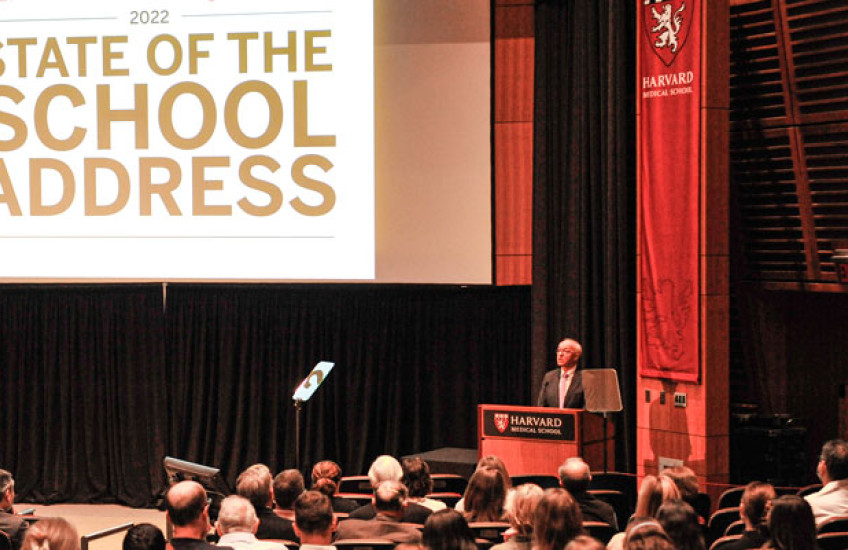
In his first in-person State of the School address since the COVID-19 pandemic began, Harvard Medical School Dean George Q. Daley told a crowd of faculty, students, postdocs, and staff assembled in the Joseph B. Martin Amphitheater and online that the School has weathered the worldwide health crisis, is on a strong financial footing, and has been able to continue making substantial investments in HMS biomedical research and education initiatives despite challenges wrought by the pandemic.
“Every day I wake up imagining how I can mobilize people, invest resources, and build infrastructure to make your science more successful, and our collective impact greater,” Daley said in his annual speech to the HMS community on Sept. 28, adding that despite the crisis, the School has been able to secure its financial health.
“I’m happy to tell you that despite all the pandemic challenges, and more than a decade of recurring budget deficits which threatened to weaken our prospects, this year HMS has balanced its books and is more financially stable than at any time in recent history,” Daley said.
He added that HMS reduced budget shortfalls throughout the pandemic, with the exception of the first year, and has now broken even for the first time since 2009 — a goal achieved ahead of schedule.
Thought-provoking content
In-depth stories on science and medicine
The dean credited substantial new revenue streams from a variety of sources for contributing to the School’s financial vitality, citing $17 million in net revenue achieved last year by External Education initiatives, as well as healthy income from commercialization revenue and increases in sponsored research funding.
He cautioned that with inflation and an uncertain U.S. economy the School must continue to be fiscally prudent and carry on developing strategies for revenue growth, but noted “the bottom line says that we are now stronger and more resilient.”
Investments in the future
Daley continued by outlining the various ways that HMS has been investing in areas critical to its mission, including research, education, and community and culture. He said research is the largest component of the HMS enterprise, accounting for 50 percent of its budget; the School has invested $203 million in fiscal year 2022 to supplement its research enterprises, which amounts to a 41 percent subsidy.
The dean added that HMS education programs have grown substantially over the past few years, with significant increases in master’s and external education enrollments. In the last fiscal year, he said, the School invested approximately $30 million in this area, or 19 percent of HMS costs.
Daley said HMS provided $57 million to the larger HMS affiliate community for extensive academic and administrative support, an amount that is “considerably more than the affiliates contribute financially for their participation in the Harvard Medical School ecosystem.”
Altogether, Daley said, “From endowment earnings, philanthropy, discretionary school accounts, and affiliate contributions, last year HMS invested $290 million to bolster research, education, and affiliate support.”
Daley explained that recent School investments have served to amplify the institution’s scientific impact, with the Dean’s Innovation Awards program alone infusing $24 million into the HMS community since 2018. These investments supported 92 projects involving 160 project leaders, with the majority of the projects rooted in fundamental, curiosity-driven science. Many of the projects have secured significant follow-on funding from the National Institutes of Health or other funding bodies.
He said that the roughly $9 million the School has invested in the Quadrangle Fund for Advancing and Seeding Translational Research has yielded more than $85 million in follow-on funding.
“Investments in fundamental Quad science research, through grant programs, core facility support, facilities upgrades to support science, and support for PIs and trainees have totaled nearly $210 million of funding commitments during my first five years as dean,” Daley said. “These funds represent investments enabled by the $200 million gift from the Blavatnik Family Foundation as well as generous commitments from the University that I received upon becoming dean.”
Educational excellence
Daley said the School’s education enterprises have grown significantly, particularly in enrollments of doctoral and master’s students, with the School’s nine master’s degree programs increasing enrollment by more than 200 percent over the past five years. Overall, HMS is “home” to roughly 75 percent of Harvard students pursuing a graduate degree in the life sciences.
Daley said he is excited about new directions being forged in the Program in Medical Education (PME) and the Harvard-MIT Program in Health Sciences and Technology (HST). The HST curriculum is being re-engineered to include more training in health equity and an increased focus on emerging disciplines, such as artificial intelligence and clinical informatics.
“One of the most ambitious and potentially transformative programs we are contemplating is a new curriculum track focused on health care leadership and transformation, aiming to position HMS at the apex of progressive primary care training in this country and equipping graduates with the skill set to become change agents in our health care ecosystem, delivering better health care outcomes at lower cost,” Daley said. “We strive to establish HMS as not only the preeminent research medical school but number one in primary care.”
Daley did express concern for faculty in affiliate hospitals who may be experiencing less protected time for scholarly pursuits and teaching.
“We are hearing from many faculty that the pressures to generate revenues for clinical service are cannibalizing protected academic time, leaving them struggling to achieve the scholarly publications and output necessary for promotion,” Daley said.
He said HMS is working closely with affiliate hospital leadership “to identify creative strategies to preserve and protect the academic excellence that has made Harvard Medical School and its illustrious clinical affiliates a bastion of biomedical innovation and compassionate health care.”
Community values
The dean went on to laud the community’s efforts to develop and reinforce diversity and inclusion across campus, citing the past year’s successful faculty cohort hire, the implementation of recommendations made by PME’s anti-racism task force, the formation of the new Black Staff Caucus at HMS, and the expansion of faculty promotions criteria to include significant supporting activities that advance diversity and inclusion.
Daley also applauded the School’s leadership in the Massachusetts Consortium for Pathogen Readiness, or MassCPR, mentioning that that the Massachusetts Department of Public Health was recently awarded a large grant from the Centers for Disease Control and Prevention to form the New England Pathogen Genomics Center of Excellence with MassCPR and HMS as two of the major partners.
The pathogen genomics center in New England will be one of five centers that are being established nationally to improve innovation and technical capacity in pathogen genomics, molecular epidemiology, and bioinformatics to better prevent, control, and respond to microbial threats of public health importance.
Celebration on the Quad
As a way to recognize the achievements of all members of the School’s community and to thank everyone for all they’ve done over the past few years, HMS hosted a celebration on the Quad after the dean’s speech. The event featured music, lawn games such as cornhole and Connect 4, photo and video booths, and a variety of food and beverages.
“I love the party. It’s top notch and I feel supported by the School,” said first-year MD student Lexi Balshi as she enjoyed refreshments with fellow first-year student Michelle Boskhe.
Faculty members lauded Daley for a speech that they said touched on so many areas and issues.
Frederick Stoddard, a professor of psychiatry at Massachusetts General Hospital, was especially pleased by the dean’s mention of a Manton Foundation grant that is supporting a new HMS mental health initiative geared toward helping children and adolescents.
“I thought it was excellent, and I was particularly happy with his mention of the mental health initiative, since that’s my area,” said Stoddard.
Others said they particularly appreciated having the opportunity to connect with so many members of the HMS community in person after several years of enforced COVID separation.
“I think it’s great, speaking from a group that’s been here every day since March 2020,” said Kelly Seary, an assistant director in the Campus Planning and Facilities department. “It’s exciting to have more people here every day. We should do more of this.”