One approach to harnessing stem cells for therapy, which researchers are investigating, is based on stimulating pre-existing stem cells in the body. Resident stem cells use cues from the tissues they reside in to determine which cell type to become. An advantage of this technique over injecting foreign stem cells into areas of damage is that the foreign cells may not turn into the cell type needed for repair.
In the retina of the eye, Müller glial cells—non-neuronal cells that help maintain the health of retinal tissue—may be the key to repairing damage from retinal diseases that cause vision loss. These cells can turn into progenitor cells, similar to stem cells but more restricted in the cell types they engender. Until now, the signal that triggers the induction of a progenitor phenotype in Müller cells was unknown.
The laboratory of Dong Feng Chen, HMS assistant professor of ophthalmology at Schepens Eye Research Institute, determined that the glutamate neurotransmitter and its analog, aminoadipate, can transform Müller cells into progenitor cells that are capable of generating new retinal cells.
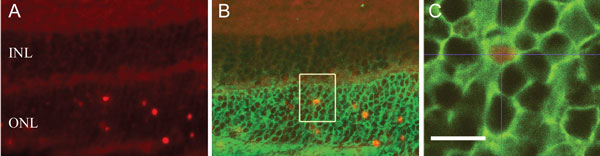
Injection of glutamate or aminoadipate into the back of the eye of adult mice caused Müller cells to divide and migrate out of the retinal layer where they normally dwell into the region where light-sensing photoreceptors reside. These proliferating cells expressed Müller cell markers and progenitor cell markers, confirming their identity. After several days, they differentiated into new photoreceptors that may be competent to heal damaged retinas.
When Müller cells were isolated from the retina and treated with glutamate or aminoadipate in culture, they turned into a broad range of retinal cells, suggesting that the retina provides environmental cues to progenitor cells that determine their ultimate cell type.
The use of aminoadipate was more efficient than glutamate at stimulating Müller cell growth because, unlike glutamate, it is specific for glial cells and does not bind to neurons. This makes the chemical an ideal candidate for therapeutic activation of retinal progenitor cells.
“This study is very significant,” said Chen. “It means it might be possible to use concentrated amounts of this chemical in a drug form to turn on the eye’s own resources to regenerate damaged retinas, without the need for transplanting outside retinal tissue or stem cells.”
The next step is to determine whether enough progenitor cells can be generated to restore retinal function in mice with retinal blinding disease.
The findings were published in the March edition of Investigative Ophthalmology and Visual Science.