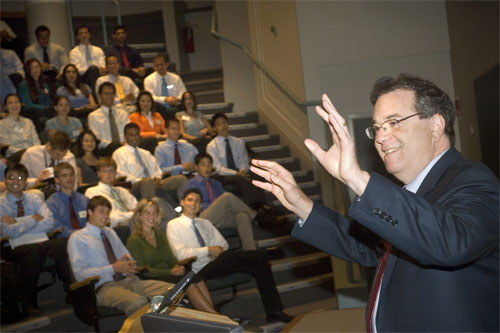
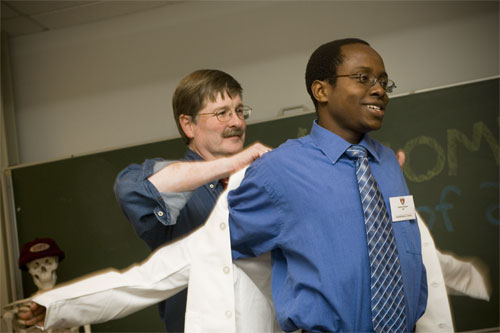
MS officially greeted incoming medical and dental students on Aug. 21—White Coat Day—in a series of special events. They included white coat ceremonies in the student societies when students receive their first white coats, talks by School leaders, and a clinic that exposes students to a patient case. During the talks, incoming HMS dean Jeffrey Flier (above) welcomed students, commenting on their remarkable strengths and diversity. The Class of 2011 comprises 77 women and 88 men who come from 30 states, 17 countries, and 63 different colleges and universities. “You are diverse in every imaginable dimension except one, and that is the promise that you represent for the field of medicine,” Flier said. “And that is what excites the faculty.”
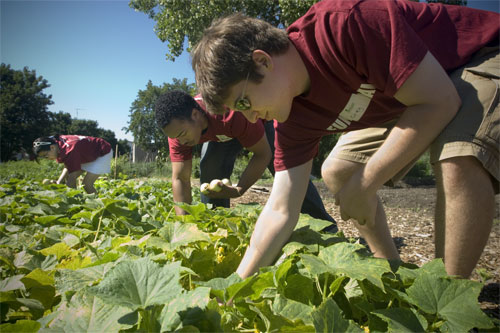
The week before, 42 first-years participated in the First-year Urban Neighborhood Campaign (FUNC), a pre-orientation, week-long volunteer program led by second-year students. FUNC students participated in several service projects linking food and nutrition with environmental sustainability, including working with the Food Project, which grows fruits and vegetables for the surrounding communities using sustainable farming techniques. The first-years harvested vegetables later sold at the Dudley Town Common farmer’s market and also weeded and assisted with other tasks at two of the Food Project’s lots in Dorchester. Other students visited Hennigan Elementary School in Jamaica Plain for Science Savvy, a week-long science camp for kids organized by Prevention NOW!, a youth center that provides after-school and summer programs for minority and urban children. HMS students led the children in a variety of activities, helping them make ice cream, silly putty, and model rockets, and they also took the kids for a visit to the medical simulator in the Tosteson Medical Education Center. Above, Greg Cvetanovich (right) and Julian Johnson experienced a little bit of country in the city at one of the Food Project sites.
Researcher Wins International Cancer MedalDimitrios Trichopoulos, the Vincent L. Gregory professor of cancer prevention at HSPH, is one of three recipients of a medal of honor from the International Agency for Research on Cancer (IARC), part of the World Health Organization. Trichopoulos was honored for his research in cancer etiology. He is best known for his theory on the origins of breast cancer, which says that exposure to certain hormones increases the number of undifferentiated cells in the mammary glands of female fetuses. These cells are susceptible to mutation and are associated with an increased risk for breast cancer later in life. Trichopoulos also studies the association among hepatocellular cancer, certain kinds of hepatitis infections, and smoking. He accepted the award at a ceremony in May at the IARC headquarters in Lyon, France.
Dzau Professorship Will Drive Cardiovascular ResearchThe June 28th reception for the Victor J. Dzau Professorship in Medicine at HMS and Brigham and Women’s Hospital marked two milestones at the Medical School. One was the establishment of this endowed chair in cardiovascular research and, as Eugene Braunwald, the Hersey distinguished professor of medicine, and others in the program pointed out, the second was the culmination of Joseph Martin’s decade as HMS dean in leading the celebration as his last official act. “Included among his many accomplishments is his strengthening of the ties between the Medical School and the hospitals,” Braunwald said, adding that the chair was emblematic of Martin’s collaborative achievements. In describing Victor Dzau (above right), the former head of the Department of Medicine at BWH and currently chancellor for Health Affairs at Duke University, BWH president Gary Gottlieb said the cardiovascular researcher was “among the Brigham’s greatest minds.” Joseph Loscalzo, the Hersey professor of the theory and practice of medicine at HMS and BWH, noted Dzau’s combination of scholarship and humanism.
Gottlieb also said that the first incumbent, Marc Pfeffer, “demonstrates the best of the Brigham.” Gottlieb praised Pfeffer’s “visionary approach to cardiovascular research.” During his remarks, Dzau said the intention of the chair is to “impact cardiology for many years to come,” and he called himself privileged that Pfeffer was the first incumbent. Pfeffer then explained, indirectly, one of the potential keys to this future impact. He considered the concept of nurturing, saying that he realized years ago nurturing is not something with a limited duration that only serves youth. “Nurturing is a lifelong process,” he said. “…Nurturing doesn’t stop.”
Scientific Grand Prize Recognizes Work in Heart DiseaseChristine and Jonathan Seidman have been presented with the Institut de France’s 2007 Grand Prix Lefoulon—Delalande for their advancement of the understanding of inherited cardiac disorders. The Seidmans accepted the award, which includes a $682,000 prize and the Medal of the Institut de France, in a ceremony in Paris on June 13. Created in 2002, the Grand Prix honors scientists who have made significant contributions in the fields of cardiovascular physiology, biology, and medicine.