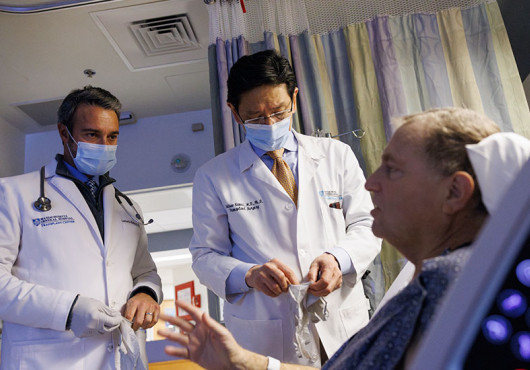
Jeffrey Flier, dean of the Faculty of Medicine, opened the Feb. 11 Faculty Council meeting by asking Jeffrey Saffitz, the Mallinckrodt professor of pathology at Beth Israel Deaconess Medical Center, to lead a panel discussion on harassment and difficult behavior in the hospital setting, which was continued from the last meeting, this time focusing on student issues.
Ronald Arky, the Charles S. Davidson Distinguished Professor of Medicine at Brigham and Women’s Hospital, who has been master of the Peabody Society for more than 20 years, said that reports of harassment were more frequent when he first took the role of society master, but episodes still do occur. The OR and ER are two areas that the students often cite as problematic. But with the implementation of the Principal Clinical Experience, students may have become reluctant to make a complaint when they are in the same hospital for the year because they are afraid of repercussions. Arky noted that as students move through Year 3 they often start to accept the culture.
Saffitz asked Laurie Raymond, director of the Office for Advising Resources (OAR), to give an overview of the department, review the literature on harassment and provide her perspective on possible solutions. Raymond noted that last year approximately 300 students visited the OAR for reasons such as attention problems, learning disabilities and psychiatric issues like depression. No students last year went to her with complaints of sexual harassment, but males often complained about the lack of opportunities for experiences on the labor and delivery floors, and students did complain about stereotypical comments that offended them.
Raymond noted that the new curriculum has provided an opportunity for more longitudinal advising in the hospitals with advisers who are not connected to student evaluation. She noted that exposure to trauma such as patient suffering and death was associated with personal growth, but harassment by superiors was associated with endpoint depression symptoms.
Saffitz asked if there is a disconnect between the students’ experiences in the hospitals and the School’s perspective. Linda Wilcox, the HMS ombudsperson, said that HMS has an effective grievance process, but people do not know enough about it, adding that the Ombuds Office sees approximately 200 students, graduate students and fellows per year.
Ellen Berkman of the University’s Office of General Counsel said that they have been successful when they not only drafted policies but also went out and taught people about them.
When Flier opened the floor to discussion, council members suggested that student stories should be viewed as a resource rather than a problem, and the students’ fear of repercussions needs to be addressed.
Jules Dienstag, dean for medical education, introduced Richard Schwartzstein, director of the HMS Academy. Schwartzstein discussed some of the goals of the Academy in the coming year, including increasing outreach to faculty and the hospitals to get a sense of their needs, improving teaching in the graduate programs and figuring out ways HMS can partner with the hospitals to support graduate medical education. For AY10, Schwartzstein outlined some additional goals, including bringing in teaching consultants and increasing educational innovation and research efforts.
One council member suggested the Academy look into collaborating with Harvard Catalyst, the Harvard Clinical and Translational Science Center, on education research. Schwartzstein responded that he has been discussing the subject with center leadership.
Alumna Called to Lead Indian Health ServicePresident Barack Obama has nominated HMS and HSPH alumna Yvette Roubideaux to be the next director of the Indian Health Service (IHS). Roubideaux is a member of the Rosebud Sioux tribe and will be the first woman to lead the IHS, pending Senate confirmation.
After graduating from HMS and earning a master’s from HSPH, Roubideaux completed the primary care internal medicine residency program at Brigham and Women’s Hospital. She is a former fellow of the Commonwealth Fund/Harvard University Fellowship in Minority Health Policy and has devoted her professional life to improving quality of care for American Indians and Alaska Natives. She is currently an assistant professor in the Department of Family and Community Medicine at the University of Arizona College of Medicine. Her research has focused primarily on diabetes in American Indians and Alaska Natives and on American Indian health policy. She previously worked in the IHS as a medical officer and clinical director on the San Carlos Indian Reservation and in the Gila River Indian Community in Arizona.
Roubideaux has served in several leadership positions. She is currently the codirector of the Coordinating Center for the Special Diabetes Program for Indians Competitive Demonstration Projects, a program implementing diabetes prevention and cardiovascular disease prevention activities in 66 American Indian and Alaska Native communities. She also serves as director of the University of Arizona/Intertribal Council of Arizona Indians into Medicine program and the Student Development Core of the UA/ITCA American Indian Research Center for Health, which recruit students into health and research professions.
Dubai Harvard Foundation Funds International CollaborationsThe Dubai Harvard Foundation for Medical Research (DHFMR) has awarded its second annual round of Collaborative Research Center Program grants. The foundation has also made two Research Fellowship Awards to postdoctoral researchers from the Middle East.
Under the Collaborative Research Center Program, DHFMR funds researchers who have demonstrated exceptional ability to generate innovative approaches to medical, biomedical or translational research relevant to Middle Eastern populations. The grants enable recipients to build on established collaborations between research laboratories at HMS and in the Middle East region.
The first research initiative, titled “Collaborative Research Network on Primary Immunodeficiency Diseases (PIDs),” is headed by Raif Geha, the James L. Gamble professor of pediatrics at Children’s Hospital Boston, and Luigi Notarangelo, HMS professor of pediatrics and of pathology at CHB. They will work with collaborators located at five regional research sites, including members of the faculty of medicine at United Arab Emirates University; Kuwait University; King Saud University, Saudi Arabia; American University of Beirut; and Ege University Medical School, Turkey. The collaboration draws on the strengths of the participating centers to establish a regional network to identify novel genes that cause PIDs.
The second research initiative, titled “Discovery of Genetic Causes for Human Congenital Malformations,” is headed by Christine Seidman, HMS professor of genetics and the Thomas W. Smith professor of medicine at HMS and Brigham and Women’s Hospital; Patricia Donahoe, professor and chief (emerita) of Pediatric Surgical Services and director of Pediatric Surgical Research Labs at Massachusetts General Hospital for Children; and Richard Maas, HMS professor of medicine at BWH, in collaboration with researchers at the King Faisal Specialist Hospital and Research Center, Saudi Arabia; the American University of Beirut; and the Weill Cornell Medical College in Qatar. The group aims to discover genetic variations that cause birth defects and to define the prevalence of these genetic variations in the Middle Eastern populations.
Recipients of the two Research Fellowship Awards are Maha Al-Mozaini of the King Faisal Specialist Hospital and Research Center and Manal Alaamery of Boston College. Al-Mozaini will investigate posttransplant lymphoproliferative disorder, while Alaamery will work to identify the genes that control the development of the human cerebral cortex. Both fellows will continue their research within the Middle East region after completing their three-year program at HMS.
Harvard Catalyst Announces Pilot Grant RecipientsHarvard Catalyst, the Harvard Clinical and Translational Science Center, has announced the first round of pilot grant recipients. Awards were made to 62 groups of investigators from Harvard and its affiliated healthcare centers, each in the amount of $50,000 for one year.
With these grants, Harvard Catalyst aims to stimulate clinical and translational research in three ways. First, the grants bring together researchers from different institutions and disciplines to jointly address important scientific questions. Second, they provide the means to generate the preliminary data needed to apply for long-term funding, an important consideration for junior investigators, in particular, as they work to establish independent research programs. Finally, the grants focus scientific resources and expertise on high-risk, high-impact areas of research.
“The pilot grants of Harvard Catalyst demonstrate the drive among the faculty to collaborate on unique problems,” said Jeffrey Flier, dean of the Faculty of Medicine. “Watching this process unfold has confirmed my deep conviction that we can most effectively impact human health by encouraging people from across Harvard who have never worked face to face to work together.”
The application window for the next round of grants opened April 2.
The Fred Hutchinson Cancer Research Center has named HMS graduate student Srinivas Viswanathan one of 13 recipients of the 2009 Harold M. Weintraub Graduate Student Award. The recipients will present their work at a scientific symposium in May and receive a certificate, travel expenses and an honorarium.
Viswanathan, a student in the Harvard–MIT Health Sciences and Technology program, was selected for his research involving the identification and characterization of Lin-28 as a novel regulator of microRNA processing, particularly the let-7 family of microRNAs, which when repressed can lead to human disease, including cancer. Viswanathan works in the lab of George Daley, HMS associate professor of biological chemistry and molecular pharmacology at Children’s Hospital Boston.
Make Me a Match
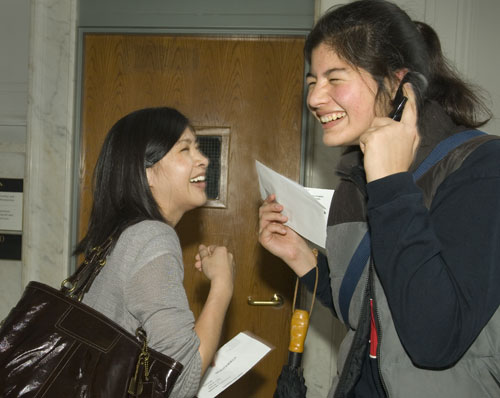
On March 19, medical school fourth-years around the country, including 165 at HMS, participated in the annual rite of passage known as Match Day, when students learn where they will do their residency training. At HMS, the students line up in front of the Registrar’s Office to learn their fate in the form of white envelopes and are later feted at a Match Day ceremony. Above, Yolanda Tseng (left) and Maria Lucia Madariaga were just two of the many students who were giddy over their matches: Tseng at Brigham and Women’s Hospital for radiation oncology and Madariaga at Massachusetts General Hospital for general surgery.
Nearly half of the HMS students will be staying in Massachusetts for at least some part of their training, while California was the second most popular destination, with 17 percent of the class of ’09 heading west. The largest percentage of HMS students, 24 percent, matched in internal medicine, followed by dermatology, general surgery, pediatrics and radiology. Seven fourth-years opted to take a nonclinical path next year. According to the National Resident Matching Program, a record number of would-be residents attempted to match in 2009, with 30,000 applicants worldwide vying for 22,427 residency spots across the United States.
Gallery Seeks Harvard ArtistsHarvard Neighbors, a volunteer and membership organization that seeks to enrich the Harvard community through educational, cultural and social events, is accepting applications from Harvard-affiliated artists to show their work in the Harvard Neighbors Gallery. Artists will be selected to show during four-week-long exhibitions (solo or group shows) between September 2009 and May 2010.