Sweet Professorship Takes Aim at Boundaries of Neuroscience
Dean Jeffrey Flier opened the Dec. 3 celebration of the William and Elizabeth Sweet Professorship
in Neuroscience at HMS and Massachusetts General Hospital, commenting on William Sweet as “one of the greatest figures of the 20th century in neuroscience.”
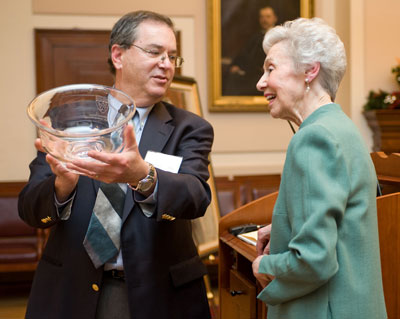
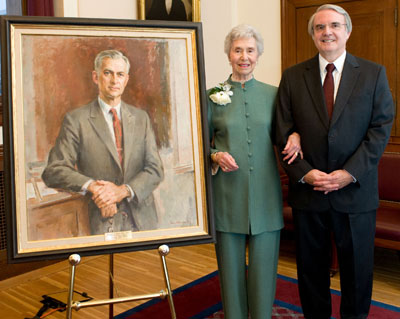
While a second-year student at HMS, Sweet was awarded a Rhodes Scholarship, which took him to Oxford University for two years, after which he returned to HMS, graduating in 1936. He later trained at HMS and MGH in neurosurgery and, in the 1960s, became chief of the Neurosurgical Service at MGH and an HMS professor of surgery. Among his numerous scientific contributions were invention (with Gordon Brownell) of the precursor to the positron-emission tomography (PET) scan and innovations in proton therapy. He also was a trustee of Associate Universities, Inc. (AUI), which established and operated major national research facilities such as Brookhaven National Laboratory. Sweet passed away in 2001, an HMS professor emeritus. The dean thanked Elizabeth Sweet, William Sweet’s widow, for the Sweets’ extraordinary generosity in fully funding the new chair.
The ceremony also announced the installation of Robert Martuza as the first incumbent of the Sweet Professorship. The chief of Neurosurgery at MGH, Martuza gave his remarks, describing the profound impact the professorship would have in advancing both scientific knowledge and clinical care.
Offering praise for Martuza and Sweet were several leaders at MGH: Peter Slavin, president; Paul Russell, the John Homans distinguished professor of surgery; and Andrew Warshaw, surgeon in chief and head of the Department of Surgery.
Elizabeth Sweet closed the speaking program, remarking that the work supported by the chair would extend the legacy of Dr. Sweet and, most important, add to the body of scientific knowledge of neurology and neurosurgery for the benefit of patients everywhere.
Grants Open to Students in Psychobiology
The Department of Psychology in the Harvard Faculty of Arts and Sciences is seeking applications to The Dr. Mortimer and Theresa Sackler Foundation’s Sackler Scholars Programme, which supports researchers conducting psychobiological studies of direct relevance to human clinical problems. The foundation provides living stipends or research funding.
Candidates must be PhD students in psychology or the medical sciences who are engaged in their dissertation research and currently in their second, third or fourth year. MD students and recent terminal degree recipients working in psychobiology are also eligible.
Nominees should provide the following: a letter of recommendation from their faculty adviser; the nominee’s CV; and a two-page description of the research project with an attached budget. Nomination packets are due Friday, March 26. Please submit nomination packets electronically to Joan Smeltzer at smeltzer@wjh.harvard.edu. For more information, contact Mark Gerstel, director of administrative services in the FAS Department of Psychology, at 617-495-3909 or mgerstel@wjh.harvard.edu.
History of Medicine Center Joins Effort to Digitize Public-domain Works
The Center for the History of Medicine at Countway Library has joined with other libraries to initiate a digital Medical Heritage Library. The center will receive $400,000 over the next two years to digitize 10,000 rare books from the 16th to the 20th centuries that relate to the intersection of medicine and society. The initiative is funded by a $1.5 million award from the Alfred P. Sloan Foundation to the Open Knowledge Commons, a nonprofit dedicated to building a universal digital library for democratic access to information.
Approximately 30,000 volumes of public domain works will be digitized from the collections of libraries including Countway and the National Library of Medicine, the Harvey Cushing/John Hay Whitney Medical Library at Yale University, the Augustus C. Long Health Sciences Library at Columbia University and the New York Public Library. The Center for the History of Medicine will contribute works in public health, psychiatry, obstetrics and other areas of social medicine
Zipcar Comes to Campus
HMS has two new hybrid Zipcars parked on campus in the Palace parking lot between 180 and 164 Longwood Avenue. Zipcar is a membership-based car-sharing program that provides vehicles by the hour or day. In addition to providing a fuel-efficient means of getting around the city, the HMS-based hybrid Zipcars will contribute to the LEED certification of 641 Huntington Avenue by providing low-emission vehicles for the occupants of that building and other members of the community. Harvard faculty, staff, students and postdocs are eligible to receive a discount on Zipcar memberships. For more information, visit zipcar.com/masco.
Applications Sought for Autism Fellowships
HMS students with an interest in pursuing autism-related research at the School or a Harvard-affiliated hospital during the summer of 2010 are invited to apply to the Summer Scholars in Medicine fellowship offered by the Nancy Lurie Marks Family Foundation. Applications are due April 1 by 3 p.m. Eligible candidates should submit (in a PDF document) a three-page (single-spaced) proposal describing their background, research project and experimental approach; a 250-word abstract; a letter of reference from an HMS mentor who has agreed to give guidance; and a CV. Please e-mail all applications and questions to Stephanie Barros at stephanie.barros@childrens.harvard.edu.
Harvard Catalyst and HMS Diversity Office Name Fellows in Two Faculty Diversity Programs
Harvard Catalyst, the Harvard Clinical and Translational Science Center, and the HMS Office for Diversity and Community Partnership (DCP) have named the recipients in two fellowship programs sponsored by the Harvard Catalyst Program for Faculty Development and Diversity (PFDD) and DCP.
The PFDD Faculty Fellowship provides $100,000 over two years to junior faculty conducting clinical and translational research. Fellows are required to devote time to the development of their academic careers and are expected to meet regularly with their mentors and present at the annual Minority Health Policy Meeting. The 2010 recipient is Arachu Castro, HMS assistant professor of social medicine, for her project titled “The Integration of Prenatal Care with the Testing and Treatment of HIV and Syphilis in Latin America and the Caribbean.”
The DCP Faculty Fellowship provides $50,000 per year for two years to junior faculty, allowing them to focus on professional development as researchers, clinicians and teachers, and advance within the Harvard system. Fellows are expected to participate in fellowship-related activities, meet regularly with their mentors and present research findings at the annual Minority Health Policy Meeting. This year’s recipients are Sherri-Ann Burnett-Bowie, HMS instructor in medicine at Massachusetts General Hospital, whose project is titled “Dietary and Hormonal Regulation of FGF23”; Francisco Quintana, HMS instructor in neurology at Brigham and Women’s Hospital, researching the “Role of the Transcription Factor Aryl Hydrocarbon Receptor (AHR) in Human Regulatory T Cells”; and Ramiro Massol, HMS instructor in neurology at Children’s Hospital Boston, whose project is “Biogenesis and Maintenance of the Enterocyte Brush Border.”
Nominations Requested for Community Service Awards
The Office for Diversity and Community Partnership at HMS is requesting nominations for the 2010 Dean’s Community Service Award. Please consider nominating an HMS/HSDM faculty member, trainee (house officer or postdoctoral fellow), staff member or student whose active commitment to the community has made a positive impact on the lives of people locally, nationally or globally. Self-nominations are also accepted. Guidelines, nominee criteria and the nomination form can be found at http://www.mfdp.med.harvard.edu/awards/csa/index.html. The deadline to submit a nomination is Friday, March 12. For more information, contact Rebecca Poe at 617-432-3020 or rebecca_poe@hms.harvard.edu.
Proceedings of the HMS Faculty Council
The Jan. 6 Faculty Council meeting began with Daniel Ennis, executive dean for administration, who discussed the state of HMS finances. During his presentation he gave updates on University finances and major actions and challenges affecting the HMS financial situation.
Dean Jeffrey Flier then introduced Gretchen Brodnicki, dean for faculty and research integrity, to give a presentation on the Faculty of Medicine Policy on Conflict of Interest and Commitment. During her presentation, Brodnicki provided background information on the policy and highlighted the recent formation of an HMS Conflict of Interest (COI) Committee. She strongly encouraged Faculty Council members to contact her or Marjorie Oettinger, who sits on the COI committee in her role as Faculty Council vice chair, with any suggestions or feedback on the policy. Brodnicki also introduced Kristen Bittinger, director of scientific integrity at HMS.
Flier said that the COI policy will come back to the Faculty Council for consideration.
Flier next introduced Donald Ingber, the Judah Folkman professor of vascular biology in the Department of Pathology, to present on the Wyss Institute for Biologically Inspired Engineering at Harvard University. Ingber, who is director of the Wyss, gave a general overview of the institute’s mission, major goals and research themes: synthetic biology, biological control and living material.
Finally, Rick Shea, associate dean for physical planning and facilities, gave an update on the August 2009 coffee incident in the new research building. Shea gave background information on what had occurred, what steps were taken as people became ill and the steps taken following the incident. Security measures have been instituted as a result. He reviewed the groups that were consulted to assist with the response and investigation. He also highlighted the different types of testing that were done. Shea said that the coffee was found to contain sodium azide, a chemical used in labs as a preservative and biocide. He noted that the symptoms experienced by those affected were consistent with case reports from a similar incident in England.
Young Scientists at HMS Join Damon Runyon Fellows
The Damon Runyon Cancer Research Foundation has awarded fellowships to 11 young scientists, three of whom are based at HMS. The three-year fellowships go to postdocs conducting basic and translational cancer research in the labs of leading senior investigators.
The new Damon Runyon fellows at HMS are Harrison Gabel, Rebecca Mathew and Alexandra Zidovska. Gabel, a postdoc in the lab of Michael Greenberg, the Nathan Marsh Pusey professor of neurobiology and chair of the Department of Neurobiology at HMS, is investigating how dysfunction of ubiquitin ligase UBE3A, an enzyme that normally regulates amounts of specific proteins in the cell, leads to diseases such as the neurodevelopmental disorder Angelman syndrome and common cervical cancers. Mathew, an HHMI fellow in the lab of Danesh Moazed, HMS professor of cell biology, is studying how cell identity is maintained throughout the life of an organism, failure of which can lead to cancer or other diseases. She is focusing on the role of a protein complex called CLRC in modifying chromosome architecture. Zidovska, a postdoctoral researcher in the lab of Timothy Mitchison, the Hasib Sabbagh professor of systems biology and deputy chair of that department at HMS, is studying the physical properties of the cell during cell division by mechanically perturbing cells. The research may lead to insights about the mechanics of cell division and contribute to a better understanding of how this process is disrupted in cancer.
Notable• Two HMS faculty members are among 118 researchers to receive 2010 Sloan Research Fellowships from the Alfred P. Sloan Foundation. The fellowships go to early-career scientists, mathematicians and economists who show promise for making substantial contributions to their fields. The recipients from HMS are Peter Park, assistant professor of pediatrics at Children’s Hospital Boston, and Sandeep Datta, assistant professor of neurobiology, who will each receive a grant of $50,000 over two years to use for the research project of their choice.
• David Hubel, the John Franklin Enders professor emeritus of neurobiology, has received the Erice Prize from the World Federation of Scientists in Sicily. The recipients are elected every year by the members of the World Federation of Scientists and recognize those who have played a leading role in promoting and implementing the goals outlined in the Erice Statement, which discusses the federation’s proposals for handling “planetary emergencies” such as water supply and pollution.
• The Association for Laboratory Automation (ALA) has announced the winner of the LabAutomation2010 ALA Innovation Award. Ali Khademhosseini, a faculty member in the Harvard–MIT Division of Health Sciences and Technology, received the honor for his podium presentation, “Microengineered Hydrogels for Tissue Engineering and Stem Cell Bioengineering.” The award honors technological innovations presented at the annual LabAutomation conference and includes a prize of $10,000.
• Rao Prabhala, HMS instructor in medicine at Brigham and Women’s Hospital, has received a 2010 Senior Research Award from the Multiple Myeloma Research Foundation. The Senior Research Award supports investigators with more than five years of experience in basic science, validation or translational blood cancer research, with the goal of accelerating the development of therapeutic approaches for myeloma. Prabhala works at the Jerome Lipper Multiple Myeloma Center at Dana-Farber Cancer Institute and at VA West Roxbury/HMS as a research health scientist.