Four HMS and one HSPH faculty members were among the 65 new members elected to the Institute of Medicine for 2007. The IOM, part of the National Academy of Sciences, is an advisory group that provides information and analysis to national policymakers on issues pertaining to health, biomedical science, and medicine.
Emery Brown
Massachusetts General Hospital Professor of Anesthesia, MGH
In his statistical research, Brown develops signal processing algorithms and statistical methods to study how the brain and nervous system represent and transmit information. His experimental research uses combined functional magnetic resonance imaging and electroencephalogram recordings to study how anesthetic drugs induce the state of general anesthesia in the brain.
William Kaelin
Howard Hughes Investigator, Professor of Medicine,
Dana–Farber Cancer Institute
Kaelin studies tumor suppressor genes and the normal functions of the proteins they encode, with a focus on the von Hippel–Lindau tumor suppressor protein, the retinoblastoma tumor suppressor protein, and the p53-like protein p73. His group is also studying tuberous sclerosis, a hereditary cancer syndrome caused by mutations in either of two genes.
David Scadden
Gerald and Darlene Jordan Professor of Medicine, MGH
Scadden’s research focuses on stem cell biology, emphasizing blood stem cells and the mechanisms by which they are governed. He has defined molecules affecting stem cell proliferation and specific components of the complex niche in which they reside. His research is linked to developing new therapies for immunocompromised patients with AIDS or cancer, and he has led related clinical trials.
Jonathan Seidman
Henrietta B. and Frederick H. Bugher Foundation Professor of Genetics, HMS
Jonathan Seidman works with lab co-director Christine Seidman to integrate clinical medicine and molecular technologies to define disease-causing gene mutations and genetic variations that increase disease risk. Major research projects focus on discovery of the genetic contributions to cardiomyopathies, hearing loss, and congenital heart disease.
Katherine Swartz
Professor of Health Economics and Policy, HSPH
Swartz’s research interests focus on the population without health insurance and efforts to increase access to health care coverage; reasons for and ways to control episodes of care that involve extremely high expenditures; and ways to pay for expanded health insurance coverage. She also is interested in the impact of mapping the human genome and its implications for health insurance.
The Howard Hughes Medical Institute has appointed four HMS faculty members as patient-oriented researchers from a competition specifically aimed at physician-scientists who divide their time between research and patient care. There were only 15 appointments nationwide. The program, which began in 2002, reflects HHMI’s commitment to ensuring that basic research is translated into treatments.
The four new Howard Hughes investigators are George Daley, Elizabeth Engle, Daniel Haber, and S. Ananth Karumanchi.
The focus of Daley’s research is the hematopoietic stem cell (HSC), which gives rise to progenitors of all the differentiated specialized blood cells. Early in his career, Daley, an HMS associate professor of biological chemistry and molecular pharmacology at Children’s Hospital Boston, showed that the oncogene Bcr-Abl, which spurs malignant growth of HSCs and overproliferation of white blood cells, is responsible for chronic myelogenous leukemia (CML).
Engle, HMS associate professor of neurology at Children’s, identified a series of congenital disorders that prevent normal control of eye movement. She found 700 families with these or similar disorders and discovered that the cause was a genetic mutation preventing normal development of one or more cranial nerves. She is now studying this developmental problem in mice.
Haber, the Laurel Schwartz professor of medicine at Massachusetts General Hospital, studies cancer genetics, with a focus on Wilms’ tumor, a cancer of the kidney that usually occurs in children. Haber characterized a gene that is mutated in 10 percent of Wilms’ patients and has recently discovered another mutation found in 30 percent of patients.
Karumanchi, HMS associate professor of medicine at Beth Israel Deaconess Medical Center, studies preeclampsia, a rare but dangerous condition that affects the kidneys and blood pressure of women in late-term pregnancy. He discovered that a protein, sFLT1, is found in unusually high amounts in the placentas of preeclampsic women and prevents two other proteins that maintain the endothelial lining of blood vessels from doing their job, resulting in hypertension and protein leakage. He is currently studying the molecular mechanisms behind preeclampsia symptoms.
Human Research Protection Program AccreditationHarvard Medical School recently received accreditation from the Association for the Accreditation of Human Research Protection Programs. To receive this accreditation, institutions must demonstrate safeguards for research participants that go above and beyond the federal and state requirements. The accreditation is valid for three years.
Hiatt Receives IOM’s Lienhard AwardHoward Hiatt, HMS professor of medicine at Brigham and Women’s Hospital and former dean of HSPH, has won the Institute of Medicine’s 2007 Gustav O. Lienhard Award, which recognizes individuals for outstanding achievement in improving health care services in the United States. Hiatt founded the Harvard Medical Practice Study, a highly regarded investigation of medical malpractice that has resulted in the publication of two reports, and he had a key role in the development of the Division of Social Medicine and Health Inequalities at BWH, which graduated its first two residents last June. Hiatt has also played a part in the growth of Partners In Health, which forms relationships with health care providers in poor countries to lower disease rates, and the Institute for Healthcare Improvement, an organization that works to accelerate the improvement of health care. The award includes a medal and $25,000.
Amos Portrait Unveiled at HMSThe Harvard Foundation unveiled a portrait of Harold Amos, the first African American to chair a department at HMS, in a ceremony on the Quad on Oct. 4. Amos, the Maude and Lillian Presley professor emeritus of microbiology and molecular genetics, passed away in 2003 at the age of 84 after a career at the School that spanned nearly 50 years. In addition to twice chairing the Department of Microbiology and Molecular Genetics, Amos was a popular teacher and mentor at both HMS and the Faculty of Arts and Sciences. The framed, oil-on-canvas portrait, painted by Harvard alumnus Stephen Coit, ’72, will make its permanent home outside the Armenise Amphitheater. The Amos portrait is part of the Minority Portraiture Project, started with a $100,000 gift to the Harvard Foundation from then president Lawrence Summers. Pictured at the ceremony, from left, are Chester Pierce, professor emeritus of education and psychiatry in the Faculty of Medicine and School of Education; Coit; and Allen Counter, head of the Harvard Foundation.
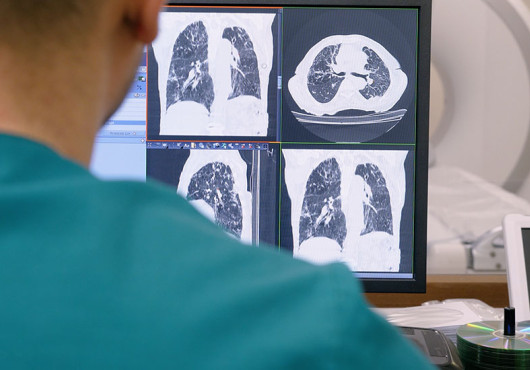
Federal Grant Launches Study of Lung DiseaseResearchers at Brigham and Women’s Hospital and the National Jewish Medical and Research Center have been awarded $37 million from the National Heart, Lung, and Blood Institute to lead a study on chronic obstructive pulmonary disease (COPD) that will seek to identify its genetic, epidemiological, and radiological characteristics. COPD, an umbrella term used to describe several progressive lung disorders such as emphysema and chronic bronchitis, is the fourth leading cause of death in the U.S. and the only leading cause that is increasing in frequency. The study will enroll a total of 10,500 participants. Approximately 3,500 of them will be African American since the rate of disease is increasing rapidly in this population and the risk factors are not well understood. Edwin Silverman, HMS associate professor of medicine at BWH, is a co-principal investigator of the study. HSPH will provide statistical analysis, along with Johns Hopkins University and the University of Colorado.
Community Service Awards AnnouncedThe Office for Diversity and Community Partnership has honored six HMS faculty members with a 2007 Dean’s Community Service Award, presented at a breakfast ceremony on Oct. 25. The awards were initiated in 1999 by then dean Joseph Martin to honor HMS faculty, trainees, students, and staff for extraordinary contributions to community service and to encourage volunteering. The 2007 Lifetime Achievement winner is Lachlan Forrow, HMS associate professor of medicine at Beth Israel Deaconess Medical Center, for his work with the Albert Schweitzer Fellowship. Rhonda Fogle, an HMS clinical instructor in pediatrics at Children’s Hospital Boston, received the faculty award for her service with the Association for Retarded Citizens of Eastern Middlesex. And Bertram Zarins, the Augustus Thorndike clinical professor of orthopedic surgery at Massachusetts General Hospital, received the faculty award for volunteering with the Latvian Medical Foundation. Ryan Thompson, a clinical fellow in medicine at MGH, won the trainee award for his work with the MGH Department of Internal Medicine. Elizabeth Cote, Class of 2008, received the student award for her time dedicated to the Kalaiselvi Karunalaya Social Welfare Society. The winner of the staff award is Dave Rizzotto, formerly an HMS media technician specialist, for volunteering with Newbury Film Series Inc.
Genomics Program Expands At HMSThe National Human Genome Research Institute, part of the National Institutes of Health, has expanded the Encyclopedia of DNA Elements (ENCODE) project with funding of more than $80 million over the next four years. The purpose of the ENCODE project is to search the human genome for DNA that has a biological function other than coding for protein, identify those functions, and investigate how they work. The new support will expand the grants of investigators already working on the project, allow for the development of two pilot projects, establish an ENCODE data coordination center, and create six sites that will develop novel methods and technologies for use in ENCODE projects.
Bradley Bernstein, HMS associate professor of pathology at Massachusetts General Hospital, is the principal investigator on a component of the project titled “High-throughput Sequencing of Chromatin Regulatory Elements,” which was funded at $4.8 million over four years. Utilizing the technique of chromatin immunoprecipitation followed by high-throughput DNA sequencing, Bernstein and his colleagues will map modifications of histones in various types of human cells.
Kidney Stone Research Program Funded by NIHThe National Institutes of Health has awarded an $8.5 million grant to Gary Curhan, HMS assistant professor of medicine at Brigham and Women’s Hospital, for a project to increase understanding of the pathophysiology of kidney stones. The three-part study will explore the physiological processes, genetic predisposition, and gene–environment interactions that contribute to risk for kidney stone formation using genomewide association studies in participants from the Health Professionals Follow-up Study, the Nurses’ Health Study, and the Nurses’ Health Study II, and in animal models and transport studies. Other BWH investigators on the project include David Mount, HMS assistant professor of medicine; Martin Pollak, HMS associate professor of medicine; Meir Stampfer, HMS professor of medicine and HSPH professor of nutrition and epidemiology; and Eric Taylor, HMS instructor in medicine.