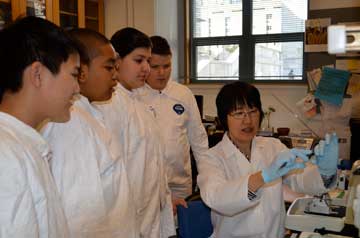
Deisi Suarez’s favorite part of her visit to HMS recently was when she got to create slides and view them under the microscope. Many of her classmates at the John D. O’Bryant School of Math and Science in Boston’s Roxbury neighborhood agreed.
“Science is really cool,” said the eighth-grade student. “There’s always something new to discover.”
Suarez visited HMS as part of the one-day Explorations program for select Boston and Cambridge middle-school (sixth- to eighth-grade) students. This fall’s Explorations event on Oct. 23 included 443 students from 19 different middle schools.
“The program is great—I’ve been doing it for 10 years or so now,” said Roderick Bronson, HMS lecturer on microbiology and immunobiology who spent an afternoon demonstrating dissections to students, creating slides and viewing cells through microscopes at the Histopathology Core located in the Goldenson building at HMS.
This year, 55 HMS faculty and research associates partnered with the students for laboratory visits and first-hand exposure to real scientific research and activities.
“It really gives the kids an opportunity to see what a day is like for scientists, or a pathologist like myself. My students will get to see how (specimens) with different diseases get dissected and turned into slides for further observation,” Bronson said.
For the students, it was a good opportunity to consider a future career in science, health care or engineering.
The primary objective of the event is to “provide middle-school students with a personal experience with math and science outside of the typical classroom setting,” said Sheila Nutt, director of educational outreach in the Office for Diversity Inclusion and Community Partnership. “The Explorations event also creates opportunities for young people to meet role models and explore career options,” she added.
“Science tends to be a black hole of questions and secrets,” said Bronson. “Explorations is great because it allows for the students to witness it firsthand. Even if they don’t become doctors or scientists, it’s still important for them to get exposed to it.”
The event, marking its 13th year, was co-sponsored by the Office for Diversity Inclusion and Community Partnership’s Minority Faculty Development Program and the Biomedical Science Careers Program.
At the end of the histopathology laboratory experience, Bronson left his new students with some words of encouragement:
“Science doesn’t require brilliance. It requires dedication, creativity and originality—whatever it takes for the light bulb to go off in your heads. You have to work hard at it. Science isn’t difficult; you just need to be committed. The hardest part is the learning. Anyone can become a scientist if they work hard at it,” he said.