The Harvard Medical School Center for Primary Care today announced the formation of an Academic Innovations Collaborative that will provide more than $10 million in resources over two years to nine Harvard Medical School affiliated hospital-based primary care teaching practices and eight affiliated community health practice partners. The Center will award more than $5 million in grants to the selected affiliates who will directly match the funds, totaling more than $10 million.
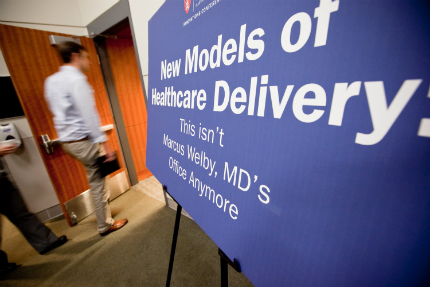 The goal is to create a platform for training future health care leaders by transforming Harvard-affiliated primary care teaching practices through innovation in four key areas: team-based primary care, management and prevention of chronic illnesses, management of patients with multiple illnesses, and patient empowerment and behavior change.
“It is well known, and has been well documented, that primary care in the United States is in crisis,” said David Bates, one of three co-interim directors of the Center for Primary Care. “If the U.S. is to have higher quality care at lower costs, primary care models will have to change, and this initiative provides the local grantees the chance to innovate solutions.”
The grantees are:
- Bowdoin Street Health Center, Healthcare Associates, The Dimock Center (Beth Israel Deaconess Medical Center affiliates)
- Brookside Community Health Center, The Phyllis Jen Center for Primary Care, Southern Jamaica Plain Health Center (Brigham & Women’s Hospital affiliates)
- Malden Family Medicine Center, Primary Care Center, Somerville Hospital Primary Care, Windsor Street Health Center (Cambridge Health Alliance affiliates)
- Children’s Hospital Primary Care Center, Martha Eliot Health Center (Children’s Hospital Boston affiliates)
- Primary Care Center, The Sagov Center for Family Medicine (Mount Auburn Hospital affiliates)
- Chelsea Health Center Adult Medicine and Pediatrics, Internal Medicine Associates, Mass General Pediatrics (Massachusetts General Hospital affiliates)
These practices serve a broad mix of patients, many of whom live in low-income communities in Boston and involve a variety of primary care disciplines including internal medicine, pediatrics and family medicine.
More than 275,000 patients will benefit from this investment. Through the Collaborative, these Harvard-affiliated clinical sites will join forces to develop best practices for transforming systems of care, improving value in health care, and creating a stronger platform for health care education.
These grants also will highlight the benefits of interdisciplinary teamwork in which patients, doctors, nurses, social workers, pharmacists and other allied health professionals learn from and support each other in innovative ways to improve patient care.
“Harvard Medical School, the Center for Primary Care and Harvard’s affiliated clinical entities share a mutual commitment to transforming care delivery within their networks to benefit patients, clinicians, trainees and society,” said Jeffrey Flier, dean of the faculty of medicine at Harvard Medical School.
“A partnership of this scope is without precedent in our community and could provide solutions to our country’s most pressing health care problems, solutions that we hope will make our state health care system, and ultimately our national health care system, among the best in the world,” said Center for Primary Care Interim Co-Director Russell Phillips.
“This collaboration is designed to engage medical students, trainees and affiliated medical faculty and staff as leaders in care redesign,” said Andrew Ellner, interim co-director. “It is as much an educational innovation as it is an effort to help catalyze change in primary care delivery on a broad scale.”
Despite increasing demands on primary care and the development of new practice models nationally, the pace of change has been incremental. The stress imposed by cost pressures, rapid changes in payment models and cuts to federal funding for research at academic medical centers has made it difficult to provide the needed resources and attention to primary care. The Center’s initiative will help expedite transformation as well as build strong connections between affiliated community health centers and community practices.
“This collaborative is a tremendous opportunity for the Center to fortify relationships between academic hospital-based practices and community health centers,” said Myechia Minter-Jordan, chief medical officer at The Dimock Center. “We know that community health is at the nexus of truly transformative health care. These grants will provide Harvard Medical School faculty, trainees and staff with unique opportunities to learn from innovative community health environments.”
To view the complete list of grantees and more information, visit: http://primarycare.hms.harvard.edu/what-we-do/program-primary-care-innovation/academic-innovations-collaborative
Harvard Medical School Center for Primary Care’s mission is to transform care by embracing service, wellness, patient and community empowerment, and innovation in systems for care and training at Harvard, academic health centers, and beyond. For more information visit http://primarycare.hms.harvard.edu/