Not long ago, every child born with severe multi-vessel primary pulmonary vein stenosis died in infancy. New therapies have helped some of the infants stricken with this condition, which constricts the flow of blood to the lungs, to survive for years. The oldest of these children today are 5 years old and still going strong.
“Medicine is constantly changing,” said Ashley Dickens, a Harvard Medical School student who studied characteristics of infants born with the disorder, analyzing the effectiveness of different surgical and medical approaches in treating the condition.
“We still have so much to learn, but the progress that has been made is amazing. None of this would have been possible without research,” Dickens said.
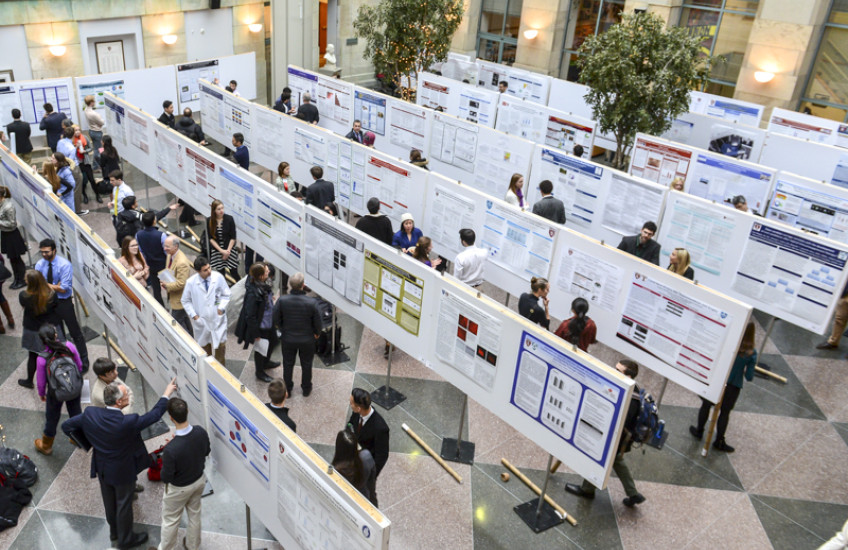
Dickens’ findings were presented at the 75th Annual Soma Weiss Student Research Day, which featured poster sessions and oral presentations in the Medical Education Center on Jan. 15 in honor of Soma Weiss, an inspiring HMS teacher and physician and an ardent supporter of student research who practiced medicine, conducted research and taught at HMS from 1925 until his death in 1942.
Projects included basic, translational and clinical biomedical research, policy studies, work in the medical humanities and analyses of innovative health systems and technologies. For example, some students developed new smartphone apps designed to help medical caregivers and patients, while others examined new clinical approaches.
The goal of the event is to educate the community about ongoing student research efforts and to encourage networking and cross-pollination between different parts of the community, organizers said.
Presenters included students in the MD, PhD, DMD and MD/PhD programs at HMS and the Harvard School of Dental Medicine. The organizers encouraged students to report on ongoing research and not just finished projects, emphasizing the importance of communication and process in biomedical research.
Broad range of inquiry
Many of the students focused on studies related to previous academic work or personal or professional interests.
When HMS student David Wen Rui Wang first encountered a calcified artery in the flesh, he was still a high school student volunteering in a pathology lab. Wang recalls the tech telling him to feel an artery, which he said was shockingly hard.
“From then on I thought that was the coolest thing,” Wang said. His research project looked at the role of aldosterone in a particular form of arterial calcification.
Working on new ways to solve problems and then testing their effectiveness was an especially rewarding combination for some students. Others emphasized the compelling combination of lab or theory-based research—and the potential that exists to deliver new cures for many people—with the personal satisfaction of working face-to-face with patients.
“It was exciting to have the experience of implementing new ideas to meet the needs of real families,” said HMS student Margaret Fallon, who studied the effectiveness of a pilot project featuring group visits for high-risk pediatric asthma patients.
At a reception following the poster session, Jeffrey S. Flier, Dean of the Faculty of Medicine at Harvard University, and members of the Soma Weiss family welcomed the participating students, faculty and community members.
Flier celebrated the event’s legacy of 75 years of launching exceptional scientific and medical careers, and looked forward to the future of health and biomedical research.
“The breadth and depth of research presented today is a credit to our students, to their research mentors and to our Scholars in Medicine program,” Flier said.
Patricia D’Amore, the Charles L. Schepens Professor of Ophthalmology and director of research at the Schepens Eye Research Institute, who is also chair of the HMS Faculty Committee on Scholarship in Medicine, introduced the student speakers selected to present their findings and presented awards for outstanding poster presentations in five categories:
2015 Student Speakers
Aaron Deutsch: “Non-additive effects of HLA genes in five common autoimmune diseases”
Pranoti Hiremath: “Identifying early changes in myocardial microstructure in hypertensive heart disease”
Bennett Lane: “Association of head and neck surgical outcomes with surgeon and hospital financial incentives”
Ivana Viani: “Dr. Vesna Bosanac: Ethical decisions in times of war”
2015 Poster Award Winners
Elizabeth D. Hay Prize for Basic Science Research
George Huang: “The Role of Sirt1 in Exercise-Induced Adaptation of Skeletal Muscle”
Judah Folkman Prize for Clinical / Translational Science Research
James Baker: “Opioid Prescribing Following the Extraction of Teeth”
Robert Ebert Prize for Health Care Delivery Research or Service
Taavish Sharma: “Oral Health Knowledge and Behaviors of Latina Mothers—a Pilot Study”
Charles Janeway Prize for International Research or Service (Tie)
Megan M. McLaughlin: “Effect of Community-based Accompaniment with Supervised Antiretrovirals on Viral Load Suppression in HIV Patients in Peru: A Cluster-randomized Trial”
Laurel S. Gabler: “Beyond the Emergency Obstetric and Neonatal Care Trial: A Qualitative Look at the Content, Delivery and Impact of the Community Mobilization Component of the EmONC Trial in Nagpur, India”
Leon Eisenberg Prize for Medicine in Society Research
Samuel Slavin: “Code Voices: An Audio Narrative of In-Hospital Cardiac Arrest”