Patient care is a three-legged stool whose two stable legs of quality and safety are compromised by a weak third leg—access—renowned surgeon L.D. Britt, (HMS, HSPH ’77) told health care professionals Dec. 9. Britt delivered a lecture celebrating the opening of two exhibits in the Countway Library: the National Library of Medicine’s “Opening Doors: Contemporary African American Academic Surgeons” and a Countway companion exhibit, “Bridging the Gap: Contributions of African American Surgeons at Harvard.”
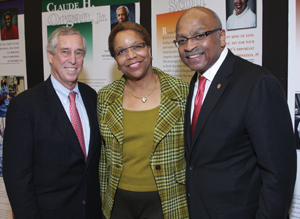
Britt, who is a recipient of the American Association of Medical Colleges’ Robert J. Glasser Distinguished Teaching Award—one of the nation’s highest awards in medicine—and the first African American in the country to hold an endowed chair in surgery, called on physicians and policymakers to pursue fundamental reforms in his lecture, “American Medicine: The Great Challenges and Dilemmas.”
After demonstrating some of the many ways that socioeconomic status and geography affect health and mortality rates, Britt introduced the “three-legged stool” model, which has patient care at the top supported by quality, safety and access. The system “can’t stand for long because we don’t have access,” Britt commented, noting that 1,168 counties in the U.S. currently lack general surgeons. “We have the best quality health care in the world. The problem is access.”
Britt addressed challenges ranging from workforce shortages to the rising cost of health care to questions of effectiveness and transparency to the nearly 50 million people uninsured in the U.S. He proposed enhancing the health care workforce, reducing inappropriate expenditures, promoting effective and proven care, reforming medical liability laws, creating universal coverage and advancing information technology. He also stressed the importance of recruiting and retaining students from diverse backgrounds to medical programs to improve the nation’s health care system. “You won’t have an optimal business if you don’t have diversity,” he said. “We need to take a multifaceted approach to this problem and we need minority representation. Dedication is a universal language.”