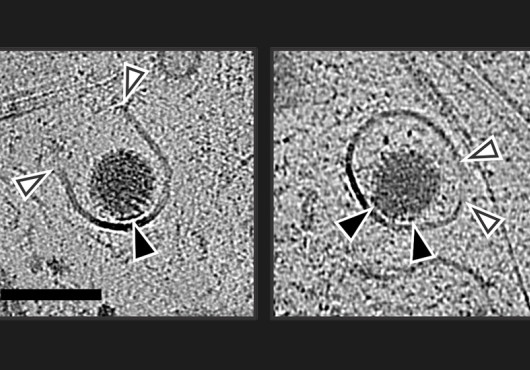
In some ways, HIV resembles a minimalist painter, using a few basic components to achieve dramatic effects. The virus contains just nine genes encoding 15 proteins, which wreak havoc on the human immune system. But this bare bones approach could have a fatal flaw. Lacking robust machinery, HIV has to hijack human proteins to propagate, and these might represent powerful therapeutic targets.
Using RNA interference to screen thousands of genes, a team led by Stephen Elledge, the Gregor Mendel professor of genetics and of medicine at HMS and Brigham and Women’s Hospital, has now identified 273 human proteins required for HIV propagation; the vast majority had not been connected to the virus by previous studies. The work appeared online in Science on Jan. 10.
Most antiretrovirals interact directly with HIV proteins, and it is quite simple for the rapidly mutating virus to avoid destruction by changing the binding sites for these drugs. Chemical cocktails combat this problem, but some HIV strains have still managed to evade particular drugs. These cagey pathogens could eventually develop resistance to several drugs, especially in patients who do not adhere to their regimens.
“That’s why we decided to take a different approach centered on the human proteins exploited by the virus,” said Elledge, who is also an investigator with the Howard Hughes Medical Institute and a member of the HMS–Partners HealthCare Center for Genetics and Genomics. “These host factors are not mutating rapidly, so they offer stable therapeutic targets.”
The new screen quadrupled the list of known host factors, implicating proteins involved with a surprising array of cellular functions. Elledge hopes that researchers will be able to cripple HIV by tinkering with some of these proteins.
“We’ve been waiting for this kind of systematic approach to identifying host factors,” said Dan Littman, a professor of molecular immunology at New York University, who was not involved in the study.
To create the list, postdoctoral researcher and first author Abraham Brass—working with Derek Dykxhoorn and Nan Yan from the lab of HMS professor of pediatrics Judy Lieberman—began with a massive library of short interfering RNAs (siRNAs) made available by the ICCB-Longwood screening facility. Brass knocked down more than 21,000 genes—one at a time—in human cervical cancer cells that thrive in culture.
He unleashed HIV-1 on these cells, which had already been modified to include receptors for the virus. If HIV replication was inhibited in a given well, it would suggest the missing protein was involved.
“Given the method, we missed some of the host factors,” Brass explained. Many of the siRNAs, for example, target proteins the cell needs to survive. These siRNAs killed the cells before Brass could apply HIV, so he could not test them. “This is just a first crack at a comprehensive list, but the majority of the host factors we found are highly likely to play a role in HIV propagation,” he said.
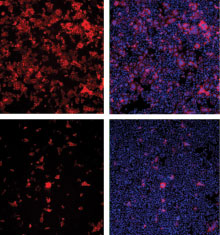
By designing a two-part screen, Brass was able to determine approximately when the host factors act on the virus. After adding HIV to the wells, he waited 48 hours before staining for p24, produced from the HIV gag gene. This allowed him to identify proteins required for viral entry through Gag translation.
To capture late-acting factors, he collected supernatant from wells where HIV appeared to be thriving, mixed it with fresh cells, waited 24 hours, and then examined the expression of tat, another HIV gene. If tat expression was low, Brass suspected the supernatant did not contain potent viral particles, suggesting he had interfered with a host factor involved in viral assembly and budding.
Of the 273 host factors he identified, just 36 had been previously implicated in the HIV life cycle.
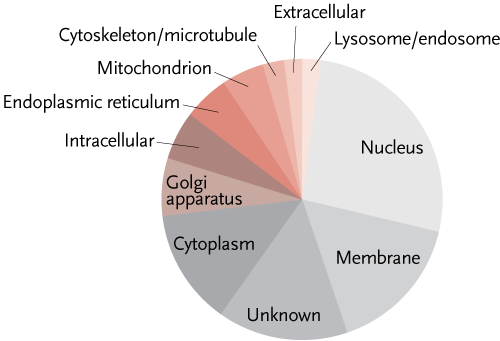
The Viral TakeoverAfter Brass combed through databases and the literature to learn more about these proteins, he turned to bioinformaticist Yair Benita in Ramnik Xavier’s lab at Massachusetts General Hospital. Benita grouped the host factors according to function, identified the connections between them, and created a comprehensive map of the viral life cycle, which contains some surprises. For example, several host factors play a role in autophagy and retrograde trafficking from the Golgi.
“We didn’t expect those pathways to pop up,” recalled Lieberman, who is also an investigator at the Immune Disease Institute and director of the HMS Division of AIDS.
Brass was particularly intrigued by retrograde trafficking from the Golgi, so he took a closer look at Rab6, which helps the organelle adorn lipids and proteins with carbohydrates by shuttling enzymes from place to place. Perhaps HIV relies on the accoutrements of cell membrane constituents more than previously realized, since tests revealed that silencing Rab6 interfered with HIV entry.
Brass also examined two proteins involved after fusion. He suspects the first protein—TNPO3—might shuttle the HIV pre-integration complex from the cytoplasm into the nucleus through a pore.
“The expanded list is a hypothesis-generation machine,” explained Elledge. “Like Abe [Brass], other scientists can look at the list, predict why HIV needs a particular protein, and then test their hypothesis.” Labs can use the list to probe the basic biology of the virus.
The team is confident that their findings extend from the experimental cancer cells to the immune cells where HIV thrives, though this remains to be proven. Immune cells contain high concentrations of many of the host factors identified, suggesting the screen is valid.
Littman, the NYU immunologist, hopes the study will bring him closer to a mouse model of HIV. “We need to find out how many of these host factor interactions are restricted to the human species before we can get a small animal model for HIV infection,” he said.
“The factors identified by the screen also represent drug targets because they’re not essential for cell viability,” added Lieberman.
And the very siRNAs Brass used to disrupt genes in vitro might hold promise as therapeutic agents in vivo. In 2006, Lieberman’s lab delivered siRNAs selectively into HIV-infected white blood cells by mixing them with an antibody fragment fused to an siRNA binding peptide. She plans to extend this work to induce silencing selectively in all the immune cells HIV can infect. As some labs pursue this angle, others will undoubtedly work toward conventional drugs that target the host factors identified by the study.
“We’re closing in on a systems level understanding of HIV, which opens new therapeutic avenues,” said Elledge. “We might be able to tweak various parts of the system to disrupt viral propagation without making our own cells sick.”