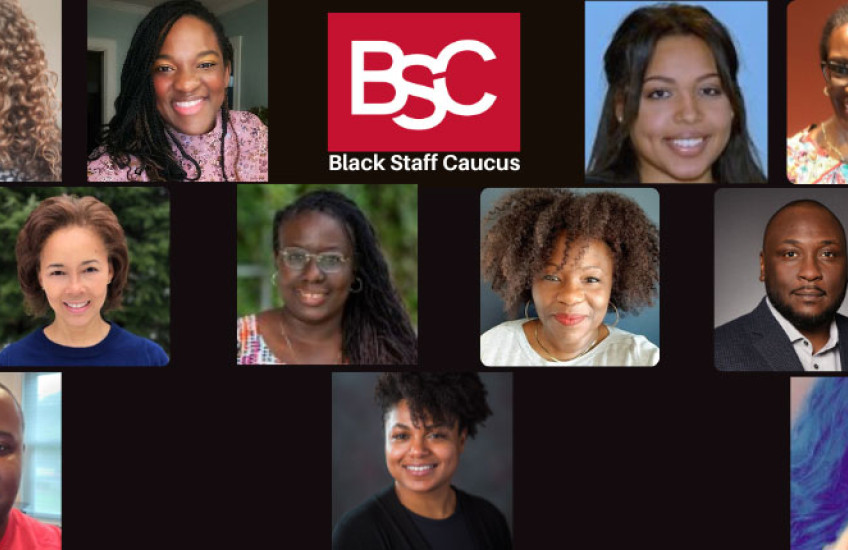
In 2020, a group of Black staffers at Harvard Medical School got together to organize an open community forum where they could share experiences and concerns and also network and build community.
The group was formally recognized by the School later that year as the Black Staff Caucus and now, nearly three years later, it has been awarded Culture Lab Innovation and President’s Innovation fund grants to build programs and support staff engagement across the Harvard Longwood Campus.
Harvard Medicine News recently caught up with BSC leadership for an update on progress and its growing mentoring program.
Harvard Medicine News: The HMS Black Staff Caucus got started in 2020. How has it evolved since then?
BSC: The caucus has used a grassroots approach, partnering with individuals who’ve worked tirelessly to create an affinity group that can serve many on the Harvard Longwood Campus. A little more than two years later, we have an organizational structure, budget, cadence, and the support of leadership. Our purpose remains the same, to provide a new model of engagement for Black staff members that strengthens Harvard’s overall commitment to diversity, equity, and inclusion.
Science & Medicine, Delivered
Harvard Medicine magazine in your inbox
HMNews: What are the biggest challenges the group has faced at HMS?
BSC: We have had great momentum, which spawns new ideas for programming and events. Our biggest challenge is resources, including people’s time, so we’ve developed a calendar of events that is carefully managed. We’ve also sought opportunities to collaborate with other campus and Harvard University groups. Another challenge has been facilitating member engagement in a hybrid work environment. We are doing member engagement surveys to determine how best to dedicate our resources.
HMNews: How has the caucus been helping and supporting its members?
BSC: We continue to collaborate with the Office of Employee Development and Wellness on the Longwood Campus Mentoring Program. We also host a regular time for reflection. We have provided networking opportunities through hybrid events that include a leadership series, group coaching sessions, career roundtable discussions, equity and social justice programs, and membership engagement surveys. We’ve conducted outreach through LinkedIn and Slack. Plans for 2023 include a diversity career symposium and a four-part Black mental health series.
HMNews: Explain more about what the Longwood Mentoring Program is and how it helps mentees.
BSC: The Harvard Longwood Campus Mentoring Program focuses on staff and facilitates one-to-one mentoring relationships. This program provides mentees with personalized guidance from experienced professionals across the three major schools on the Harvard Longwood Campus — HMS, the Harvard T.H. Chan School of Public Health, and the Harvard School of Dental Medicine — as well as the Wyss Institute.
The goal of the program is to help mentees expand their networks, gain new knowledge and insights, build new skills, and work towards career advancement.
The program is beneficial to mentors by providing opportunities to learn from mentees and further develop their own leadership and communication skills.
In addition, the mentoring program provides a unique and inclusive learning environment by connecting mentees and mentors of diverse backgrounds and experiences, which facilitates cross-cultural and cross-functional learning opportunities.
Established through the combined efforts of the Office of Employee Development and Wellness and the Black Staff Caucus, the mentoring program is deeply committed to cultivating and preserving a culture of diversity, inclusion, and belonging on the Longwood Campus.
HMNews: Why is mentoring so important?
BSC: Mentoring is important for:
- Improving staff engagement and retention.
- Supporting diversity and inclusion efforts.
- Building community.
- Developing potential new leaders.
- Providing opportunity for collaborative knowledge-sharing.
- Career development and advancement.
- Cross-functional learning opportunities.
- Assistance with navigating organizational culture.
- Developing confidence in advocating for self and dealing with workplace challenges.
HMNews: Please explain how Chronus functions and how it came to be.
BSC: Chronus is online mentoring software that helps in the administration of the Longwood Campus Mentoring Program in many ways, including matching mentees and mentors based on goals, mentee goal-setting, meeting scheduling, access to mentor and mentee resources, customized communications, and tracking program metrics.
Mentees and mentors can communicate with the program administrator through Chronus. Having the program centrally managed through the software is very efficient and helps with the sustainability of the program over time.
Chronus was already in use at Harvard prior to our being introduced to it in 2021. The Harvard Women in Technology+ Program, the Harvard College Women’s Center and its WiSTEM Program, and the Harvard Graduate Women in Science and Engineering Program collaborated to receive the original funding for Chronus through a Culture Lab Innovation Fund grant to expand mentoring efforts at Harvard.
Collaboration has been key to establishing the program, and we are grateful for the support of the many people who helped bring this idea to where it is today. The participation and contributions of both mentees and mentors are critical to this program’s success.
HMNews: The caucus was one of the recipients of Culture Lab Innovation Fund and President’s Administrative Innovation Fund grants. How will they be used?
BSC: Receiving the CLIF and PAIF grants was a milestone accomplishment for BSC. Funding allows us to build and expand innovative programs and engage qualified experts to support our objective of increasing staff engagement.
The grants have supported events including a hybrid talk on the principles of inclusive leadership, a voter mobilization postcard initiative, a presentation on navigating organizational culture, and membership engagement activities.
Other significant initiatives for 2023 include a diversity career symposium and a four-part Black mental health series.
HMNews: The caucus has made significant strides in the short time since it came together. What are the two to three major priorities or goals ahead in the next few years?
BSC: Over the next few years, the priorities are:
- Developing programs that support professional and leadership development training, especially advocating for more experiential learning programs; mentorship, sponsorship, networking; and creating supportive spaces for conversations and dialog on emerging issues that bear on success in the workplace.
- Collaborating with Harvard Longwood Campus human resources and other departments to develop innovative programs aimed at improving retention and promotion of Black staff.
- Partnering with University-wide groups on projects to advance diversity, equity, and inclusion initiatives in the workplace.