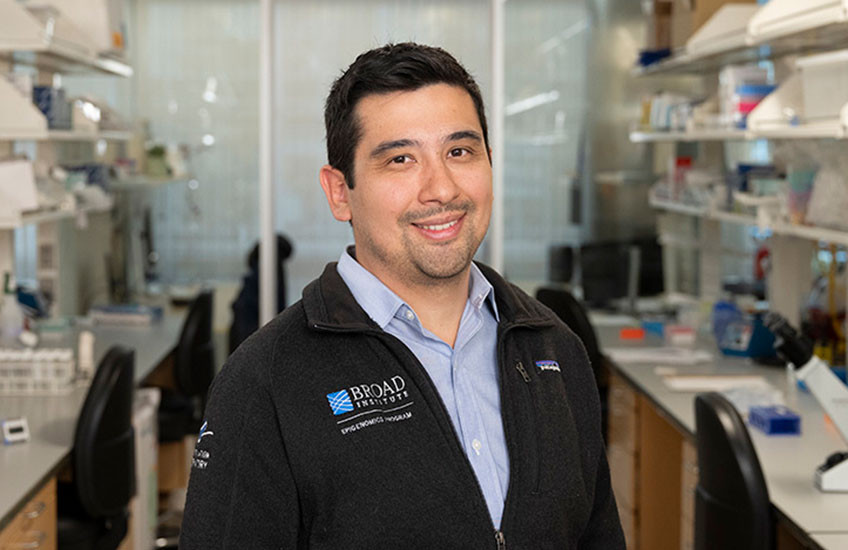
In October 2023, Jason Buenrostro received some unexpected, career-changing news: He’d been awarded a prestigious “genius grant” from the MacArthur Foundation in recognition of his work developing tools widely used by scientists to study how genes are turned on or off in individual cells.
He had no idea he’d even been nominated. Getting that surprise phone call “was an emotionally charged moment,” said Buenrostro, professor of stem cell and regenerative biology at Harvard University and core institute member at the Broad Institute of MIT and Harvard.
The unrestricted, $800,000 award arrived at an opportune moment. At the time, Buenrostro had been thinking a lot about his childhood and early memories of stressful times. A child of immigrants from Mexico, he and his family had lived in cousins’ living rooms or garages in the San Francisco Bay area before getting a permanent home of their own, and he had witnessed the effects of poverty, addiction, and violence in his extended family and community. He and his siblings, however, had benefited from a safe and loving home experience and, as they grew up, had stayed out of trouble. They’d thrived in school and were the first in his family to graduate high school and attend college.
After becoming a celebrated scientist and Harvard professor, Buenrostro began to wonder how he’d achieved professional and personal success while so many in his community and larger family struggled with poverty or addiction. He credits the unwavering support of his parents, who emphasized the importance of education, but Buenrostro wondered if that was the only factor.

As a biologist, he naturally homed in on a scientific question: Could there be a biological basis for physical and mental resilience in the face of adversity?
“Those of us who grew up poor or are first-generation, like I am, wonder why we made it and some of our friends and family members didn’t,” Buenrostro said. “I still have this deep desire to understand why it is that I got out and others didn’t, especially acknowledging that I wasn’t the smartest one.”
This question stayed with him for years. Then the MacArthur award gave him not only the resources but also a confidence boost to make a bold choice.
In 2024, Buenrostro pivoted from technology development to a new goal: studying the health impacts of life experiences like those that shaped his youth. In partnership with a foundation that shares the desire to make headway on this problem, he launched a pioneering effort to study it at scale and with scientific rigor.
He committed to learning why some people who endure adversity and trauma go on to develop mental health, cardiovascular, or immune issues while others don’t — and what might be done to help those at risk.
But first, he needed a crash course in brain circuits, stress hormones, and social sciences.
A scientific trailblazer
Venturing into a new scientific field is a risky move, but Buenrostro had ample experience. At Santa Clara University, near his hometown of Redwood City, California, he was one of the school’s first undergraduates to pursue bioengineering through earning two degrees. He considered becoming a doctor but decided to embark on a career in research instead because he thought he could impact more people by developing new technologies or treatments.
During graduate school at Stanford University, he became the first member of a new researcher’s lab and invented a creative method for analyzing the epigenome — the dynamic chemical marks on DNA that determine which genes are turned on and off, alter how cells work, and help the body respond to the environment. His method, ATAC-seq, was easier and cheaper to use than existing approaches and quickly became a standard tool in the field.
He moved to Boston in 2016 and, skipping the traditional postdoctoral position, became a junior fellow in the Harvard Society of Fellows and the first Broad Fellow at the Broad Institute, where he led his own lab. Two years later, he joined the Harvard faculty, became an institute member of the Broad, and continued advancing his epigenomic tools by incorporating gene expression and spatial information in addition to new computational methods.
Finding purpose
Although he knew his tools were enabling other scientists to make discoveries, Buenrostro had a nagging sense that he should be doing more. He started intensely reading scientific papers on the effects of stress and learned that it can not only influence the decisions that shape a person’s life but also damage the brain, heart, and immune system. He was especially intrigued to learn how war, famine, and disasters can shape health at a population level.
“We know these things make imprints on communities, yet we don’t understand where that’s being biologically embedded,” he explained.
Buenrostro learned that it’s well known that stress can damage the body and that stress hormones like adrenaline and cortisol interact with cells to change which genes are activated or deactivated. These changes can help the body adapt and be resilient, but they can also lead to negative health outcomes. The details of how this happens at the molecular level were still murky.
Buenrostro began envisioning a new application for the tools he developed: to measure and identify the key epigenetic impacts of life events both positive and negative. This could open the door to new preventive or therapeutic measures for people exposed to stress and trauma.
Despite his success, Buenrostro admits to experiencing impostor syndrome and worrying about his colleagues’ perception of him. Some even warned that studying the biology of stress was “too crazy” and could ruin his career.
Buenrostro found encouragement in his wife, MIT neuroscience professor Sara Prescott, who helped him learn more about neuroscience and urged him to pursue his passion. He also realized that, with his own personal history of adversity and his expertise in epigenetics tools and approaches, he might be particularly well placed to tackle these questions.
A new project takes shape
When he received the MacArthur grant, Buenrostro was contacted by the Treehouse Family Foundation, whose mission is to improve lifelong health and opportunity by preventing childhood adversity and reducing its effects. In 2022 the foundation had worked with the Broad to launch the Broad Trauma Initiative, aimed at exploring the biological impact of trauma and improving the health and well-being of trauma survivors.
Initiative and foundation members recognized that understanding the molecular and cellular roots of trauma would require advanced epigenomics technology and expertise. They invited Buenrostro to participate and suggested scaling up his efforts.
With a $50 million gift from the foundation, in 2025 Buenrostro launched the Biology of Adversity Project, which he now leads. Based at the Broad and in collaboration with the Broad Trauma Initiative, the effort is aimed at discovering how different life experiences get embedded in DNA, cells, and tissues.
Buenrostro has built an interdisciplinary team of scientists to investigate how stress and adversity affect different parts of the body and to conduct both molecular experiments in the lab and public health studies with human cohorts. The team is looking across the whole body and in large numbers of people.
“Jason has an uncanny ability to find people who can nucleate around the ideas that he wants to push,” said physician-scientist Ravikiran (Ravi) Raju, HMS instructor in pediatrics, part-time, at Boston Children’s Hospital and one of the project’s lead researchers. “He embodies the passion, interest, drive, and curiosity that help our whole community move forward. He is a natural leader for this work.”
Project scientists are using model systems to measure the physiological effects of early-life stressors like social isolation and to assess the role of environmental enrichment in promoting resilience. They also plan to look for durable epigenetic changes in the blood of people who have experienced adversity or trauma.
The team imagines a range of future possible interventions, such as dietary supplements that promote resiliency in at-risk communities or even gene therapy in cases of extreme trauma. In addition, they hope to identify measurable biomarkers that could quantify a person’s stress load and suggest steps to prevent illness. Just as molecular discoveries in cancer ushered in an era of precision therapies, a richer molecular understanding of stress and adversity could open the door to targeted approaches tailored to a person’s particular stress response.
Although the work is still in early stages, Buenrostro is optimistic that it can one day help others overcome challenging circumstances.
“Fixing the damage of stress is something that keeps me up at night,” he said. “We hope that the work we’re doing improves our understanding of the shared human experience and over time not only helps us better understand history but also helps us build society for a better future.”
Adapted from a Broad Institute news article.