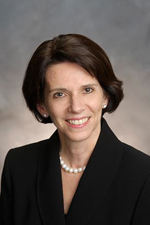
 Janey Wiggs, Paul A. Chandler Associate Professor of Ophthalmology at the Massachusetts Eye and Ear Infirmary, is one of 10 winners of the National Eye Institute’s Audacious Goals challenge. The challenge was a nationwide competition that invited compelling ideas to advance vision science, and garnered a pool of nearly 500 entries. Each winner received a $3,000 prize plus travel expenses to attend the NEI Audacious Goals Development Meeting which took place in February. Wiggs is associate chief of ophthalmology clinical research and associate director of the Ocular Genomics Institute at Massachusetts Eye and Ear Infirmary.
Wiggs’ winning submission, entitled “Vision BioBank — A Network of Ocular Phenotyping Centers Using Genomic and Epidemiologic Data to Promote Personalized Ophthalmology,” proposes to create a network of biobanks that collect corresponding phenotype (physical characteristics) and genotype (genetic) data on people with certain eye diseases. These biobanks could be used for a wide range of studies, including the development of sensitive and specific gene tests that could accurately determine a person’s risk for such diseases, as well as their likely response to certain therapies.
The NEI Challenge to Identify Audacious Goals in Vision Research and Blindness Rehabilitation is part of a government-wide effort to bring the best ideas and top talent to bear on the nation’s most pressing challenges.
Eric Lander, director of the Broad Institute of MIT and Harvard, and Lewis Cantley, HMS visiting professor of medicine at Beth Israel Deaconess Medical Center, were recently awarded a Breakthrough Prize in Life Sciences.
Lander recieved the prize for the discovery of general principles for identifying human disease genes, and enabling their application to medicine through the creation and analysis of genetic, physical and sequence maps of the human genome. Cantley, who is the Margaret and Herman Sokol Professor and director of the Cancer Center at Weill Cornell Medical College and New York-Presbyterian Hospital, recieved the award for the discovery of PI 3-Kinase and its role in cancer metabolism.
The Breakthrough Prize in Life Sciences was founded to recognize excellence in research aimed at curing intractable diseases and extending human life. The prize is administered by the Breakthrough Prize in Life Sciences Foundation, a not-for-profit corporation dedicated to advancing breakthrough research, celebrating scientists and generating excitement about the pursuit of science as a career. The Breakthrough Prize in Life Sciences Foundation was established by Yuri Miller, an entrepreneur and philanthropist, Sergey Brin, a Google co-founder, Anne Wojcicki, the founder of the genetics company 23andMe, and Mark Zuckerberg, the founder of Facebook, who collectively agreed to establish five annual prizes, of $3 million each.
The prizes were awarded for past achievements in the field of life sciences, with the aim of providing the recipients with more freedom and opportunity to pursue even greater future accomplishments. Each year’s prize winners will join the Selection Committee for future awardees.
All Breakthrough Prize recipients will be invited to present public talks targeting a general audience. These lectures, together with supporting materials, will be made available to the public, allowing everyone to keep abreast of the latest developments in life sciences, guided by contemporary masters of the field.