A widely held belief about Alzheimer’s disease is that its characteristic plaques accumulate over decades, preceding and possibly causing dementia and other clinical symptoms. But now a team of HMS researchers led by Bradley Hyman, the John B. Penney Jr. professor of neurology at Massachusetts General Hospital, reports in the Feb. 7 Nature that plaque formation can occur literally overnight.
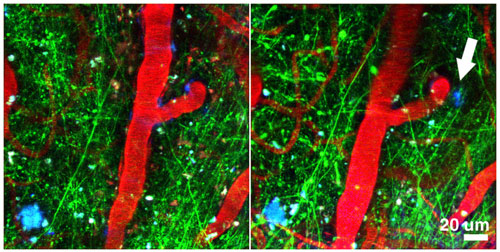
This surprising finding emerged when postdoctoral researcher and first author Melanie Meyer-Luehmann and her colleagues observed plaque formation and the accumulation of brain inflammatory cells, or microglia, in real time. “A longtime goal within the field has been to uncover the kinetics of plaque formation and microglial activation. We’ve known for a while that plaques and microglia occur together in Alzheimer’s, but we’ve never known whether plaques cause microglial activation or whether microglial activation causes plaques,” said Meyer-Luehmann.
Previously, it was possible only to look at plaque formation through the production of sequential snapshots from thin slices of brain. But through a novel microphoton imaging technique, Hyman and his team were able to image thick sections of tissue in vivo, essentially allowing them to capture a movie of plaque formation.
The researchers initially imaged plaque-free areas in several strains of transgenic mice so they could detect the onset of a new plaque and monitor its growth. To their amazement, new plaques developed in as quickly as 24 hours and stabilized soon after.
The researchers then went back to examine the point at which the microglial response occurred and found that while the plaques were definitely the first to appear, it was not long before microglia were recruited to the site.
“It is still unknown if the microglia are good or bad, but we think they may be involved in restricting plaque growth,” said Meyer-Luehmann. Whatever their precise role may be, it is clear from the studies that their coexistence with plaques resulted in progressive degeneration in neuronal function.
“We now know the actors, and we know when they come on stage,” Hyman said. “So now we would like to track the changes from initial plaque formation up to the onset of alterations in neuronal function, and then explore ways where we can either reverse the progression of these changes or, better still, inhibit them.”