
Learning to Think Like a Scientist
Student Perspective | September 29, 2026
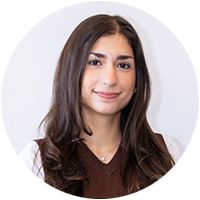
Christina Kotsaninis has always been interested in what happens when you look a little closer. As a research associate at Novo Nordisk, she worked on a nonviral delivery team, using cell-based assays to assess the potency and toxicity of novel delivery systems. She contributed to collaborations involving gene therapy and gene editing and gained experience in the early stages of therapeutic development. But the work also made her curious about the biology underneath the results she was generating.
“I knew that I was really interested in cell biology, but I wanted to do something a little more mechanistic,” she says.
Kotsaninis had studied biochemistry at Northeastern University, where her early clinical experiences included working as a physical therapy aide and patient care technician. By the time she joined Novo Nordisk after graduating in 2023, she knew that she wanted to remain close to the development of new therapies. What Kotsaninis had not yet decided was exactly what role she wanted to play in that process or how much more scientific training she wanted to pursue.
Graduate school offered a chance to explore both questions.
While researching programs in the Boston area, Kotsaninis discovered the new Master of Medical Sciences in Therapeutic Sciences program that launched in 2025 at Harvard Medical School. Its emphasis on research and drug development aligned closely with the work she had already begun in the biopharmaceutical industry, while the thesis component would allow her to move beyond carrying out established experiments and begin taking greater ownership of a scientific question.
She was also drawn to the breadth of the program. Rather than requiring students to arrive with a narrowly defined research agenda, Therapeutic Sciences offered laboratory rotations and exposure to different areas of drug discovery and development. For Kotsaninis, who was interested in cell biology but eager to explore, that flexibility mattered.
Joining the inaugural Therapeutic Sciences cohort meant that some of that exploration was happening at the program level, too. Kotsaninis and her classmates are the first group of students to move through the two-year curriculum, giving them an unusual opportunity to help shape the experience as they go.
“It feels like things are a bit more tailored to us,” she says. “Since this the first cohort, they’re very open to feedback.” That responsiveness has made being part of the first cohort feel collaborative.
The cohort itself quickly became another important part of the experience. Kotsaninis was surprised by how easily the students connected despite coming in with different levels of professional and research experience. “It’s a unique experience being a part of the first cohort of a program, and I think we all bonded over that,” she says. “It’s not competitive at all, which is great. We all help each other as much as we can.”
Academically, Kotsaninis has found herself developing a different relationship with experimental science. Her industry experience had given her a strong foundation in conducting assays and generating reliable results. In graduate school, she has had more opportunities to step back from the experiment itself and ask what the results mean, why they occurred, and what question should come next. “I think the classes have helped me learn how to think more like a scientist,” she says.
Coursework in areas such as assay optimization and development has helped her reconnect fundamental concepts in biochemistry and cell biology with the decisions researchers make at the bench. “If you love science, it’s really important to ask, ‘How do I use my fundamental knowledge to interpret my results, and what new discoveries can I gain from them?’”
Her thesis research has given her the opportunity to put that curiosity into practice. Students in the program rotate through laboratories before selecting a thesis environment. Kotsaninis approached the process knowing that she was interested in cell biology and curious about neurobiology, but deliberately avoided committing herself to one narrowly defined research question.
She ultimately rotated through two neuroscience laboratories using different approaches before joining the laboratory of David Van Vactor, PhD. Her current research focuses on cellular mechanisms associated with amyotrophic lateral sclerosis, or ALS. Kotsaninis is investigating a pathway associated with neurodegeneration and searching for regulators that could potentially be manipulated to reduce neuronal death and the aggregation of a protein associated with the disease.
Van Vactor serves as her primary mentor, meeting with Kotsaninis every other week to discuss her results, troubleshoot challenges, and consider where the research might go next. She also works closely with postdoctoral researchers in the laboratory, who provide more hands-on guidance with experimental techniques and data interpretation. That combination has helped Kotsaninis move from learning how to conduct an experiment toward thinking more independently about why she is conducting it in the first place.
“The postdocs in the lab will help teach me by asking: ‘How do I do these experiments? How do I interpret these results?’” she says. “And then, when I meet with the PI, it’s a bit more high level. He helps me brainstorm and think more like a scientist versus a research tech.” That shift has changed how Kotsaninis imagines the next stage of her education.
She began the master’s program unsure about whether to pursue a PhD. As Kotsaninis enters her second year, she now plans to apply to doctoral programs. Part of that change came from discovering possibilities in academic research that she had not fully considered before. Coming from biopharma, Kotsaninis had assumed that staying close to therapeutic development might eventually pull her away from basic or mechanistic research.
Her thesis experience complicated that distinction. By investigating the cellular mechanisms involved in ALS, she can ask fundamental biological questions while still considering how those discoveries might eventually inform a therapeutic approach. “There’s a lot of therapeutics you can do in academia,” she says. “That’s one of the reasons why I want to do a PhD. Now I can see how this research can be translational.”
A PhD would give Kotsaninis more time to pursue those questions, investigate the molecular mechanisms of disease, and continue developing the scientific independence she has begun building through her master’s research. Ultimately, she still sees herself returning to the biopharmaceutical industry. “I just like being close to the therapeutics aspect of science,” she explains.
For Kotsaninis, then, the value of the master’s program has not been in confirming a path she had already mapped out. It has given her room to test her assumptions about what kind of research she enjoys and discover new questions she wants the time and training to pursue.
That spirit of exploration also informs the advice she would give prospective Therapeutic Sciences students. Kotsaninis recommends treating laboratory rotations as an opportunity to explore rather than simply confirm an existing plan. Even her own rotations, both broadly connected to neuroscience and cell biology, exposed her to different techniques and approaches. One involved animal research that she initially did not want to pursue, but trying it changed her perspective.
“Don’t tie yourself down to specific research interests,” she advises. “If you think you might be interested in doing something new, then try to do all sorts of different things when you’re rotating labs.”
It is advice that mirrors her own experience. Kotsaninis did not begin the program knowing precisely which disease she wanted to study, which laboratory she wanted to join, or whether a PhD was in her future. Instead, she gave herself permission to investigate. That discovery has become one of the most important parts of learning to think like a scientist.
Written by Bailey Merlin