
Advancing Cancer Research Through Immunology
Student Perspective | February 10, 2026
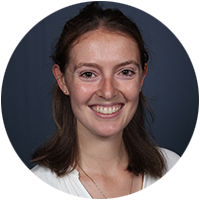
Originally from Belgium, Marie Verdonck completed her undergraduate studies in bioscience engineering and a master’s degree in cellular and genetic engineering. During the master’s program, she became interested in the potential of genetic engineering to improve immunotherapies. At the same time, she recognized a growing gap in her training. “I realized that I didn’t have the knowledge to meaningfully contribute to immunotherapies,” Verdonck explains.
While completing a master’s in Belgium, Verdonck began to feel a growing distance from the human impact of her work. “I loved the project, but felt so far away from the human patient,” she says. An introductory immunology course further sharpened her interest in a field that is both scientifically rich and directly tied to human disease. Rather than continuing along a purely technical path, she decided to pursue a second master’s degree focused on immunology.
When Verdonck entered the Master of Medical Sciences in Immunology program at Harvard Medical School, she had a clear sense of direction and an equally clear sense of what she needed to learn. Early in the program, she worked in the Wucherpfennig Lab on CAR T-cell therapies for solid tumors, gaining hands-on experience in cancer immunotherapy. “I loved the project [in Belgium], but still felt far from the patient,” she recalls, an experience that reinforced her desire to pursue translational work grounded in immunology.
For her thesis, Verdonck is using generative AI-based protein design tools to develop novel binders for cancer immunotherapy. Recent advances in protein structure prediction and design, including the release of AlphaFold-based tools, have opened new possibilities for therapeutic development. Her work focuses on designing binders that recognize peptide–MHC complexes, enabling researchers to target antigens presented inside cells rather than only those on the cell surface.
“What we currently have in most FDA-approved therapies is limited to what’s on the outside of the cell,” she explains. “This approach allows us to look inside the cell, which could significantly expand what’s possible for cancer immunotherapy.”
Mentorship has been central to Verdonck’s experience in the program. She describes working with Garcia Beltran as both motivating and formative. “His door is always open,” she says. “He’s incredibly available, very involved in every project, and genuinely passionate about the science.”
The lab’s structure—smaller than many of Harvard’s larger labs—allows for frequent interaction, including multiple weekly lab meetings and regular one-on-one discussions. That environment has encouraged Verdonck to take intellectual risks and pursue multiple research directions simultaneously.
Four students from Verdonck’s cohort of 21 are based in the same lab, creating an additional layer of collaboration. “That’s pretty rare,” she notes, “but it’s been amazing.” With the second year of the program devoted almost entirely to full-time research, sharing a lab with classmates has helped maintain a sense of community. “You don’t get to see each other as much once classes end,” she says, “so being able to work alongside friends has been really meaningful.”
Academically, Verdonck has been struck by the structure and accessibility of the immunology curriculum. Courses are taught by a rotating roster of faculty, each an expert in a specific subfield. “Instead of one professor covering everything, you’re learning from people who are specialists in cancer immunology, allergy, or another area,” she explains.
Verdonck was also surprised by how often those instructors were the very scientists who had made foundational discoveries in the field. “You realize that you’re being taught by the people who invented what you’re studying, and they talk to you like a fellow researcher. The professors are incredibly approachable, and they treat you as someone whose ideas matter.”
As she looks ahead, Verdonck has already taken her next step: she has been accepted into Harvard’s Immunology PhD program, which she plans to begin in the coming years. She sees the Master of Medical Sciences in Immunology program as foundational preparation for that path, providing the scientific depth, translational perspective, and mentorship needed to pursue independent research at the highest level.
For prospective students, she emphasizes the importance of mentorship. “Look for people who want you to become a great researcher,” Verdonck advises, “someone who’s accessible, honest, supportive, and invested in your goals.” Working with a mentor who is both a physician and a scientist has reinforced what drew her to immunology in the first place: the possibility of bringing rigorous science all the way to the patient.
Written by Bailey Merlin