
Measuring Outcomes and Improving the System
Student Perspective | September 14, 2026
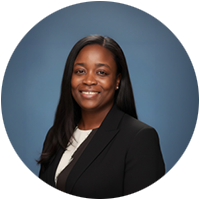
Olawunmi Obisesan, RN, CPHQ, came to the Master of Science in Healthcare Quality and Safety program with nearly two decades of experience in nursing, epidemiology, research, and quality improvement. What she did not expect was how quickly the program would challenge some of the fundamental ways she thought about quality improvement and patient safety projects.
Obisesan is the senior clinical program manager for research and outcomes in Patient Care Services at Barnes-Jewish Hospital in St. Louis, where she works as a nurse scientist and research leader. Her work combines clinical nursing, population health, research, and data analytics to address preventable harm and to improve care delivery across complex health systems.
Before entering the program, she had also worked extensively in public health and population health/outpatient quality improvement, where many of the measures focused on prevention science: screenings, preventing readmissions, and whether patients could easily access the services needed to keep them healthy and out of the hospital.
Moving more deeply into inpatient quality and safety introduced a different set of questions. As an epidemiologist and researcher, Obisesan was accustomed to approaching data through statistical significance, sample size, confounding variables, and predictive models. Quality improvement sometimes used data differently, with an emphasis on measurement over time and rapid changes in practice.
“I would ask, ‘What are the confounding variables? How do you predict that? You can’t just pick that number,’” Obisesan recalls. “And people would say, ‘Well, it’s just data for measurement.’” Eventually, she realized that understanding the field on its own terms required more training.
“I said that I need to get some training in quality improvement so I can better understand what people are telling me,” she says. When someone suggested that she pursue another degree, Obisesan joked that Harvard was the only place that could persuade her to go back to school.
“It was just a joke,” she explains. “My mentor then said, ‘Well, you know, Harvard does have that program.’ And I said, ‘Wait, what?’”
She applied.
Although Obisesan already held the Certified Professional in Healthcare Quality credential, the Master of Science in Healthcare Quality and Safety offered the opportunity to deepen her understanding of inpatient quality improvement and to learn from faculty with extensive experience putting improvement science into practice. “If I’m going to torture myself to go back to school, then why not just learn from the best of the best?” she asks.
Because she is completing the program part-time, Obisesan has remained in her leadership role at Barnes-Jewish Hospital throughout her studies. With the support of her hospital system leadership, she has been able to integrate graduate coursework into a demanding professional schedule. More importantly, staying at work has given her somewhere to use what she learns almost immediately.
During an early class, Obisesan learned about the Swiss cheese model of accident causation, which illustrates how harm can occur when weaknesses within multiple layers of a system align. Within hours, she found herself discussing the model at work. The concept also prompted a significant change in how she approached preventable harm projects.
“I’ll be honest,” she says. “I was one of those people that when things happen—maybe someone gets hurt on the job, or a patient gets hurt, or they fall—I would begin to look at, ‘Who is this nurse taking care of this patient? What did they do wrong?’”
The program challenged her to look elsewhere. “This class has taught me it’s not about the individual,” Obisesan says. “We need to look at the process. What in that process failed them?” Rather than asking only who made an error, she began examining how staffing, workflows, technology, communication, policies, and other conditions might have made that error more likely.
“If you don’t fix that process, then it becomes a Swiss cheese model,” she says. “There’s a gap, and then there’s another gap, and there’s another gap.” That systems perspective now shapes Obisesan’s work every day.
She has also incorporated frameworks taught by Anjala V. Tess, MD, into quality improvement projects across her health system. Tess’s approach to identifying risk and considering the human factors involved in improvement work has become particularly useful as Obisesan balances her background in advanced statistical analysis with the practical needs of frontline clinicians.
“I do a lot of logistic regression, linear regression, and all the fun stuff,” she says. “But I’ve learned to do the simple things like the XmR chart and the p-chart, because people understand those better.” For Obisesan, learning how to communicate data effectively has become as important as knowing how to analyze it.
“Bedside nurses appreciate the Shewhart charts more,” she says, “because they provide the answers that they need—what they’re doing and how they’re improving in that process.” That intersection of research, quality improvement, and frontline practice is also driving her capstone project.
As a student in the program’s Clinical Informatics pathway, Obisesan is leading work on a fall predictive model designed to identify hospitalized patients at greater risk of falling. The goal is to make risk information more useful to nurses before an adverse event occurs. “We have to make it easier for nurses to do the right thing,” she says.
Predictive modeling could help care teams proactively identify patients at risk and increase nurses’ situational awareness. But one of the most important lessons that Obisesan has taken from the program is not to begin with the desired technology or solution.
“They don’t want us to have a solution,” she says of the capstone process. “They want us to first identify the risk/problem.” That distinction has shaped the project. Before relying on an existing predictive model in Epic, Obisesan and her team examined the information feeding into it. They identified a more fundamental issue: the list of medications used to assess fall risk needed to be updated.
She is working with her hospital’s multidisciplinary team to develop a Delphi consensus study to bring experts together around an updated medication list. That work will strengthen the underlying data before it is incorporated into the predictive model.
The project brings together many of the areas that Obisesan has spent her career developing: epidemiology, nursing, quality improvement, informatics, implementation, and patient safety. It also reflects the shift toward proactive safety that has become increasingly important to her during the program.
Joseph Jacobson, MD, MSc, serves as her faculty mentor for the capstone. Obisesan had already taken courses with Jacobson when she learned that he would be mentoring her project. “I told him I did a dance when he called me,” she says. Their early meetings have strengthened her confidence in the project.
At Barnes-Jewish Hospital, Obisesan is also working with nursing leadership on the project. Just as importantly, she began engaging stakeholders across the broader BJC Health System before the predictive model was fully developed.
That was intentional. “Harvard teaches you how to negotiate and get stakeholder buy-in from the beginning,” she says. The initial pilot is planned for Barnes-Jewish Hospital, but Obisesan hopes that the work will eventually extend across the health system.
For her, scaling the project is also a question of equity between institutions. A major academic medical center may have nurse scientists, analysts, informatics specialists, and other resources available to develop and evaluate a new intervention. Smaller community hospitals within the same health system may not. Her goal is to build it into Epic, test the approach rigorously at Barnes-Jewish Hospital, and create something the other hospitals can adopt with support from the team that developed it.
The project has also given Obisesan an opportunity to apply another part of the curriculum that she did not initially expect to transform her work: leadership. “I used to think leadership was a one-way street, where you have a type of leadership style and you stick with it,” she says.
Her coursework challenged that assumption. Different teams, organizational conditions, and moments of change require different approaches. “There’s a time where, if you look at the organization and it’s hurting, you take that role of the healer, where you’re actually trying to restore people that month,” she says. “And there’s a time when people just need to be held accountable and you have to change your leadership style to meet that need.”
That ability to adapt has become part of how Obisesan thinks about leading improvement. Technical expertise matters, but implementing change also requires understanding the people in the room, what has happened before the meeting began, who has influence, how to bring stakeholders along, and identifying ahead of time your BATNA (Best Alternative to a Negotiated Agreement) and WATNA (Worst Alternative to a Negotiated Agreement).
One of the biggest surprises of the program, however, had less to do with methodology than with who was sitting beside her in the classroom. On her first day, Obisesan looked around at a cohort that included physicians, surgeons, emergency medicine specialists, and other clinical leaders and wondered where she fit. “What am I doing here?” she remembers thinking. “You’re talking about physicians and surgeons, and I’m a nurse.”
She initially worried that the physicians would share a professional language that left everyone else on the margins. Instead, she found a classroom built around the opposite expectation. “Everybody has a place at the table,” she says.
That experience has reinforced something fundamental in Obisesan’s approach to quality improvement: safer systems cannot be designed from only one professional vantage point. The accessibility of the faculty surprised her as well. “The level of education and the engagement I’ve had with the program has by far been the best I’ve ever had,” she says. “And I have so many degrees, so please know that’s saying a lot.”
For students entering the program, her advice is to arrive prepared to reconsider what their own experience has already taught them. Obisesan entered with years of experience as a nurse, researcher, epidemiologist, and quality improvement professional. But she believes that students get more from the program when they are also willing to examine the approaches that have worked for them in the past.
“The experience matters,” she says, “but for you to be able to learn the content and use it the right way, you have to unlearn what you think you know.” For Obisesan, that willingness has changed everything, from how she analyzes quality data to how she leads teams and responds when something goes wrong. “You may experience feelings of imposter syndrome for a week or two,” she explains. “However, over time, you’ll start to develop a sense of belonging.’”
Even before completing the degree, she can already see its influence in the work happening around her: in the charts that nurses use to understand their progress, in the conversations about adverse events, in a predictive model being built to prevent patient falls, and in a growing habit of looking beyond the individual whenever a system fails.
Written by Bailey Merlin