Understanding Health Through a Social Justice Lens
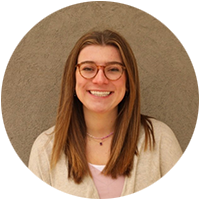
Long before Cecilia Needham entered the Master of Medical Sciences in Global Health Delivery program at Harvard Medical School, she had been thinking about the relationship between health, poverty, and social justice.
Needham first traveled to Haiti in 2015 through a partnership between her high school and a sister school in the country. During the trip, she visited a Partners In Health hospital and read Mountains Beyond Mountains, Tracy Kidder’s account of the work of physician and anthropologist Paul Farmer, MD, PhD. The experience became the beginning of a much longer relationship with Haiti and global health.
As an undergraduate at Middlebury College in Vermont, Needham studied international and global studies and global health, completing an independent study on mutual aid and self-determination in Haiti as well as an honors thesis examining state and nongovernmental organization health care services in the country.
After graduating, she joined Build Health International, a global health infrastructure nonprofit, where she worked in development, communications, and partner relations. Needham soon realized that she wanted to move closer to the research and program implementation side of global health. “I knew that meant going back to school for a master’s degree,” she says.
As Needham considered graduate programs, she was drawn to Global Health Delivery because of its grounding in social justice and health equity, as well as its emphasis on field-based research. Co-founded by Farmer and Joia Mukherjee, MD, MPH, the program offered an approach to global health that aligned with the questions that she had already been asking through her work in Haiti.
For Needham, a defining feature of that approach is the insistence on looking beyond an immediate diagnosis to understand the conditions that produced it. “If a patient has tuberculosis, why do they have tuberculosis?” she asks. “Maybe their living conditions are crowded and they’re malnourished. The traditional social determinants of health model attributes these risk factors to poverty, but our program asks, ‘Well, why is this family poor?’”
That additional question changed the way that Needham thought about global health.
“The first year, you’re deep diving into the history and political economy of your subject,” she says. “It gives us such an intimate understanding and appreciation for the situation that our research is focused on.”
Just as important for Needham was the opportunity to put that thinking into practice. The program prepares students in research methods before they leave Harvard to conduct mentored thesis research in the field, where they collect and analyze primary data in partnership with host organizations and communities.
Needham initially expected that fieldwork to take her back to Haiti. Working with Mukherjee as her primary mentor, she planned to conduct her thesis research with Partners In Health. As escalating gang violence reached Haiti’s Central Plateau, however, the project was no longer feasible.
Needham and Mukherjee considered alternatives, including conducting research virtually or shifting the project to the United States. Instead, they decided that the field experience itself remained important to her professional development.
“I hadn’t had as much field experience as a lot of my colleagues,” Needham says. “Joia and I agreed that it would be a valuable experience.” That decision took her to Neno, Malawi, where she joined Partners In Health’s sister organization Abwenzi Pa Za Umoyo (APZU).
As Needham prepared for Neno, she deliberately chose to not approach the team with a predetermined research topic. “I had no experience working there, so I wanted to answer a question that the APZU team would find useful,” she says.
Mukherjee introduced her to the team as a student who wanted to learn and conduct research but was open to studying whatever would be most useful locally. Through those conversations, Needham learned about the challenges surrounding Malawi’s outpatient malnutrition treatment program.
“It was definitely a co-design,” she explains. “They said, ‘This is a problem that we’re having. The Ministry of Health has this outpatient malnutrition treatment program, but it could be improved and we’d be interested in learning how we can support that.’”
The question became the foundation of her thesis, “The Invisible Cost of Care: Facilitators and Barriers in Outpatient Malnutrition Treatment in Neno, Malawi.” Her mixed-methods study examined treatment outcomes alongside the socioeconomic barriers that caregivers encountered while trying to access care.
Malnutrition had not previously been Needham’s area of focus. Once she began studying it, however, she saw how closely it aligned with her broader interests. “Malnutrition is a social justice, social science, and public health issue,” she says. “Most of the time, a child is malnourished because of poverty and social injustice. It’s not a disease you catch.”
Needham originally planned to spend approximately three months in Malawi, but stayed for seven months. Her research became deeply collaborative. She worked with health surveillance assistants who conducted quantitative data collection after training on the study tool. Members of the research and nutrition teams helped develop the study, navigate government protocols, and establish relationships at research sites.
The experience also challenged Needham to think about what responsibility researchers have to the people participating in their studies.
When interviews revealed that some participants had been lost to follow-up or needed a higher level of care, Needham and nutrition program coordinator Charles Marshall worked to connect them with health services or social support programs. “It’s not required by the Institutional Review Board,” she says, “but we both felt it was important.”
Those moments reflected the values that had initially drawn her to the Global Health Delivery program: research was not separate from the lives of the people it was intended to serve. “I remember in a check-in meeting with Joia, I shared that Marshall and I were doing this, worried that it might ‘confound’ our results. But Joia completely agreed with our convictions and approach, she too advocates against ‘impartial’ research.”
Life outside the formal research process proved equally educational. “I felt so welcomed by the community,” Needham recalls. “I learned so much through informal conversations on walks or sharing food. The Malawians are known as the warm heart of Africa, and that’s a very apt description. I feel so grateful for my friends in Neno, our research team, and APZU’s support.”
The field experience gave Needham a new appreciation for the complexity of producing global health research. Conducting primary data collection, navigating protocols, working alongside community partners, analyzing findings, and eventually writing a thesis revealed the enormous amount of work behind the research that she had previously encountered primarily as a reader.
“Thesis research is difficult,” she says. “I have a new level of appreciation for what goes into every manuscript that you’ll read in a journal.”
Although Needham entered the program expecting to learn from classmates who had spent years working in health systems around the world, she did not anticipate how profoundly their experiences would shape her own thinking.
Listening to classmates during discussions and building relationships outside the classroom prompted her to reflect more deeply on the role she plays within global health. “I learned so much from them,” she says. “I did a lot of self-reflection on my positionality in global health and feel assured as an ally and ‘accompagnateur’ of those doing the work in low-resource settings”
Now back in the United States, Needham is the development manager at the Institute for Justice and Democracy in Haiti, an organization whose work she has followed for years. Alongside her development responsibilities, she supports advocacy efforts focused on protecting Temporary Protected Status for Haitians living in the United States.
Still, her experience in Malawi continues to shape where Needham hopes to go next. “I loved my time in Malawi,” she says, “and I’m eager to get back there to implement our lessons learned and build upon that research.”
Ultimately, Needham hopes to either continue her studies in a PhD program or move into a research or program-focused role where she can continue examining health through the questions Global Health Delivery taught her to ask: not simply what illness a patient has, but what social, political, and economic conditions placed that patient at risk in the first place.
For prospective students interested in doing the same, Needham highlights the program’s combination of research training, field experience, and commitment to equity as distinctive. “If you’re interested in global health or public health through a social justice and equity lens, this is definitely the program for you.”
Written by Bailey Merlin