
Building the Future of Neurotrauma Research
Student Perspective | February 18, 2026
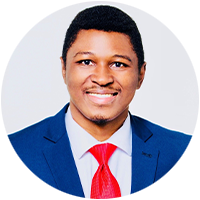
From an early age, Jerry Adie, MD, knew that medicine would shape his future. Raised in Nigeria, Adie grew up drawn to the science and service of health care, inspired in part by his family’s physician. By the time he finished high school, Adie was committed to pursuing a medical career—a decision that ultimately led him to the United States and to his current work as a physician specializing in neurotrauma.
As he began to think seriously about postgraduate education, Adie set his sights on Harvard Medical School. “I’ve always seen Harvard as a melting pot of the best and brightest—some of the most hardworking people in the world,” he says. “I knew that I wanted to be part of that environment.”
When Adie learned about Harvard Medical School’s new Master of Science in Clinical Research, he immediately recognized it as a unique opportunity. The program’s emphasis on clinical trial design aligned directly with his professional goals, and the chance to join the inaugural cohort made the experience even more compelling. “I was excited to be part of something new,” he says. “This program equips students with the tools they need to become independent researchers, and that was exactly what I was looking for.”
Among the programs he considered, Harvard’s stood out for its depth of expertise and scholarly leadership. “The quality of clinicians and researchers at Harvard is very rich, and they are extremely prolific in their specialties,” Adie explains. “Harvard has everything a growing researcher would need to build a strong foundation for advancement, no matter their clinical focus.”
He also appreciated that the Master of Science in Clinical Research is well suited for early medical school graduates, including international medical graduates transitioning into clinical practice in the United States. Designed to be completed at the beginning of residency, the full-time one-year program fits seamlessly into this training path.
Being part of the first cohort has given Adie and his classmates a unique voice in shaping the program as it evolves. He has been particularly energized by the faculty, many of whom serve as editors for leading medical journals while also teaching courses on clinical research methods and grant writing. Coursework in clinical trial protocol development, systematic reviews, artificial intelligence, and therapeutic development has helped him sharpen his research skills, while leadership-focused classes have broadened his professional perspective.
Leadership courses are integrated into the curriculum. “Overall, the themes of the courses sufficiently prepare students to analyze medical literature and develop insights that can be turned into original research questions.”
Outside the classroom, Adie has taken on significant leadership responsibilities as president of the Harvard Medical School Master’s Student Council. Advocacy has long been important to him—a passion he traces back to his early school years—and this role has allowed him to work closely with faculty and students across the medical school. Through the council, he has helped foster a supportive, collaborative community that ensures students have access to resources, particularly during times of vulnerability.
“We’ve built a family that will advocate for and support one another,” he says. “It’s great to be part of such a strong community.”
For his capstone project, Adie is focusing on advancing precision medicine approaches to optimize functional recovery in neurotrauma patients. His work explores the use of neuroprosthetic brain–computer interface technology to help individuals with traumatic brain or spinal cord injuries regain autonomy and improve quality of life.
“There’s a significant clinical challenge—these patients need a novel standard of care that isn’t widely available,” he explains. “Brain–computer interface technology can help patients type on a computer, relearn how to walk, regain vision or speech, and achieve greater independence, while also supporting their caregivers.”
With limited expertise in this area currently available in the United States, Adie is grateful to be conducting this work at Harvard, surrounded by mentors and collaborators who can help take the research to the next level.
Adie also values the global diversity of his cohort. “There are people from all parts of the world, all with a track record of working hard and functioning at a high level,” he says. “It’s been a very cohesive class.” Social events and cross-program interactions have created opportunities to exchange ideas and learn from peers across Harvard Medical School.
After graduating in May 2026, Adie plans to continue advancing his clinical research, with the long-term goal of establishing an independent research laboratory at UC San Diego Health.
His advice for prospective students is straightforward: be prepared to work hard—and take full advantage of everything Harvard has to offer. “Expand your network while you’re here,” he says. “There are so many opportunities to collaborate with faculty and other students.”
Looking ahead, Adie knows that he will reflect fondly on his time in the Master of Science in Clinical Research. “Any physician who goes through this program will come out equipped with all the tools needed to perform clinical research at the highest levels,” he says, “along with a network of professional relationships that will last well beyond graduation.”
Written by Lauren Young