Earning an MD at Harvard Medical School doesn’t end in the classroom or clinic. Students also learn to conduct research that pushes medical science ahead, whether in basic research, clinical or translational science, or the compassionate and just delivery of health care.
On March 12, 70 MD students mentored by HMS faculty presented the results of their projects at the 84th annual Soma Weiss Student Research Day.
Classmates and faculty gathered in the School’s TMEC amphitheater to hear a select group of podium presenters. Afterwards, the sun shone down through the Atrium glass and onto the poster session. A loud murmur spread throughout the room as students described their projects and attendees asked questions.
HMS Dean for Medical Education Bernard Chang, who was not able to attend the event in person, began the event with a prerecorded welcome.
“If you’re like me, you’re going to be amazed at the research that our students have accomplished, all while here as medical students,” he said.
Poster session judge Lisa Iezzoni, HMS professor of medicine at Massachusetts General Hospital, said that the diversity of projects presented was staggering.
“It’s a delight to see young minds so energized and thinking about the future,” she said.
“Some of the students were confronting socially sensitive topics, and I thought that showed a lot of empathy and willingness to confront some of society’s greatest issues,” she added.
Research poster sessions
Student Priya Amin presented on how health care teams speak with cancer patients and how patients understand what is being communicated.
“I really like understanding the soft side of medicine, because it is just as important as giving somebody chemo,” she said.
Amin said she would like to pursue palliative care and noted that her research experience helped her decide what cancer-related specialty she wanted to pursue.
Drhuva Gupta, who pursued his project with HMS researchers at Mass Eye and Ear, said the most exciting part of his experience was combining his interests in AI and ophthalmology.
In their project, Gupta and his colleagues challenged the notion that vision loss caused by glaucoma is irreversible. The team suggested that vision can improve because of the brain’s neuroplasticity.
While more studies need to be done, Gupta said the implications of this work could extend to better glaucoma diagnosis and treatment.
Rohan Jha has his sights set on being a neurosurgeon and worked with his mentor to study the placement of electrodes in patients who might need surgery for epilepsy. They developed a mathematical model to assess electrical stimulation in the brain.
Jha hopes to continue investigating structural and functional connectivity in the brain.
“It’s only a one-year research experience for me, but I think it’s truly advanced me so much further in my journey to becoming a researcher-physician,” he said.
Later, Jha learned that he’d been awarded the Judah Folkman Prize for Clinical/Translational Research for his poster during the awards presentation at the end of the day.
Look for more Research-in-a-Minute videos from Soma Weiss Research Day on the HMS Instagram channel.
An award for innovation
Some students focused on everyday issues encountered in the clinic.
For his project, Mario Russo designed a device that would save medical staff from replacing dislodged drainage catheters, which happens 10 to 30 percent of the time, he said.
“We set out to solve a simple problem,” Russo said, “and we created a simple solution.” The device “just disconnects, there are valves on both sides so fluid doesn’t go everywhere, and the patient or provider can simply reconnect it, restart the device, and restore proper function.”
Russo received the 2024 Martin Prince Award for Student Innovation for his work and spoke to the audience in the amphitheater before the four podium presentations.
Oral presentations
Four students were selected to give podium presentations of eight minutes each with accompanying slides.
Blake Hauser spoke about her study of human protein structures with the aim of understanding inherited retinal disease.
Matthew Parsons focused on medical education, creating and evaluating a model where third- and fourth-year MD students teach second-year students entering the core surgery clerkship.
An HMS and a family tradition
The School’s first research day was co-organized by HMS teacher and physician Soma Weiss in 1940. It was named in Weiss’s honor after he died suddenly from a brain aneurysm in 1942.
“He was an extraordinary mentor and friend to students,” said Jeffrey Katz, director of the HMS Scholars in Medicine program.
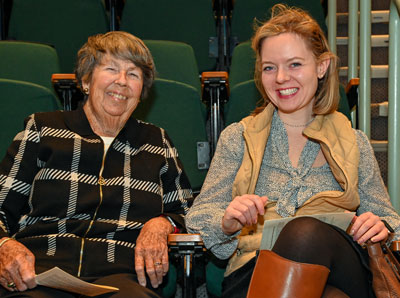
Members of the Weiss family often attend the event in remembrance of Soma Weiss. This year, Weiss’s daughter-in-law, Joyce DiBona, attended with her granddaughter and Weiss’s great-granddaughter, Allyson Bergeron.
“It’s really nice to be grounded in the roots of our family,” said Bergeron. “Plus it’s excellent to be able to support up-and-coming researchers and see the new work being done on the cutting edge of science.”
Soma Weiss Research Day Honors and Poster Prizes
All student presenters and awardees this year:
2024 Martin Prince Award for Student Innovation
- Mario Russo, DrainStay: A Novel Medical Device that Prevents the Ubiquitous Dislodgement of Drainage Catheters
2024 Soma Weiss Student Research Day podium presenters
- Ruby Guo, Chemogenetic Oxidative Stress in Utero: A novel model of neonatal heart failure
- Blake Hauser, Structure-Based Network Analysis Predicts Pathogenic Variants in Human Proteins Associated With Inherited Retinal Disease
- Michael Liu, Neighborhood Environmental Burden and Cardiovascular Health in the United States
- Matthew Parsons, Medical Students as Surgical Educators: A near-peer teaching program for the core surgery clerkship
2024 Soma Weiss Student Research Day poster award winners
Elizabeth D. Hay Prize for Basic Science Research
- Jules Albritton-King, A Novel Perfused Cardiac Organoid System to Define the Impact of Vascular Dysfunction in Heart Disease
- Runner-up: Ruby Guo, Chemogenetic Oxidative Stress in Utero: A Novel Model of Neonatal Heart Failure
Judah Folkman Prize for Clinical/Translational Science Research
- Rohan Jha, Low Voltage Stereoelectroencephalography (SEEG) Stimulation Suggests Recorded Intracranial Signals and Cortico-Cortical Evoked Potentials (CCEPs) Are Often Artefactual Echoes of Each Other
- Runner-up: Jean Filo, Conservative Medical Therapy Is a Safe and Effective Primary Treatment for Extracranial Carotid and Vertebral Pseudoaneurysms
Robert Ebert Prize for Health Care Delivery Research or Service
- Laboni Hoque, Expansion of the Health Champions Program
Charles Janeway Prize for International Research or Service
- Donald Fejfar, The Impact of COVID-19 and National Pandemic Responses on Health Service Utilization in Seven Low- and Middle-Income Countries
Leon Eisenberg Prize for Medicine in Society Research
- Julia Beatini, #GenderAffirmingHormoneTherapy on TikTok: An analysis of content and health information reported on social media
- Runner-up: King Fok, Representation in Leadership: A parity analysis of gender and racial/ethnic diversity of department chairs in academic psychiatry
Images: Steve Lipofsky. Videos: Rick Groleau