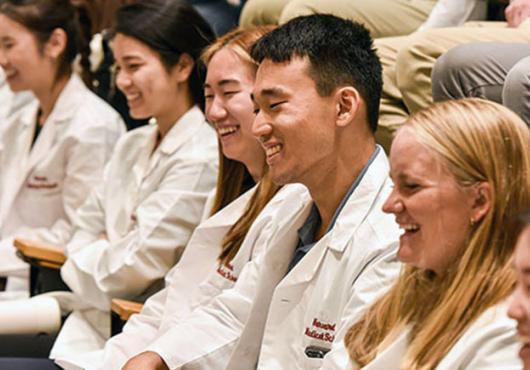
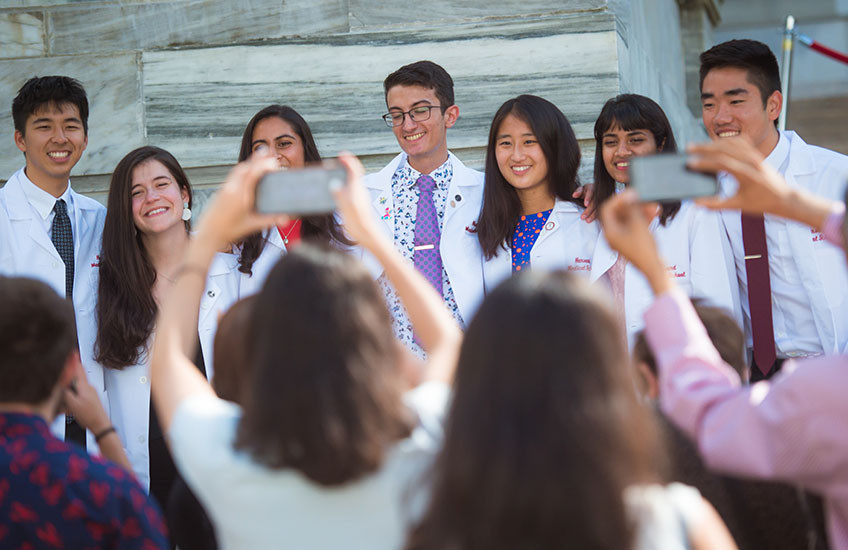
At the start of each academic year, entering students at Harvard Medical School, Harvard School of Dental Medicine, and many other health professional schools in the United States and abroad receive a white coat at an event known as a white coat ceremony.
Usually held during the first week of medical school, the festivities involve students putting on their new coats and introducing themselves to their classmates. Friends and family also attend to celebrate the hard work it took to get there.
But white coat ceremonies are not just feel-good affairs. They may vary in format at different institutions, but the act of putting on the coat is universally a symbolic rite of passage.
It signifies a moment of transition when students take their first steps wearing their identity as medical professionals, physically and figuratively, said Edward Hundert, former HMS dean for medical education and current senior lecturer on global health and social medicine.
Origins of the white coat
For more than 100 years, the white coat has symbolized the commitment doctors make in service to humankind and in taking on the responsibility to care for people’s health and well-being.
But doctors’ attire hasn’t always been white. Before the beginning of the 20th century, doctors wore black, partly because it was associated with formal and solemn occasions.
After 1900, doctors (and nurses) began wearing white in response to medicine becoming grounded in science and to a growing understanding of the role of microorganisms in disease, which led to an emphasis on cleanliness.
Steadily, the white coat became the doctor’s uniform and a sign of medical expertise.
Although the clean, starched linen can evoke respect, it can also project an austerity that makes some patients apprehensive. There is even a phenomenon known as “white coat hypertension” in which patients’ blood pressure rises at the doctor’s office. Some practitioners, including most pediatricians and psychiatrists, no longer wear white coats to try to alleviate such anxiety.

Today, medical schools are teaching and more clinicians are practicing patient-centered care, which emphasizes kindness, trust, more equitable relationships between doctors and patients, and joint decision-making, with the goal of reducing patients’ anxiety and further empowering them to take charge of their care.
It is all part of a complex and evolving understanding of what the white coat means to those who wear them and those they care for.
Origins of the white coat ceremony
White coat ceremonies are a relatively recent tradition.
In 1989, the University of Chicago Pritzker School of Medicine held the first formal white coat event. Then the Arnold P. Gold Foundation, which champions humanism in medicine, collaborated with what was then known as the Columbia University College of Physicians and Surgeons to hold a white coat ceremony there.
The Gold Foundation advanced the idea at other medical schools, and it was quickly taken up. Today, the custom has become established across the United States and many countries around the world.
From the start, the ceremonies have included the new students reciting an oath to care for their patients.
Previously, the Hippocratic oath had been recited only at graduation when the students became licensed doctors. But because medical students begin seeing patients within the first few weeks of their education, educators began to realize that this recitation was four years too late to take such a vow, Hundert said.
“They are hearing patients’ confidences and should have already pledged themselves to the values of confidentiality, truth-telling, informed consent, and the rest at the start of medical school, before interacting with patients in a professional capacity during their first year,” said Hundert.
Origins of the white coat ceremony at HMS
HMS held its first white coat ceremony in 1994, when Hundert was associate dean for student affairs.
From the beginning, the white coats have been a gift from the HMS alumni Aesculapian Club, which is dedicated to improving student life and building community.
Like the first ceremonies at Pritzker and Columbia, the entering class of Harvard medical and dental students received their white coats, got acquainted, and recited an oath — but it was an oath the class itself wrote, a practice unique to HMS at the time.
The practice of each class writing their own oath carries on to this day. The class selects a committee, which is provided with the Hippocratic oath, “Physician’s Pledge,” “Physician’s Prayer,” and other historical oaths to reflect on and draw on for inspiration.
By donning their white coats and making a pledge to their patients at the start of medical school, the students begin to think about and internalize the privilege, and burden, that comes with the responsibility of caring for others, Hundert said.
“Just by virtue of seeing you walk in wearing that white coat, a patient may start telling you things that sometimes they haven’t said to some of the people closest to them,” Hundert added.
Growing into the white coat
The HMS and HSDM Class of 2030 will don their white coats on August 3, 2026, at orientation. During their first week, they will write their oath to patients and recite it together on August 7.
When they graduate, they will recite another oath which the fourth-year class composes for Class Day, to send them off as they begin their life’s work.
But for now, during their medical school training — when they meet patients, listen to them, and become part of their care teams — the white coat will embody their development as they learn the art, science, and humanism of being a physician or dentist.
Photos from the 1994 ceremonies courtesy of the Harvard Medical Library collection, Center for the History of Medicine in the Francis A. Countway Library of Medicine, Harvard University.