This is one in a series of profiles featuring Harvard Medical School’s remarkable graduates.
The stories we tell, and the stories we hear, are like the threads of a tapestry. Made with care, the fabric can connect people from different places and different experiences, united by their shared humanity.
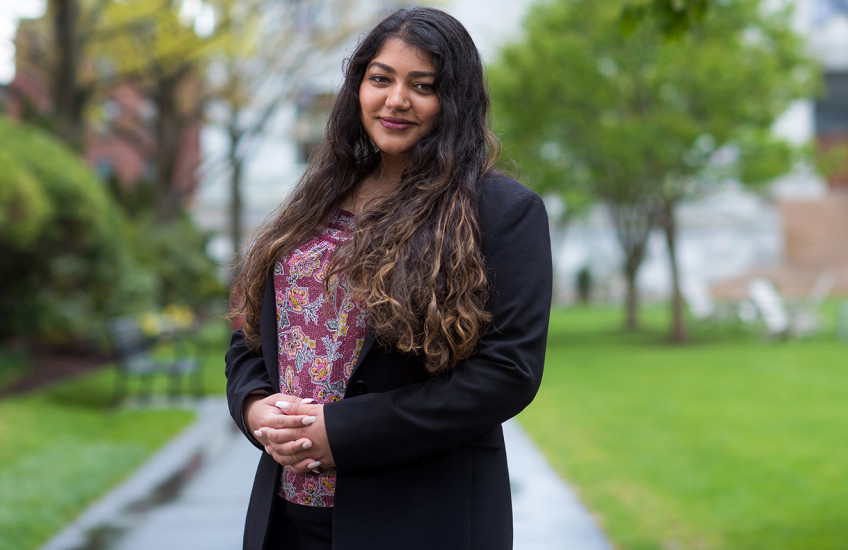
Stories also have the power to heal, according to Ramya Chunduri, a clinical social worker, writer, and dancer trained in classical Indian dance.
For Chunduri, who will receive her master’s degree in Media, Medicine, and Health from Harvard Medical School on May 25, all of the different forms of her work revolve around different forms of shared stories.
During second-year field placements for her degree in advanced clinical social work from Columbia University, Chunduri worked with children who were being treated for chronic diseases and terminal illnesses. She was taken aback at the number of families that were also experiencing domestic violence.
Chunduri, who was born in the U.S. and identifies as South Asian, found the level of domestic violence among members of her community especially startling.
Science. Medicine. Humanity.
Harvard Medicine magazine delivered to your inbox
The South Asian population in the U.S. is one of the fastest growing ethnic groups in the country. This group inludes people who emigrated from or can trace their lineage to India, Pakistan, Bangladesh, Sri Lanka, Bhutan, and Maldives, including those whose families were also previously migrants to places like Africa, the Caribbean and the Middle East.
Studies have found that 40 percent of South Asian immigrant women in the U.S. report experiencing intimate partner violence, which is strikingly high compared to the 20 percent average lifetime prevalence overall in the country.
So, Chunduri began to explore the social and cultural dimensions of the physical, emotional, sexual, and financial violence she was seeing. She also began working with a South Asian community organization in Washington, D.C., with a focus on domestic violence.
When Chunduri learned that physician-showrunner Neal Baer, HMS lecturer on global health and social medicine and Jason Silverstein, a lecturer in the Department of Global Health and Social Medicine in the Blavatnik Institute at HMS who has written extensively about the cultural, social, and economic aspects of health, were launching a new degree program at HMS that might help her find ways to combine her passion for storytelling and her commitment to healing, she was thrilled.
“Creativity and community are two of the most important tools we have to help people live healthier, better lives,” she said.
Students in the media and medicine program must complete a capstone project that combines research and media production.
For hers, Chunduri researched the social, economic, cultural, political, and legal elements of domestic violence among South Asian people in the U.S. and then produced a video project that she hopes will be the first in a series of outreach and training tools to help both those who are experiencing domestic violence and the people trying to care for them.
One of her goals is to help women affected by domestic violence realize that they have tremendous reserves of power, resiliency, and boldness within themselves.
The way a person’s stories are framed can make a tremendous difference in how they perceive their own experiences, Chunduri noted. Depending on how a tale is told, a person some might call a victim can become a survivor, and someone who was suffering might turn into someone who can start to heal, she said.
Culturally sensitive communications tools can help ensure that important messages about domestic violence (and other health challenges) reach their audiences, she said, offering her belief that outreach efforts that use familiar imagery, sounds, and themes may help overcome the sense of stigma and shame that often prevents people experiencing domestic violence from seeking or accepting help.
Training tools that touch on the social and cultural elements of domestic violence unique to South Asian communities can also help caregivers who don’t have personal roots in the culture to better understand how to work in the community, Chunduri said.
For the creative element of her capstone project, Chunduri learned how to produce an animated film and created a short video that combines stop motion clay animation and simple animated line art of an Indian dance, superimposed on lush color-pencil-drawn backgrounds.
Floating on top of the images, traditional Indian music provides the accompaniment for a voiceover narration that tells the story of a 16-year-old betrothed to a man in an arranged marriage. As the years go by, the protagonist feels her identity disappearing, her individual character replaced by roles as wife and mother.
Chunduri said that her captsone film will grow into the first project for Saurya Media, a company she launched and hopes will become a place for long-term healing in the aftermath of violence, with resources for survivors and care providers. Plans are in the works to produce a live Indian classical dance ballet in New York City in 2024 in collaboration with South Asian dancers and survivors, she said.
The production will include two versions, she said. The live action version will bring together audiences to engage with the material in real time. There will also be a narrated, animated version that will serve as a training tool for providers, as well as an opportunity for survivors who want to share their story to take part in the process, but remain anonymous. They can learn dance and animation and be involved in the production. Survivors can participate in the live version if they choose to.
While studying at HMS, Chunduri has continued working as a therapist, supporting people dealing with domestic violence, complex medical situations, and other challenges.
“I love my work because of the people I get to know,” she said.
“I have the privilege of bearing witness to their lives,” Chunduri said. “Sometimes, as a therapist, you don’t even have to say anything. It’s enough for people to know that you care enough to listen.”
These ideas align with the work of the HMS Department of Global Health and Social Medicine, which is home to the masters in media, medicine, and health program.
The late Paul Farmer, who was chair of the department until his death in 2022, coined the term “accompaniment” for relationship-based care, and believed that what he called “reverent listening” was a crucial element of all health care delivery and a movement toward a more just world.
Chunduri was initially inspired to become a clinical social worker based on her experiences as a patient care technician for a community health system in Indiana, after she graduated from college.
The nature of that work gave her plenty of time to spend with patients, to hear their stories, and to bond with many of them.
She recalled one patient who was about to be discharged following surgery talking about how unlikely it was that he would be able to follow the recommended infection control protocols because he didn’t have any good options for housing.
“I remember him saying, they stitch you up and send you home; they don’t care about how you’re doing. That really stuck with me,” she said.
It’s important for everyone to remember that patients are more than just their injuries or their illnesses, Chunduri added.
“If we pay attention to what they’re saying, and try to understand where they are coming from, we can do a better job of taking care of them,” she said.
“I’ve learned so much from my patients and from my community, and I hope my films and my stories can amplify those voices and share those stories, to help make all of our lives better.”