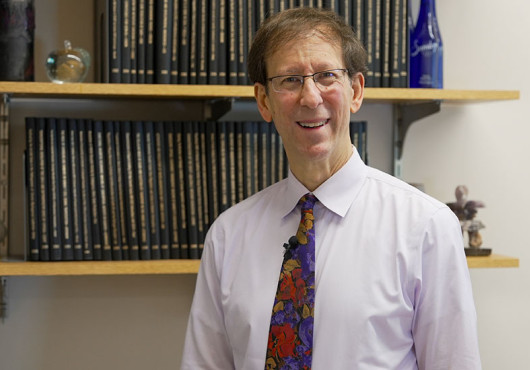
Ati Alipour joined the Harvard Ombuds Office in Longwood this past July. As an ombuds, Alipour serves as a neutral, independent resource for Longwood Medical Area community members —including those at Harvard Medical School — who are navigating complicated, sometimes difficult work situations.
MyHMS chatted with Alipour about the services the office provides, when people might find it helpful to reach out to an ombuds, and her fondness for Atticus Finch.
MyHMS: What brought you to your work in the Harvard Ombuds Office at HMS?
Alipour: Prior to joining HMS, I served in the Ombuds Office at Cornell University and worked at the Office of the Ombudsman for United Nations Funds and Programmes, serving several United Nations agencies globally.
My path to ombuds work grew out of my early career as a practicing attorney. Over time, I transitioned to alternative dispute resolution (ADR), including mediation and arbitration. The more I facilitated these processes, the more clearly I saw how effective these collaborative approaches and procedures are compared to traditional court hearings.

As I continued this work, making the shift to becoming an ombuds felt like a natural progression in my career. While I loved mediation, I wanted to engage with organizations on a deeper level. In an ombuds role, I get to know an organization very well and can positively affect organizational improvement or policy changes by providing constructive, upward feedback.
MyHMS: What do you find most rewarding about serving as an ombuds?
Alipour: What I find most rewarding is contributing to a genuine sense of community within the institution.
Beyond that, it is incredibly fulfilling to know that the skill sets people learn through our training sessions, one-on-one meetings, or facilitated conversations are tools that remain useful in all aspects of their lives. Visitors leave our office with a better toolkit to predict, prevent, navigate, and manage conflict whenever it arises.
MyHMS: For those who may be unfamiliar with the Ombuds Office, what is its role, and how does it support members of the HMS community?
Alipour: The Ombuds Office serves as an independent, impartial, informal, and confidential resource for the entire community. We support faculty, staff, students, and trainees at HMS, the Harvard School of Dental Medicine, the Harvard T.H. Chan School of Public Health, and anyone with a Harvard appointment at one of our affiliated hospitals and institutions.
Many people assume you only reach out to an ombuds when there is an active, major conflict, but we often act simply as a safe sounding board or thought partner. Whether someone is facing a communication breakdown; navigating a workplace, ethical, or academic dilemma; or simply looking to talk through options before taking next steps, we are here to help them think through their situation in a safe, off-the-record environment.
MyHMS: What are some common concerns that bring people to the Ombuds Office? Are there situations in which someone might not realize that an ombuds could help?
Alipour: Common concerns run the spectrum — from interpersonal disputes between lab members and principal investigators, faculty colleagues, or peers to questions involving authorship, workplace transitions, communication, or Title IX matters.
People often don’t realize that the Ombuds Office can be used in parallel with other resources. Because our services are confidential, we do not report to or participate in any formal processes. However, if a situation warrants a formal proceeding or specialized institutional support, we help connect individuals with the appropriate resources and offices across HMS and Harvard, guiding them through all available options — including formal ones — so they receive full support.
MyHMS: Some people may hesitate to contact the Ombuds Office because they aren’t sure their concern is serious enough. What would you say to someone who is unsure whether to reach out?
Alipour: I often look at conflict through a preventative lens, much like medicine. We wouldn’t tell someone, “Your cholesterol isn’t high enough for a heart attack yet, so let’s wait a bit longer to take action.” Why should we treat interpersonal or academic challenges any differently?
It is always easier to learn how to swim with a lifeguard in a calm pool than when you’re struggling in open water. Reaching out early allows us to prepare and address potential issues before they escalate. Even if there is no active conflict but you anticipate an upcoming issue, coming in early to talk through your approach is one of the best steps you can take.
MyHMS: What should someone expect when they first contact the Ombuds Office? What does a typical conversation look like, and how might you help someone explore their options?
Alipour: The process begins when someone calls or emails our office to set up an appointment with one of our ombuds. In our initial conversation, we start by explaining the core principles of our office — confidentiality, impartiality, independence, and informality — and answering any questions regarding our role.
From there, visitors are invited to share as much or as little as they feel comfortable. Through careful listening, a typical conversation is centered on identifying the issues, clarifying goals, and collaboratively exploring next steps — whether that means acting as a sounding board, coaching through a difficult conversation, explaining institutional policies, or helping map out alternative paths forward.
MyHMS: As you settle into your new role, what are you most looking forward to about being part of the HMS community?
Alipour: In my first few months here, I have already experienced a remarkable sense of community and warmth. I have been deeply impressed by how well-connected and collaborative the various offices and resources across HMS and the broader community are. As I settle in, I look forward to further integrating into the community, strengthening those collaborative relationships, and learning even more from the talented faculty, staff, trainees, and students who make this institution so vibrant.
MyHMS: What do you enjoy doing outside of work?
Alipour: I love spending time exploring art galleries and admiring fine art, especially paintings. I also play the violin — very much at an amateur level, but purely for the joy of it — and practice yoga regularly. I also enjoy playing pickleball, though I haven’t had as much time to play as I’d like!
MyHMS: If you could meet any fictional character, who would it be, and why?
Alipour: I would love to meet Atticus Finch from To Kill a Mockingbird. As someone whose career started in law and evolved into dispute resolution, I’ve always admired his unwavering integrity, deep empathy, and ability to remain a calm, principled voice of reason under intense pressure. His philosophy — that you never really understand a person until you consider things from their point of view and walk in their shoes — is a timeless perspective that resonates deeply with the core of ombuds work.
This conversation was edited for length and clarity.