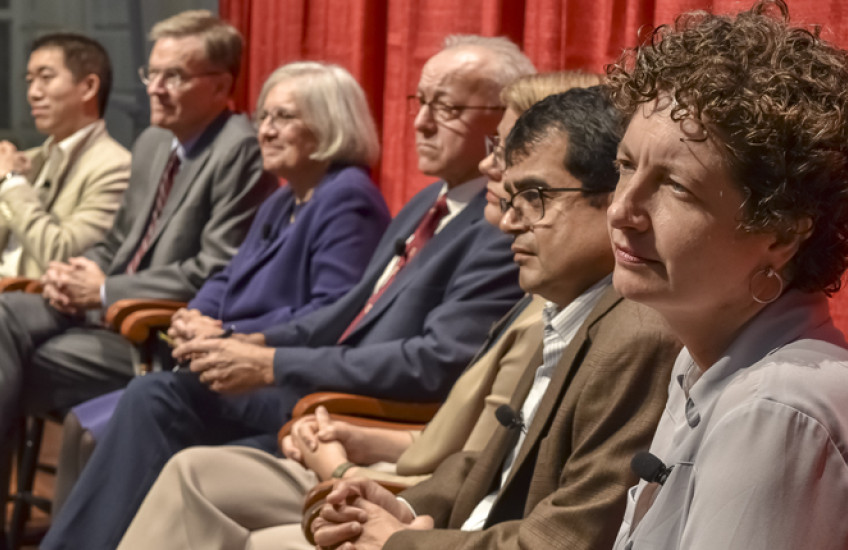
As part of the celebration of Lawrence Bacow’s inauguration as Harvard University’s 29th president, six world-renowned life scientists from across the university came together to discuss their vision for what is possible in life science, medicine, global health and care delivery in an Oct. 5 symposium, “Life Sciences and the Future of Medicine.”
The panel, moderated by Harvard Medical School Dean George Q. Daley, presented work that spanned the spectrum of biomedicine, from curiosity-driven fundamental research to translational science and therapeutics. The symposium was held in Askwith Hall at the Harvard Graduate School of Education.
The panelists emphasized their passion for turning research findings into treatments that benefit patients and society, and highlighted the importance of working together across diverse communities to build something for the common good. The wide-ranging conversation focused on transformational research, therapies and care delivery methodologies and on the importance of ethics, communication and collaboration.
“Together, this diverse, vibrant, brilliant community is united by the audacious goal of transforming the future of human health and well-being, and I can think of nothing more worthy of their efforts,” Daley said at the start of the event.
The symposium was part of a series of eight symposia celebrating Bacow’s installment, highlighting the potential that the research, education and actions of the Harvard community have for improving lives around the world.
In his opening remarks, Daley welcomed the new president, noting Bacow’s ardent support for those working within the Harvard community to improve health and lives, both for the current generation and for generations that will follow.
“America is a world leader in biomedicine, and Harvard, with its vibrant community, is uniquely positioned to lead in transforming the health and well-being of people worldwide. We are joining with others to imagine what is possible, and will work relentlessly to deliver on the promise of science,” Bacow said in the video.
The symposium featured a sampling of the cutting-edge work being done at Harvard that will redefine biomedical science and health in the coming years. The scientists introduced their work in videos before they joined Daley on stage for conversations about their work.
Thrill of discovery
In the first presentation, Rachel Wilson, the Martin Family Professor of Basic Research in the Field of Neurobiology at HMS, discussed the powerful moment in science when researchers are able to see that there’s a completely new way of doing things.
“I love that kind of risky, uncertain environment, and that’s part of why I am a research scientist,” Wilson said. Her lab is working to understand the wiring of the fruit fly brain and nervous system, which she said is about as complex as the wiring of a commercial jet airplane.
“What we’re seeking is a really kind of fundamental, basic understanding of the nature of complexity in brains,” she said.
At the most basic level, Wilson said, science is about discovering the unknown.
“The new therapies of today were the prototypes of yesterday. And the prototypes of yesterday were previously just findings in a laboratory, and before that, they were just an idea, Wilson said. “Unless we have new ideas, we’re not going to have useful therapies. Great new therapies don’t just fall like an apple from a tree.”
Decoding disease
David Liu, the Richard Merkin Professor, director of the Merkin Institute for Transformative Technologies in Healthcare, and vice-chair of the faculty at the Broad Institute of MIT and Harvard; professor of chemistry and chemical biology at Harvard University; and Howard Hughes Medical Institute Investigator, discussed the potential for a new gene-editing technique that he has pioneered.
By changing a single base pair in a person’s genome, Liu said, current thinking suggests that it might be possible to cure many common genetic diseases by reversing harmful mutations.
For example, sickle cell anemia is commonly caused by an AT base pair that has become a TA base pair, Liu said. If one could reverse that change, he said, perhaps the patient would no longer suffer the symptoms of the disease and would lead a relatively normal life from that point on.
Liu noted that genome editing and the application of base editing is really a multidisciplinary activity, like so many of the activities in current life sciences research.
“The Boston area is a great intersection of academia, of medicine and of entrepreneurship,” Liu said. “And all of those three worlds collide in the life sciences to create this perfect storm where innovations in the laboratory can transition into societal benefit with an unusual ease and success rate.”
Delivering on the promise
Samir Mitragotri, the Hiller Professor of Bioengineering and Hansjörg Wyss Professor of Biologically Inspired Engineering at the John A. Paulson School of Engineering and Applied Sciences at Harvard University, who presented his work on the development of a potential oral delivery method for insulin using ionic liquid geranic acid, also emphasized the importance of multidisciplinary collaborations to solve the big problems that we will face in the future.
“We need expertise from academics, different branches of academics, engineering, sciences, biology. Mitragotri said. “We need industry, we need entrepreneurs, we need clinicians. Strong collaboration will be the foundation of advancing or translating these ideas into the hands of the patients.”
The researchers noted that it’s not surprising that the biggest outstanding problems require complex solutions.
Global reach
Dyann Wirth, the Richard Pearson Strong Professor of Infectious Diseases at the Harvard T.H. Chan School of Public Health, the faculty chair of the Harvard Integrated Life Sciences Program at the Harvard Graduate School of Arts & Sciences and faculty chair of Harvard’s Defeating Malaria: From the Genes to the Globe, noted that about a third of the world’s population is at risk of malaria. There are over 200 million new cases each year, and over 500,000 deaths, primarily in children in Africa each year.
“If this were easy to solve, someone would have already solved it,” Wirth said.
Wirth’s lab leverages genomic tools and novel approaches to better understand the fundamental biology of the malaria parasite and mechanisms of drug resistance, with the goals of understanding basic molecular mechanisms in protozoan parasites and discovering and applying preventive and therapeutic interventions against infection.
Wirth has created a unique malaria research and training network that brings together scientists with expertise in biological, chemical and quantitative population sciences with scholars and professionals involved in drug, insecticide and vaccine development to create new tools and approaches for malaria eradication. Defeating Malaria integrates biomedical, political, behavioral and social sciences and brings business and the private sector into the network.
Wirth noted that since malaria is a disease of poverty, progress in eradication is going to depend on universities and governmental funding because it doesn’t have the incentive of private sector profit that could be used to develop innovative approaches.
“I think Harvard has both a responsibility and an opportunity to make great advances in this field,” Wirth said.
Training the next generation
Bruce Walker, the founding director of the Ragon Institute of MGH, MIT and Harvard, the Phillip T. and Susan M. Ragon Professor of Medicine at HMS, professor of microbiology and immunobiology at the Harvard Chan School and a Howard Hughes Medical Institute Investigator, works in the clinic as an infectious disease specialist and as a researcher focused on cellular immune responses in chronic human viral infections, with a particular focus on HIV immunology and vaccine development.
Early in his career as an infectious disease doctor, he found himself facing an unexpected challenge.
“We saw a patient with a disease that nobody had ever seen before,” he said. “The patient rapidly died. And then we saw another. And then we saw another. And that was really the beginning of the HIV epidemic. I realized then that we, as physicians on the front lines, were going to be the people to see new diseases, and if we didn’t do research, we were going to watch a lot of people die. And that, to me, is really what research is about. And that’s why it’s so critical.”
In addition to his own research, Walker also works to bring resources to South Africa, to the heart of the HIV epidemic. Along with colleagues from across Harvard, he has helped create two research institutes in South Africa that provide facilities for research and training for the next generation of African scientists.
“What has become extremely clear to me from our work in Africa, and also from our work in Boston, is that none of these diseases is just a scientific problem. None of them is just a social problem. None of them is just an economic problem. It’s all of these things wrapped together,” Walker said. “And I think that’s where an institution like Harvard has the ability to make a tremendous impact.”
Scientific citizenship
Angela DePace, associate professor of systems biology at HMS, investigates the mechanism and evolution of gene expression in animals—fundamental biology with implications for personalized medicine. She’s also leading efforts to help scientists be more socially responsive and socially responsible.
In systems biology, DePace said, she works with physicists and physicians, with mathematicians and engineers to try to solve complex biological puzzles, to search for new treatments and to build new biological tools.
“In this new world,” DePace said, “it’s not going to be enough for scientists to be isolated geniuses working alone in the lab.” She added that it isn’t enough for scientists to work with other scientists, or other members of the academy.
DePace has helped launch a scientific citizenship initiative to help scientists at all stages of their career engage with the public. For example, trainees learn to work with community stakeholders from the beginning of the scientific process to help shape scientific inquiry and guide developing research with input from the people they aim to serve.
Scientists need to understand the social context of their work and how their work has an impact on their communities and the world, DePace said.
“Our students will come from all over the nation and all over the world to learn the technical knowledge of science,” DePace said. “But they will also learn the skills and perspectives and relationships that they need to truly make the world a better place.”