Finding Your People in Medical Education
Student Perspective | October 23, 2026
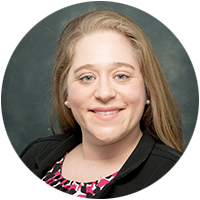
Nearly a decade after graduating from the Master of Medical Sciences in Medical Education program at Harvard Medical School, Kristina Dzara, PhD, MMSc, welcomed Magalie Cadieux, MD, MMSc, a friend and program alumna, to an educator development event at the Saint Louis University School of Medicine (SLU SOM). Both women have built careers in academic medicine in St. Louis, Dzara at SLU SOM and Cadieux at WashU Medicine, and have coauthored two publications. During the event, she sent a “selfie” of Cadieux and herself to former program director Jennifer Kesselheim, MD, and associate program director Ayres Heller, EdM, to their delight.
The moment may seem small, but it captures something else that Dzara has come to believe deeply about a career in medical education: you have to find your people. For her, many of those relationships began at Harvard Medical School, and they remain part of how she collaborates, publishes, solves problems, and builds community for other educators.
Today, Dzara is associate professor of family and community medicine and assistant dean for scholarly teaching and learning at the SLU SOM, where she also directs the Center for Educator Development, Advancement, and Research (CEDAR). She has spent more than 15 years in medical education. But when Dzara completed her PhD in sociology at Southern Illinois University, she did not yet know it could be a career.
Her first job was in the department of psychiatry at the Southern Illinois University School of Medicine, where she was hired for research and education work with residents. “That was the first time I even learned that medical education was a career option, and that it might actually be something that I was interested in and could potentially be good at,” she recalls.
A position at the Yale School of Medicine took her into health policy and health services research. Dzara worked with supervisors she admired, learned a great deal, and published papers she was proud of. She also learned something equally valuable. “I realized that I did not want to be a health services researcher,” she says.
By the time life brought her to Boston, she had a clearer sense of what she did want. Yet the job search was harder than expected. Although Dzara held a PhD and had published in the medical education literature, she was a sociologist entering a field populated largely by clinicians and education specialists. “I realized that as a sociologist who didn’t have a PhD in education and who didn’t have an MD or any other health care credential, I was falling short on the application process,” she says.
So Dzara made a deliberate decision to go back to school and was candid about why during interviews. “I told them flat out: I know what I want to do. I want to be a PhD medical and health professions educator. I need to learn some things to help me do that, and I also need this credential so that I can get a good job when I’m done, completely legitimizing me in this field,” she says. Kesselheim and Heller admitted her to the program’s second cohort the next day. “It was one of the best decisions that I’ve ever made,” she adds.
Her cohort had nine students, and all but Dzara were physicians. As the sole social scientist, she sometimes came “out of left field,” but she fit in and still keeps in touch with many of them. Most importantly, she approached her coursework with a specific career goal in mind. She was most drawn to the medical education courses and the Harvard Medical School faculty who taught them. “Those were the things that I care about most deeply,” she says, “in part because it was introducing me to ways of thinking, as well as people who were going to be part of my long-term community.”
One highlight of her time in the program was an independent study she designed around the work she hoped to do. Dzara partnered with the Office of Graduate Medical Education at Massachusetts General Hospital (MGH) to conduct a formative program evaluation of an onboarding and development opportunity for residents. It was her first chance to rigorously collect long-term program evaluation data and make the findings impactful at an institutional level, and it counted for course credit. She worked alongside leaders in graduate medical education, and Kesselheim made the introduction with a single email.
For Dzara, the project showed what can happen when you are explicit about what you want. “It was, in a way, me saying this is the kind of thing I want to do with my career. How can I do this in my program?” she explains. “And for me to just be able to do it was truly amazing.”
That approach carried her past graduation. She worked at the Brigham Education Institute at Brigham and Women’s Hospital, then served as assistant dean for educator development at the University of Washington School of Medicine. Three years ago, SLU recruited her to build CEDAR, a new hub for educator development and collaborative educational scholarship at the School of Medicine. “Everything that we’ve built up is work that I’ve done in the past three years,” she says.
Her scholarship traces the same arc. The number of her publications is approaching 60, with about 45 of them in the medical education literature, and she often helps students publish for the first time, including two collaborative papers this past summer. Dzara is emphatic in her belief that medical education research deserves the same rigor as scholarship elsewhere in academic medicine.
“People have this misconception that medical education work is easier or that medical education scholarship is easier to publish,” she says. “Publishing is incredibly hard, but this is just as scientific as any other work that we do.”
Dzara also values scholarship that travels beyond the page. Years ago, she and a former supervisor at MGH developed a “no-prep” journal club model. She now uses it at SLU SOM to bring rooms of about 20 educators together to discuss educational research. “If you want to talk about impact and translation, stuff that I did way back in the day, I am still using it to facilitate educator development and build community here at SLU SOM,” she notes.
When asked what lesson from the program she still carries, Dzara does not name a research method or an educational framework. “I think you have to find your people,” she says.
Her own community now reaches well beyond any one institution. Some are people she met through Harvard Medical School or the Harvard Macy Institute, and others came through collaborative scholarly opportunities and conferences. When Dzara hits a question outside her expertise, she knows who to call. “Not everybody who is even a medical or health professions educator is going to, by default, be your person,” she says. “I consider myself somebody who has ‘Med Ed’ buddies all over this country.”
Increasingly, her work is about building community for others. The Kern National Network for Flourishing in Health invited her to write the chapter on community and flourishing for the Medical Science Educator Handbook: A Guide to Flourishing. When asked whether she wanted a coauthor, she called Sarah K. Wood, MD, FAAP, director of the Harvard Macy Institute. The chapter presents Harvard Macy as an established example of a flourishing community and her work at SLU SOM as an emerging one.
The same long view shapes her advice to students entering the Master of Medical Sciences in Medical Education program today. She says, “Treat it as the potentially life-changing opportunity that it can be.”
For Dzara, that means engaging fully with the coursework and the people around you, seeking out experiences that fit the career you hope to build, and being clear about what you need. “Make sure that others know what your goal for this is,” she says. “If you’re going to do it, do it completely. Do it fully.”
Written by Bailey Merlin