
Curriculum Governance and Program Oversight
Educational Policy and Curriculum Committee (EPCC)
Reporting to the Dean of the Faculty of Medicine and chaired by the Dean for Medical Education, the Educational Policy and Curriculum Committee (EPCC) is a faculty standing committee with collective responsibility for the four-year MD curriculum — including both the Pathways and HST preclerkship tracks — and for the educational policies that govern the MD program at Harvard Medical School. The EPCC and all of its subcommittees include student representation.
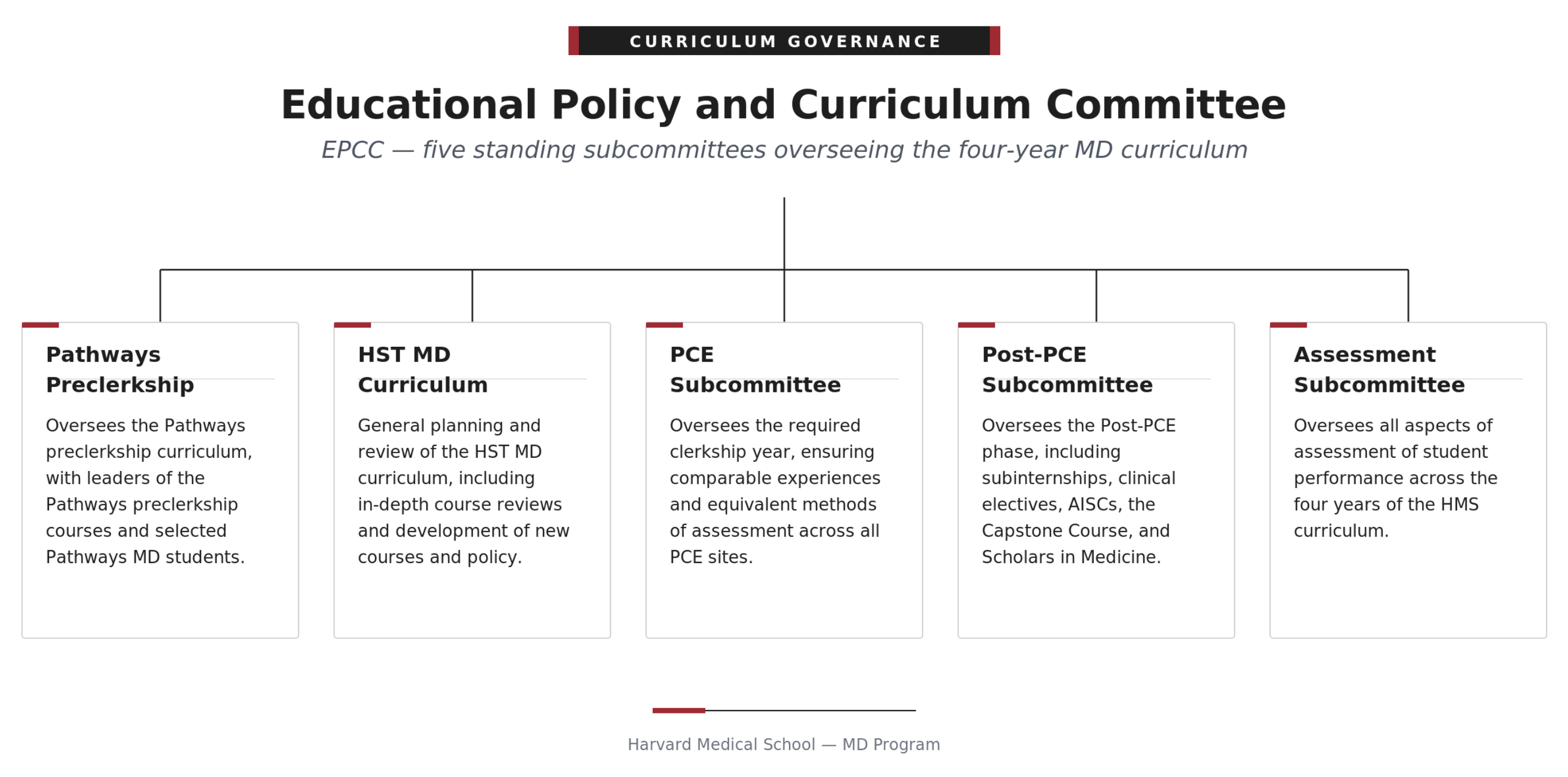
EPCC Subcommittees
Pathways Preclerkship Subcommittee
The Pathways Preclerkship Subcommittee oversees the Pathways preclerkship curriculum, coordinating course content, pedagogy, and the student experience across the first two years of the MD program.
HST MD Curriculum Subcommittee
The HST MD Curriculum Subcommittee plans and reviews the HST MD curriculum, conducts in-depth reviews of individual courses, recommends changes to existing courses, and develops new courses and curricular policy.
PCE (Principal Clinical Experience) Subcommittee
The PCE Subcommittee oversees the required clerkship year, ensuring comparable educational experiences and equivalent methods of assessment across all PCE sites. It also governs the longitudinal components of the PCE.
Post-PCE Subcommittee
The Post-PCE Subcommittee oversees the post-PCE phase of the MD curriculum, including required subinternships, clinical electives, Advanced Integrated Science Courses (AISCs), Essentials of the Profession II, the required Capstone Course, and the Scholars in Medicine requirement.
Assessment Subcommittee
The Assessment Subcommittee oversees student performance assessment across the four years of the MD curriculum, including preclerkship courses in Pathways and HST, core clerkships in the PCE, designated post-PCE courses, formative and summative OSCEs (Objective Structured Clinical Examinations), and faculty-development programs that strengthen assessment skills.
MD Admissions and Financial Aid Committees
Committee on Admission of Students
Established by the Faculty of Medicine in December 1918 to oversee student admissions and set policy on entrance requirements and credentials, the Committee is organized around an Executive Committee — chaired by the Faculty Associate Dean for Admissions and holding final authority over admissions decisions — together with two main admissions committees (Pathways and Health Sciences and Technology) that rank competitive candidates for the Executive Committee, and eight advisory subcommittees (four Pathways, three HST, and one MD/PhD).
Committee on Financial Aid for Medical Students
Established by the Faculty of Medicine in March 1948 to set policy on scholarship and loan funds and to administer those funds, the Committee comprises faculty, students, and staff who set cost-of-attendance budgets, enact financial aid policies, and consider financial aid appeals.
Learning Environment Committee
The Learning Environment Committee is a standing committee of Harvard Medical School charged with monitoring the quality of the learning environment for HMS students across classrooms, laboratories, and clinical settings; coordinating initiatives to strengthen that environment; and making recommendations to the EPCC, department chairs, and the Dean of the Faculty of Medicine.
Student Advising, Performance, and Promotion Committees
Council of Academic Societies (CAS)
Chaired by the Dean for Students, the Council of Academic Societies convenes all aspects of student services — including Society Advisory Deans and Advisors, as well as the Offices of Student Affairs, Learning Resources and Support, Disability Services, Financial Aid, and the Registrar — and meets regularly on matters of student life.
Medical Student Promotion and Review Board (PRB)
The Medical Student Promotion and Review Board certifies that students have made satisfactory academic progress at the end of each curricular phase and are eligible to advance to the next. The PRB also reviews the performance of students experiencing academic or professional difficulty to ensure that each MD student meets the academic standards, promotion rules, standards of professional conduct, and graduation requirements detailed in the HMS Student Handbook.
Additional information about committees
Faculty Leadership, Standing and Administrative Committees