
Striving to elucidate brain-body networks
Research and therapeutics
The mechanisms by which the body interprets environmental factors, reports them to the brain, and is in turn directed by the brain to respond to them are little understood. The lab of HMS cell biology professor Stephen Liberles, AB ’94, AM ’96, PhD ’00, supported by a $1.65 million grant from the Bill & Melinda Gates Foundation, is working to understand these brain-body networks.
Scientists are beginning to see the brain as the principal conductor of a symphony of body biology, from monitoring the function of every
internal organ and system to modulating nutrition, metabolism, physiology, and immunity.
Stephen Liberles
He and his team hypothesize that sensing pathways in the gut-brain axis act as relays, signaling for neural circuits to in turn release hormones and other chemical signals. Revealing these pathways and understanding how they work will provide insight into the mechanisms that control cell behavior and respond to environmental conditions.
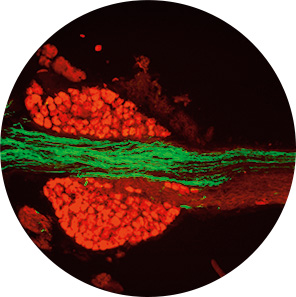
IMAGE: LIBERLES LAB
A deeper molecular understanding of the brain-body axis could be revolutionary. By fully characterizing the neural circuits involved, scientists may be able to develop a new class of therapies. These therapies would target sensory receptors to drive the brain toward healthy physiological states.
The first aim of Liberles’ project is to experiment with neural control of unconscious body processes. He and his team will activate different cell types in the gut-brain axis and use fiber photometry to assess the brain’s response. If they identify specific connections, they will be able to determine what different arms of the gut-brain axis sense physiologically and how perturbing those particular sensory pathways impacts bodily functions.
The project’s second aim involves studying how the brain signals back to the body through the autonomic nervous system to control body development and gastrointestinal physiology. In a recent collaboration with Bradford Lowell, MD, PhD, an HMS professor of medicine at Beth Israel Deaconess Medical Center, the Liberles Lab, which is housed in the Blavatnik Institute at HMS, identified particular neurons it wishes to investigate. The team will manipulate these neurons in mouse models and observe how stimulating, silencing, or eliminating them affects physiology and behavior.
“The neural basis of many physiological phenomena remains mysterious,” explains Liberles. “Defining the key neurons involved will help us to understand the signaling mechanisms, develop intervention strategies, and evaluate the likely consequences if we were to block adverse responses associated with particular stimuli.”