Work described in this story was made possible in part by federal funding supported by taxpayers. At Harvard Medical School, the future of efforts like this — done in service to humanity — now hangs in the balance due to the government’s decision to terminate large numbers of federally funded grants and contracts across Harvard University.
A world-class biomedical research laboratory sits in an unassuming recycled shipping container in a neighborhood in one of the global epicenters of tuberculosis.
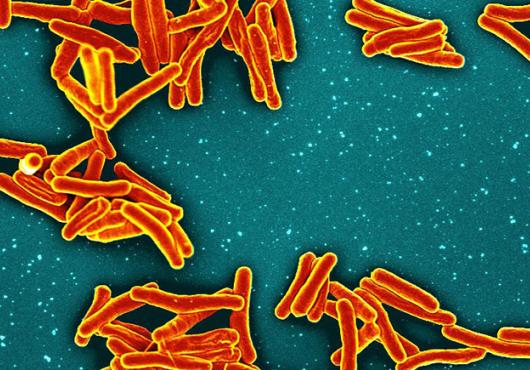
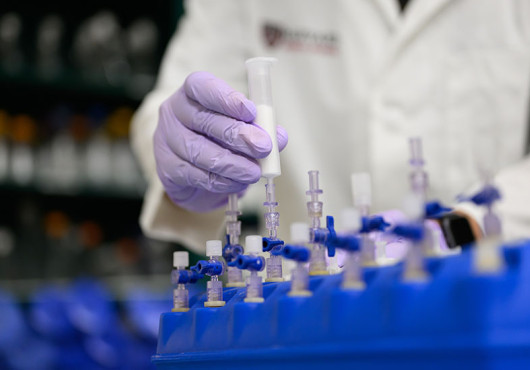
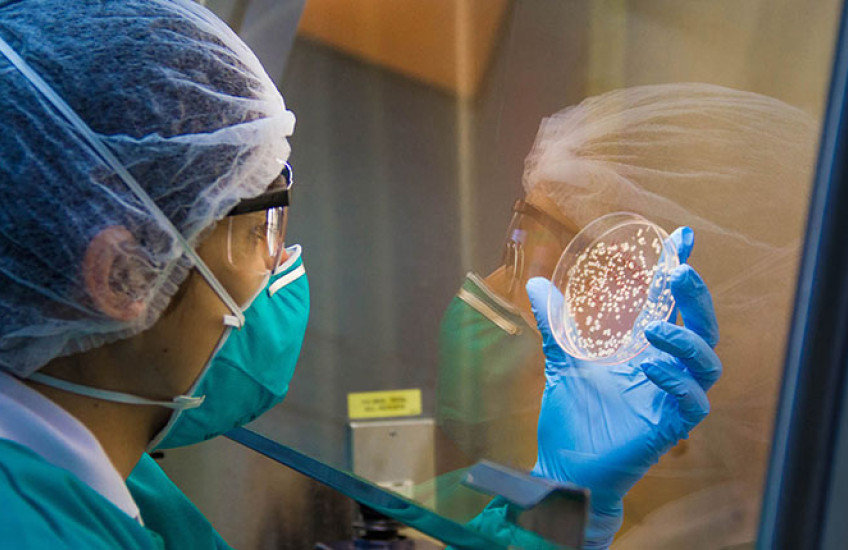
As the ventilation system hums, scientists and technicians in the lab — owned and operated by Socios En Salud, the Peruvian branch of the international health care delivery nonprofit Partners In Health — work to improve TB diagnosis for the sick people in their neighborhood, improve treatment for TB and other diseases worldwide, and deepen scientific understanding of one of humanity’s oldest and deadliest infectious foes.
Since its founding in the 1990s, Socios En Salud has worked closely with researchers from Harvard Medical School and other institutions to improve clinical care while helping advance the basic science that provides the foundation for more progress.
Those collaborations have helped build a biobank with hundreds of thousands of sputum and blood samples, tens of thousands of cultures of purified samples of tuberculosis from different patients, and more than 5,000 complete genome sequences of the bacteria that cause TB. The samples are linked to electronic medical records that include valuable, anonymized patient information, such as how people responded to TB drugs; what other illnesses they had; and social, economic, and environmental factors that researchers suspect play a role in determining who gets sick.
“Those samples, linked to robust clinical and demographic data in a searchable database, are an unequaled, irreplicable resource for the future of science and for the fight against tuberculosis,” said Megan Murray, the Ronda Stryker and William Johnston Professor of Global Health in the Blavatnik Institute at HMS. Much of Murray’s work has been done in collaboration with Socios En Salud and other branches of PIH.
But reductions in funding from the National Institutes of Health, USAID, and other U.S. agencies that support science and global health may now make it impossible to keep the lab running or to maintain the freezers that preserve the samples. Socios En Salud has already had to cut clinical staff and programming, making it difficult to see how they can cover the costs on their own, Murray said.
Since it arrived, the lab has powered major advances in understanding and treating TB and other illnesses and provided clinical testing for many diseases for Lima residents. Socios En Salud has invested in highly trained people and shared its know-how across Latin America and around the world.
“If we lose those freezers and can’t preserve the archive they contain, we’re never going to get it back. There isn’t anything like it anywhere in the world,” Murray said.
A lab where science is needed most
In 2008, Murray was working with Mercedes Becerra, now the Jeffrey Cheah Professor of Global Health and Social Medicine at HMS, to launch a new research project in Peru. Initially, they were hoping to use Peru’s national laboratory system to do the microbiology work for the project, but when the Peruvian collaborators saw the scale of the work, they realized they couldn’t meet the demand while also providing the lab work their patients needed.
Socios En Salud was already involved in the project, and PIH decided the time was right to get their own lab to improve care delivery for patients in local communities and to support the research project.
At a cost of approximately $1 million, PIH arranged for a Biosafety Level 3 lab to be built in South Africa in a repurposed cargo container and shipped across the Southern Ocean to Lima.

Since then, funds from a series of NIH grants to HMS, the Harvard T.H. Chan School of Public Health, and other academic medical centers and universities, along with direct U.S. federal funding for Socios En Salud, have supported the lab’s work. In return, the lab has supported efforts to find better treatments and diagnostic tools for TB and to deepen understanding of how the disease infects and sickens people and develops resistance to antibiotics.
The team has spent 20 years of hard work building an irreplaceable resource for the world, Murray said.
Working together to deepen science and improve health
Although it has been 80 years since the first people were cured of TB with the advent of antibiotic drugs, many people around the world still can’t access the medicine they need to fight the disease. Each year, 1.5 million people die of TB, including more than 500 in the United States.
Beating TB requires better basic understanding of the interactions between microbe, host, and a complex set of social and environmental factors. To power statistics for meaningful studies, researchers must work in the communities around the world that have the most cases, especially less common, highly drug-resistant cases.
Since high levels of TB tend to occur where there are high levels of poverty and limited health care infrastructure, it’s rare for the places that have a high burden of TB to also have integrated health systems that unite community, primary care, and hospital-based efforts and the cutting-edge research capacity required to contribute to a sophisticated scientific study.
With its lab and its innovative health care delivery model, Socios En Salud has all that. That’s why the organization was a crucial partner in studies that helped identify mutations associated with TB drug resistance, improved tools for diagnosing pediatric TB, and deepened insights into how the immune system responds to TB.
“Losing any part of that capacity to collaborate would be a huge setback in the fight against tuberculosis,” Murray said.
Local lab, global reach
Meanwhile, the lab also plays a vital role in the health of the community where it sits. As the population of Lima and the capacity of Socios En Salud have grown, the facility has become the main public testing site for more than 3.5 million of Lima’s 12 million people. That cohort includes many of the city’s most vulnerable, with high rates of extreme poverty in the district.
Socios En Salud has also expanded the lab’s capacity to include HIV testing, routine blood chemistry tests, immunology, hematology, and other clinical testing. They were the first private lab in Peru to provide molecular testing for SARS-CoV-2, the virus that causes COVID-19.
Since their clinics don’t just work on TB, they need to provide a full range of lab tests for patients, said Leonid Lecca, executive director of Socios En Salud and lecturer on global health and social medicine, part-time, at HMS.
To keep the lab working, Lecca said that Socios En Salud and PIH are looking for new sources of support, including research institutions and networks in Australia, Canada, the United Kingdom, the European Union, and Asia. They’re also continuing to deepen their relationships with Peruvian universities.
In the meantime, Lecca said he worries about losing the highly trained researchers and technicians who work in the lab, since Socios En Salud has invested years and considerable resources in training their scientific team to the level of skill needed to do sophisticated lab work.
“Research is a huge part of our mission to help find solutions for the most vulnerable populations, not just in our own backyard but everywhere,” he said. “Our challenge is to find a way to continue.”
Update, spring 2026: A donor has provided $1.2 million to support TB research at Socios en Salud and ensure that this lab can continue to serve patients and researchers for some time.