At a glance
Researchers have uncovered new genetic details about the rare neurodegenerative disease Friedreich’s ataxia.
The team identified gene mutations in roundworms that allow the animals to survive without frataxin, the key mitochondrial protein that is missing in the disease.
By identifying a potential drug target, the research could someday lead to better treatments.
Scientists have uncovered new genetic details of Friedreich’s ataxia, a rare but devastating neurodegenerative disorder that does not yet have a cure. Working in the roundworm C. elegans, the researchers described a genetic modifier that enables cells to survive without frataxin, the key mitochondrial protein that is lacking in people with the disease.
Their findings deepen understanding of the basis of Friedreich’s ataxia and, if confirmed in humans, could lead to better therapies by providing a new drug target.
The team, led by researchers at Harvard Medical School, Mass General Brigham, and the Broad Institute of MIT and Harvard, outlined their results on Dec. 10 in Nature.
New treatments needed
Friedreich’s ataxia is a genetic disorder that causes progressive damage to the nervous system and brain, leading to a loss of coordination, muscle weakness, and heart problems, among other issues. Patients are often diagnosed between 5 and 15 years old, and live into their 30s or 40s.
There is currently only one FDA-approved therapy. It can slow the progression of the disease in some patients but can’t cure it, leaving a need for new treatments.
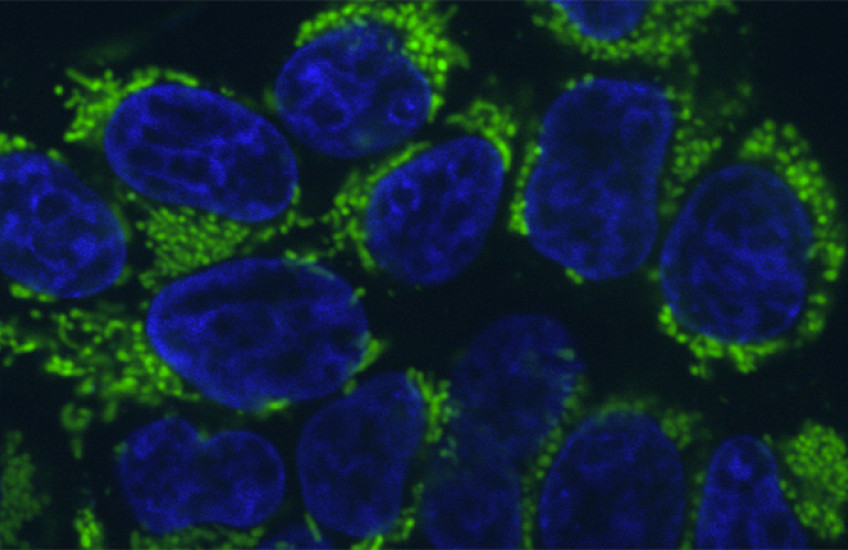
Friedreich’s ataxia occurs due to the loss of frataxin, a protein in mitochondria, the energy-producing structures inside cells. Frataxin is part of the protein machinery that mitochondria use to make molecules called iron-sulfur clusters needed to produce energy and carry out cell functions.

In previous research, the lab of Vamsi Mootha, HMS professor of systems biology at Massachusetts General Hospital, showed that a certain amount of hypoxia, or breathing air with low oxygen levels, can partially restore frataxin levels in human cells, worms, and mice.
Yet the researchers wondered if instead of pursuing hypoxia as a therapy for Friedreich’s ataxia, they could use it as a tool to discover genetic mutations that suppress a cell’s need for frataxin, said lead author Joshua Meisel, a former HMS postdoctoral fellow at Mass General who is now an assistant professor at Brandeis University.
A delicate balancing act
To understand how cells might overcome the loss of frataxin, the researchers created C. elegans worms that lacked frataxin and grew them in low-oxygen conditions, which allowed the otherwise nonviable worms to survive. The team then randomly introduced genetic changes into the worms and looked for animals that could grow in higher-oxygen conditions that would normally be lethal.
By sequencing the genomes of the survivors, the scientists identified specific mutations in two mitochondrial genes that make the proteins FDX2 and NFS1. They found that these mutations can bypass the need for frataxin, allowing cells to better produce iron-sulfur clusters even when frataxin is missing. They showed that too much FDX2 can block this process, but reducing FDX2 — either by introducing a genetic mutation or by removing one copy of the gene — restored iron-sulfur cluster production and cell health.
Overall, the results suggest that carefully adjusting the levels of proteins that interact with frataxin could help counteract the effects of its loss in disease.
“The balance between frataxin and FDX2 is key,” said Mootha, who is co-senior author on the paper with Gary Ruvkun, HMS professor of genetics at Mass General. “When you are born with too little frataxin, bringing down FDX2 a bit helps. So, it’s a delicate balancing act to ensure proper biochemical homeostasis.”
To see if similar strategies could help in more complex organisms, the researchers confirmed the effects of the mutations using advanced genetic engineering, biochemical tests in the lab, and experiments in human cells and mice.
They found that lowering FDX2 levels in a mouse model of Friedreich’s ataxia improved neurological symptoms — suggesting a new potential treatment strategy.
“The reason this is exciting is because the suppressor that we’ve identified, FDX2, is now a protein that can be targeted using more conventional medicines,” Meisel said.
The researchers note that the precise balance of frataxin and FDX2 needed for healthy cells may vary depending on the situation, and more work is required to understand how this balance is regulated in humans.
Future studies will be needed to test whether adjusting FDX2 levels is safe and effective as a therapy for Friedreich’s ataxia before contemplating human trials.
Authorship, funding, disclosures
Additional authors on the paper include Pallavi R. Joshi, Amy N. Spelbring, Hong Wang, Sandra M. Wellner, Presli P. Wiesenthal, Maria Miranda, Jason G. McCoy, and David P. Barondeau.
This work was supported by the Friedreich’s Ataxia Research Alliance, the National Institutes of Health (grants R00GM140217, R01NS124679, R01AG016636, and R01GM096100), the Welch Foundation (A-1647), the Jane Coffin Childs Memorial Fund for Medical Research, and the Deutsche Forschungsgemeinschaft (431313887). Mootha is an investigator of the Howard Hughes Medical Institute.
Mootha is an inventor on patents filed by Mass General on therapeutic uses of hypoxia. Meisel, Ruvkun, and Mootha are inventors on a patent filed by Mass General on technology reported in this paper. Meisel, Ruvkun, and Mootha own equity in and are paid advisors to Falcon Biotech. Mootha is a paid advisor to 5AM Ventures.