Thirty years ago, a small group of Harvard Medical School professors launched a bold experiment. Their goal was to show that giving financial support to promising young doctors at the challenging early stages of their careers could help them juggle their personal and professional responsibilities and accelerate their careers as they find their footing as physicians, scientists, educators, and leaders.
The team started with a commitment to support 10 fellowships at $25,000 a year — audaciously announced before a penny of financing had been secured.
Since then, the program has funneled millions of dollars to thousands of early-career doctors and professors who are transforming biomedical research and health care delivery and forging new paths to meet the challenges of tomorrow’s medicine, both within the HMS community and beyond.
Because the year of its inception, 1995, was the 50th anniversary of the first class of women being accepted at HMS, the program was originally called the Fiftieth Anniversary Program for Scholars in Medicine. It was renamed The Eleanor and Miles Shore Faculty Development Awards Program in 2004 to honor Eleanor Shore, former HMS dean for faculty affairs, and the late Miles Shore, whose last title at HMS was the Bullard Professor of Psychiatry, Emeritus, for their support of the program over the years.
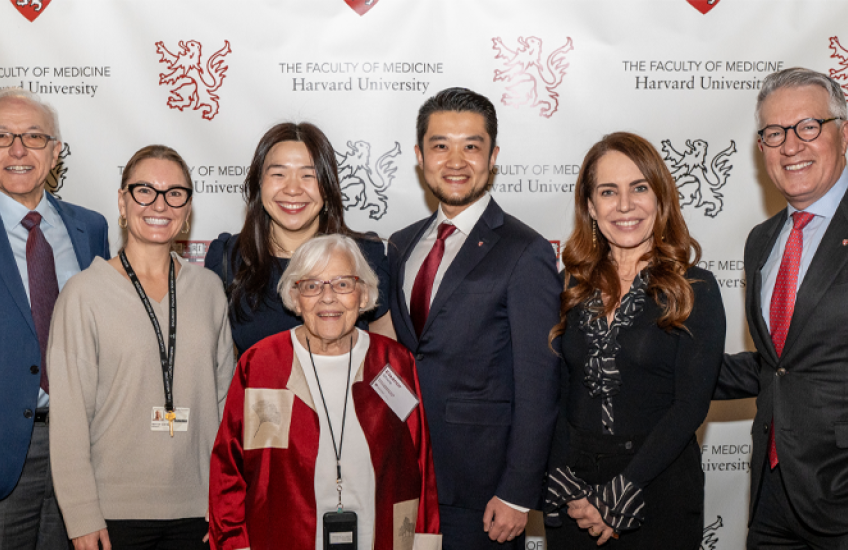
“The Shore Program signals HMS’, Harvard School of Dental Medicine’s, and their affiliate hospitals’ commitment to supporting faculty at a stage of life where they are particularly vulnerable to being overwhelmed by all the pressures of work and life,” said Grace Huang, HMS dean for faculty affairs, at a reception on Nov. 25, where school leaders, new awardees, family members, mentors, and past recipients gathered to celebrate the first three decades of the program and to honor the latest class of scholars to receive the awards.
By providing early-career faculty with time and resources to pursue research, clinical, and educational projects, the awards help accelerate recipients’ success in supporting the school’s mission to improve health and well-being for all, Huang said.
Eleanor Shore, who is now senior consultant to the HMS Office for Clinical and Academic Affairs, was among those who helped envision the program, inspired by the boost she received early in her own career when she was named a Macy Scholar.

One of just eight women admitted to her HMS class in 1951, Shore went on to blaze an innovative path balancing clinical care, research, administration, and family life. Shore credits that crucial early support with enabling her to advance several areas she was passionate about, including excellence in women’s health, increasing the diversity of HMS faculty, and gender equity across the medical profession.
“Junior faculty face many challenges as they start a career and a family at the same time,” Shore said. “Any assistance in this critical early stage pays dividends in terms of scientific, clinical, and academic productivity for years to come.”
Shore said that it has been a joy witnessing everything that recipients have done to strengthen academic medicine and the HMS community over the last 30 years and that she is inspired to see how the work has carried on from generation to generation.
Putting resources to work to improve medicine
Recipients have used their awards to begin research programs that are helping advance an array of different aspects of research and care delivery: finding ways to improve access to surgery around the world, using new insights into tumor biology to fight cancer, leveraging new technology in emergency departments to make cutting-edge care available to more people, and engaging community members in improving health and well-being for their neighbors, among many other projects.
Mary Rice, the Mark and Catherine Winkler Associate Professor of Environmental Respiratory Health at Harvard T.H. Chan School of Public Health and HMS associate professor of medicine at Beth Israel Deaconess Medical Center, said that receiving the Miles Shore Fellowship was instrumental in launching her scientific career. The fellowship allowed her to hire a research assistant to support her first project linking climate-related exposures to respiratory health in the Framingham Heart Study, work that helped propel her research and eventually led her to direct the Center for Climate, Health, and the Global Environment (C-CHANGE) at the Harvard Chan School.
“This protected time was especially meaningful as I was balancing this work with caring for my young children,” Rice said. “Support like this is essential for helping junior faculty advance their research, and I’m proud that my mentee, Nicholas Nassikas, HMS assistant professor of medicine at Beth Israel Deaconess, has also benefited from this program.”
Many awardees note that a Shore award makes a tremendous difference in the trajectory of the work — a busy dermatologist with a passion for quality improvement who needed some protected time to enact protocols to improve the efficiency of the clinic, a health services researcher who was in a dry spell between grants and needed funding for a research assistant, a surgeon with three kids under the age of 6 trying to launch a clinical program.
Huang, herself a recipient of an education-focused Shore fellowship, said the award enabled her to get formal training as a teacher and to delve deeply into a community of educators.
“Breathing room is the best way to describe it. During that year I got to be a student of the science of education and to learn skills and make connections that led to educational projects that solidified my career path as a teacher, an educational researcher, and now an administrative leader,” Huang said. “Protected time and resources are some of the best investments an institution can provide its faculty to show they are valued.”
Celebrating community support
The awards not only support and celebrate recipients, they also highlight the generosity of departments, institutions, and donors and the critical support of mentors, family, and the broader community in fostering the next generation of researchers and leaders, School leaders said.
Early on, all the funds for the Fiftieth Anniversary Program for Scholars in Medicine came from individual donors. Now the Shore Program has direct financial support from academic and clinical departments, centers, and programs; the central administration of Harvard’s medical and dental schools and affiliated hospitals; and private donors.
Since launching, the program has supported 1,593 faculty members with a total of $78 million, which would be worth an estimated $115 million today.