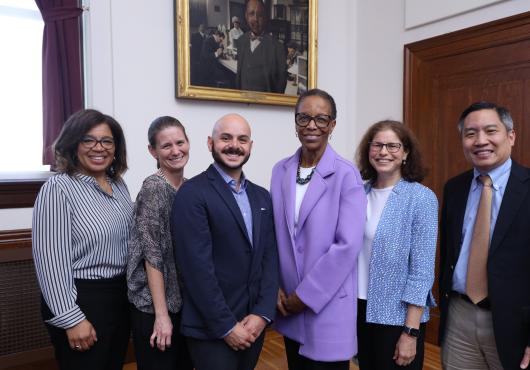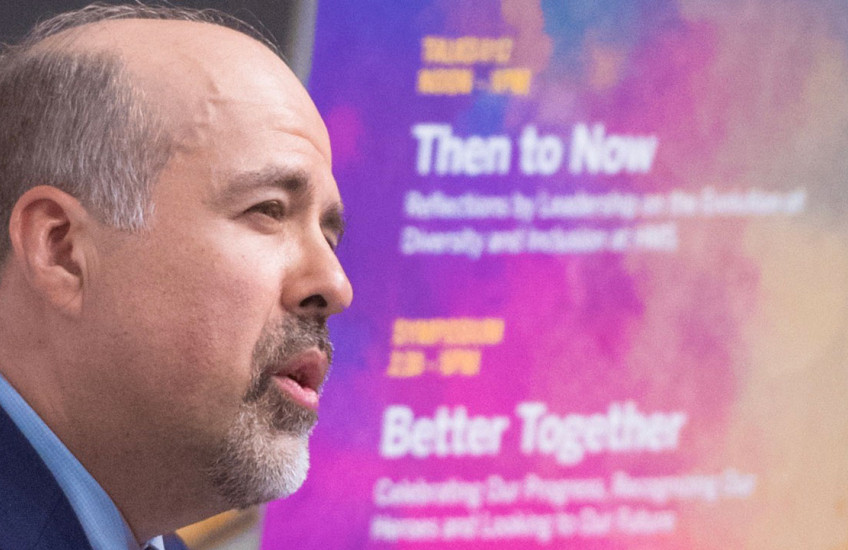
Rafael Campo at the Better Together symposium, celebrating 50 years of diversity and inclusion at HMS and HSDM.
Fifty years after Harvard Medical School launched an historic initiative to promote diversity and inclusion in its student body, the community gathered to celebrate progress, take stock of remaining challenges, and plan the way forward toward an even more diverse and inclusive community.
The event held on October 28 marked the anniversary of the year that HMS moved to establish a program to recruit 15 African American students.
Rafael Campo, an associate professor of medicine at HMS and Beth Israel Deaconess Medical Center and poetry editor of JAMA, opened the afternoon symposium with a reading of a poem he composed for the event.
The poem, “Hopefully,” explores the power and strength that can be drawn from patients, teachers, students, colleagues and neighbors who have diverse life histories.
HOPEFULLY
The homeless guy who shoved his grimy cup
in front of me smiled, gap-toothed, said, “Man,
you have a blessed day!” I realized
he was my neighbor, even as I looked
away. Unasked, he gave me something: hope.
In clinic, fluorescent lights abuzz, she
tells me how her daughter died in childbirth.
Depressed, she worries she’ll turn back to drugs.
She shows me pictures, tiny grandbaby,
black as onyx. Her bright eyes make us hope.
I had a teacher once who wouldn’t leave
the wards until all of the work was done.
He spoke in hushed tones to the drag queen draped
in KS lesions. To me, they looked hideous.
He told her in her beauty there was hope.
“I wonder what she looks like under there.”
Teenagers sneer outside the ER as
she passes on her way to work, in headscarf,
white coat, scrubs. I wonder which patient’s hand
she’ll warm, when the rest of us give up hope.
It’s decorated with a rainbow flag,
assorted bumper stickers – “I can’t walk,
duh!,” “Stairs suck,” and “Desert Storm Vet” – and foil
red, white and blue pinwheels. Inked arms propel
his fly wheelchair, sweet chariot of hope.
Another case of chronic pelvic pain.
You don’t need an interpreter, they’d said.
My Spanish takes us back across the seething,
white-hot desert. Anything, to give her kids
a chance. I don’t know how to translate hope.
What else I learned: a classmate, US-
Vietnamese, explained it wasn’t the blood
sloshing in their crammed boat that made him want
to be a doctor. His surgeon father, stooped
from picking strawberries, showed him work was hope.
A day to celebrate. We’re all still here.
Among us, these undaunted heroes, told
we were unworthy, deserving only grief.
In healing their own wounds, they save us all.
Their balm is justice. The cure they found is hope.
–Rafael Campo
Related story: Imagination and Healing, JAMA’s new poetry editor discusses the healing power of the arts