It was at once a homecoming, a glimpse into the future, and an opportunity to connect and reflect on a program that stands as a paragon of training of physician-scientists and physician-innovators.
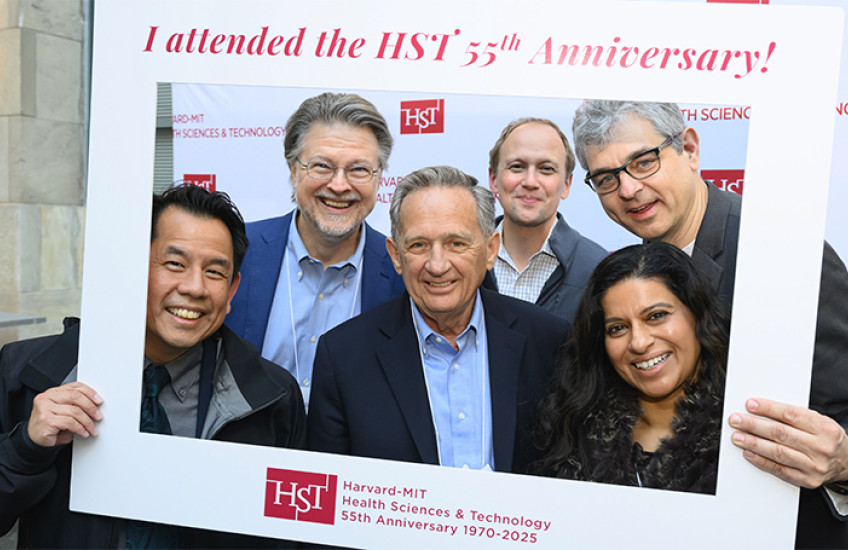
On Nov. 7-8, the Harvard-MIT Health Sciences and Technology (HST) 55th anniversary celebration — originally planned for the 50-year mark in 2020 but postponed due to the COVID-19 pandemic — brought together students, faculty, alumni, staff, and trainees in ebullient recognition of an enduring collaboration among Harvard University, Harvard Medical School, and Massachusetts Institute of Technology.
Founded in 1970, HST is one of the world’s oldest interdisciplinary educational programs focused on translational medical science and engineering.
The anniversary provided multiple perspectives on the program’s evolution and accomplishments, with alumni, student, and director panels; scientific lightning talks; a fireside chat with Harvard President Alan Garber and MIT President Sally Kornbluth; and an awards ceremony at Boston’s Museum of Fine Arts. The festivities were made possible by a gift from the Chiang J. Li MD Family Foundation and by the J.W. Kieckhefer Lectures in Health Sciences and Technology.
“Over the past 55 years, HST has proven that when engineers, scientists, and clinicians get together, human health leaps forward,” said Maria Yang, interim dean of MIT’s School of Engineering, in her opening remarks at MIT on Nov. 7.
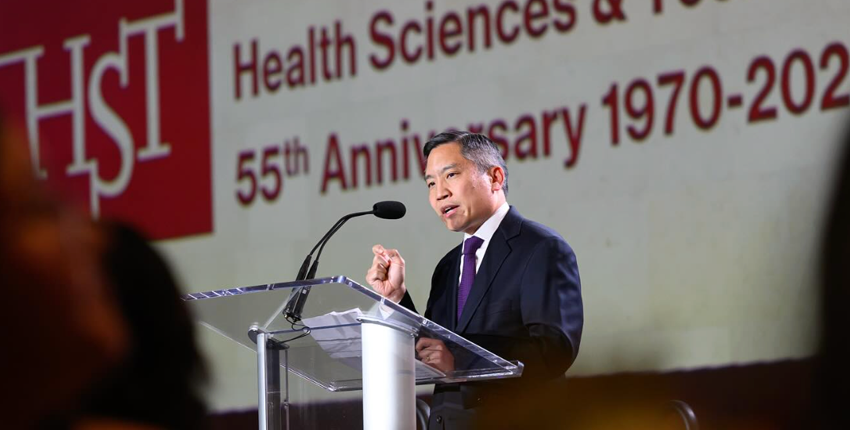
During events on the HMS campus on Nov. 8, HMS Dean George Q. Daley remarked on how this collaboration has helped spawn generations of alumni of exceptional caliber who dedicate their careers to improving and saving lives.
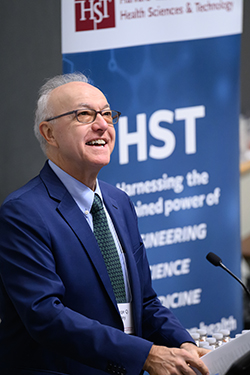
“HST — the most long-standing, successful collaboration between our two institutions — has gestated a startlingly illustrious brood of alumni who are responsible for a vast array of biomedical innovations,” he said. In HST classrooms, he added, “intensity of work ethic and a rich intellectual community combine to make tremendously exciting advances possible.”
Daley, himself an HST alumnus, cited alumni like David Ho, who pioneered the drug regimen that transformed HIV/AIDS into a treatable disease; Bruce Rosen, who developed functional MRI (fMRI) as the first noninvasive technology for observing the brain in action; and others who have entered public service, such as former U.S. FDA Commissioner Mark McClellan.
Alumni don’t necessarily have to wait long for the seeds of their education to germinate, as presentations by recent graduates illustrated. That education fosters critical thinking skills, the ability to tackle real-world challenges, and an understanding of the clinical contexts within which students hope to devise innovative solutions.
HST “has totally changed the way I think about research problems,” said presenter Elizabeth Healey, a postdoctoral fellow in machine learning for health at Boston Children’s Hospital and a member of the HST Class of 2025. She completed her PhD thesis on machine learning for precision medicine in type 2 diabetes with advisor Zak Kohane, the Marion V. Nelson Professor of Biomedical Informatics and head of the Department of Biomedical Informatics in the Blavatnik Institute at HMS.
One of the strongest themes to emerge during the anniversary observance was that HST students are a large part of what has made, and will continue to make, the program successful and in a continuous state of rejuvenation.
Said Daley, “It is through our students that HST is reborn into something new each and every year.”
Defined by the undefined
Since its inception, HST has married the technical rigor of MIT’s curriculum with the clinical and biomedical expertise afforded by HMS faculty.
When Irving London became the first director of HST, this notion of cross-training in science and medicine was somewhat radical. Its only precursor was Albert Einstein College of Medicine, which London joined as chair of medicine in 1955, just two years after the institution was founded. London and Alfred Gilman, chair of that college’s Department of Pharmacology, hatched a hypothesis: that educating trainees in both science and medicine could steer them toward meaningful, fruitful careers.
They quickly saw “what is now obvious,” said former HST Director David Cohen, HMS professor of medicine at Brigham and Women’s Hospital, during his talk about London’s legacy: “that science and medicine fit together, that you can create medical curricula that have scientific principles, and that you can have medical students who spend time in laboratories.”

Other schools took notice, and in 1969, London was asked to chair the joint Harvard-MIT planning committee for what would become HST. He assumed the directorship shortly thereafter. The London Society, one of five academic societies at HMS and the one to which all HST students belong, is named in his honor.
In this way, the invention of new fields and novel approaches is baked into the ethos of HST. That spirit has lived on in HST students.
During a panel discussion with former and current HST directors — Cohen, Martha Gray, Michael Rosenblatt, Emery Brown, Wolfram Goessling, and Collin Stultz — Gray noted that HST “tends to attract people who are not attracted to the siloes.”
One example is Michelle Walsh, an HST MD-PhD student in the second year of her PhD program, who thinks of herself as sitting in the intersections of disciplines.
“I’ve always identified as someone who didn’t have a clear, single calling,” she said. “It’s exciting to be in a community where that is the strength — where the undefined is the opportunity rather than the limitation.”
Knowledge through community
Malavika Ramarao, an HST MD-PhD student in her first year of medical school, felt drawn to HST when she first visited and met students who were as curious and excited about medicine and research as she is. She attributes another part of the appeal to the devoted efforts of HST faculty, staff, and administrators.
“Once I came here and saw how invested people are in our success, I knew I couldn’t be anywhere else,” said Ramarao, who wants to marry her passion for diagnostic devices with biochemistry and eventually help implement cancer biosensors in rural and underserved settings.
HST MD-PhD student Adam Berger, now in his final year of medical school, echoed Ramarao’s sentiment about HST directors’ dedication.
“They’re moving mountains silently for us,” he said.
That effort fosters an environment where students don’t just learn from faculty but also from one another.
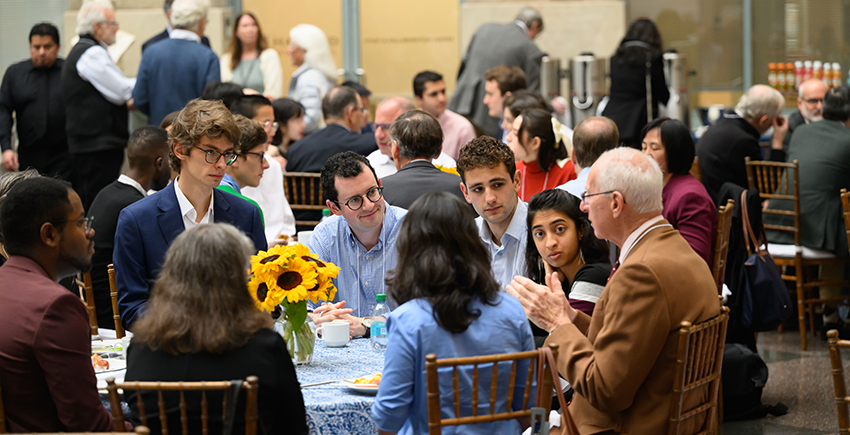
“One of the hallmarks of an HST education is that [all types of] students sit in the same room,” said Richard Mitchell, associate director for curriculum of HST, HMS professor of pathology and health sciences and technology at Brigham and Women’s, and associate director of the London Society. “The PhD students and MD students approach problems and think about things slightly differently, and both groups benefit.”
Becoming experienced in professional peer-to-peer exchange is essential because the explosion of scientific and medical knowledge in the past several decades has made it increasingly difficult for trainees to master everything, said Goessling.
“There’s no way we [as teachers] can keep up, so we need more approaches,” he said. Excellence in biomedical science, he said, demands knowledge through community. At about 52 students per year, HST is a tight-knit network that facilitates knowledge sharing and absorption.
Members of the celebration’s alumni panel pointed out that the benefits of this small, heterogeneous community translate well to effective leadership.
Ann Celi, HMS assistant professor of medicine at Brigham and Women’s, observed that the variety of students’ training backgrounds in HST prepared her for how to collaborate and build consensus across institutions or with industry or government.
“This ability to move beyond the walls of something — it’s the greatest part of the work, and also the most challenging,” she said.
Alumna Catherine Ford Corrigan, president and CEO of Exponent, agreed that HST instills in students the combination of technical excellence, leadership, and relational skills needed to do jobs like hers, which involves cultivating trusted relationships with clients facing critical business decisions.
Innovation is a process
In 2022, Daley asked Goessling to create a task force of HST faculty and students to outline a revision of the HST MD curriculum for the next 50 years. The effort was similar to the restructuring of its sister MD curriculum at HMS, Pathways, relaunched in 2015.
The task force found that in today’s medical landscape:
- Traditional PhD disciplines are being applied at the interface of patient care.
- Career paths are becoming more varied and complex.
- Generative AI is changing medicine, science, and society.
- The fabric of knowledge is changing, and critical discernment is key.
The team then made recommendations for how to get HST students into the clinic earlier and more often; further integrate basic science education with other important components, such as the social determinants of health; and improve alignment between basic science teaching, clinical experiences, and active research.
One significant change implemented in the last academic year was the addition of a series of core courses called Integrations and Innovation in Medical Sciences (I2MS). These classes meet weekly to add clinical and societal context — from social factors of patient care to climate and health — to students’ basic science learnings. In other MD programs, this integration might not take place until students’ third year, which is entirely focused on the clinical setting.
Mitchell says the next stage of HST evolution will involve ensuring that the “arc of the HST physician” continues in the clinical years.
Beginning in April of the second year of medical school, HST students typically join Pathways peers in clinical clerkships and electives to gain valuable real-world experience. At the moment, there is little opportunity on the wards for them to ask questions that go beyond what is necessary for clinical education and patient care, said Mitchell. Instead, he envisions having HST students rotate with clerkship role models whose careers mirror their own ambitions — such as those juggling clinical work with a laboratory or drug or device development.
Former director Rosenblatt reiterated that although curricular innovation may come in spurts, HST is always adapting and self-renewing thanks to its students.
Medicine as an art and science
The integration of engineering, science, and medicine creates a specific sensibility in HST students and alumni. Throughout the anniversary festivities, many remarked on how the program energizes and equips graduates to think deeply, creatively, and across disciplines.
Kayton (Katie) Rotenberg, a second-year HST MD student, commented during the student panel that her coursework has encouraged her to “keep asking ‘why’ along every step of the way.”
Understanding medicine is only part of the story, emphasized HST alumnus Elazer Edelman, HMS professor of medicine at Brigham and Women’s and the Edward J. Poitras Professor in Medical Engineering and Science at MIT.
“The only way to transform medicine as an art is by the inculcation of science,” he said. “HST is a systemic enterprise of acquiring knowledge by not just observation and legacy, but by experimentation and reasoning. It’s the grounding of medicine scientifically while not sacrificing dignity or compassion.”
Stultz, interim HMS co-director of HST, said the 55th anniversary is both a triumphant moment and a calling to continue the relentless pursuit of progress that is a hallmark of the program.
Alumni can attest to what’s in store for those who continue to push the boundaries of knowledge and patient care through HST.
Said Raphael Bueno, the HMS Lawrence Harvey Cohn Professor of Surgery in the Field of Cardiothoracic Surgery at Brigham and Women’s, “HST made it possible for me to understand that nothing is impossible.”