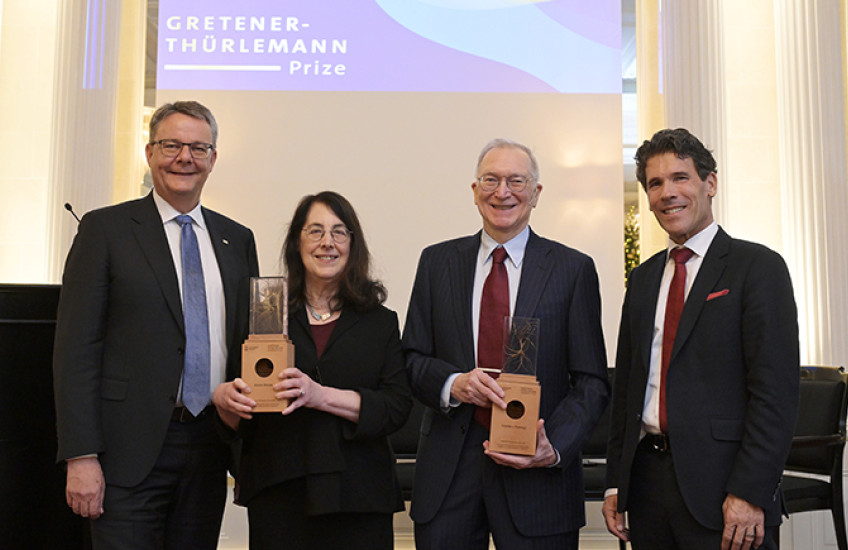
Gordon Freeman, Harvard Medical School professor of medicine at Dana-Farber Cancer Institute, and Arlene Sharpe, the Kolokotrones University Professor and chair of the Department of Immunology in the Blavatnik Institute at HMS, have been awarded the inaugural Gretener-Thürlemann Prize by the University of Zurich.
The prize, worth 500,000 Swiss francs or approximately $625,000, recognizes outstanding researchers in medicine, chemistry and physics for foundational and pioneering research of societal benefit.
Freeman and Sharpe were honored for decades of discoveries that proved pivotal for the development of immune checkpoint inhibitors — immunotherapies that have transformed cancer treatment for millions of patients worldwide and infused newfound energy into the field.
“We are delighted to receive this recognition on behalf of the work of our teams and all the researchers involved,” Sharpe and Freeman said. “We are honored to be the first recipients of this important award.”
The two researchers have been married since 1978 and have been working together since the 1980s to better understand the immune system and the therapeutic potential of directing immune response.
Shared lives, shared research
Since first meeting in German class as Harvard undergraduates, Freeman and Sharpe have shared their lives and their research interests. In the 1980s, the two collaborated on work on the B7 protein, which contributes to the immune system’s response to pathogens. Their first joint publication was a 1993 paper in Science describing their work on B7.
Beginning in the 1990s, the pair discovered important signaling pathways that inhibit the immune response to tumors. T cells play an important role in this process.
Proteins on T-cell surfaces, including the protein PD-1, stimulate or inhibit T-cell activity. Freeman and Sharpe discovered that the proteins PD-L1 and PD-L2, which are produced by cancer cells, among others, can interact with PD-1.

Certain immune cells themselves also produce inhibitors such as PD-L1 and PD-L2 to modulate T-cell activity so that the immune response is neither too strong, which could damage healthy tissue, nor too weak, which could let disease linger.
Sharpe and Freeman published a critical finding in 2000 in the Journal of Experimental Medicine: When PD-L1 on tumor cells binds to PD-1 receptors on T cells, it activates an inhibitory pathway that slows T-cell activity. In other words, cancer cells use these inhibitors to suppress immune responses that would otherwise attack the tumor.
It quickly became apparent that this new knowledge could be used therapeutically. Sharpe, Freeman, and others recognized that blocking the inhibitors could reactivate the immune system’s response against cancer cells, while boosting the inhibitors could rein in overactive immune response in autoimmune disease or after organ transplantation. Researchers therefore set out to develop antibodies to influence the relevant proteins.
The next step was to develop antibodies to influence the relevant proteins and restore the immune system’s ability to recognize and fight cancer cells. Development by pharmaceutical companies transformed Sharpe’s, Freeman’s, and others’ discoveries into a new class of FDA-approved anticancer therapies.
These so-called checkpoint inhibitors are now used in more than 25 types of cancer.
Freeman and Sharpe are now trying to further decipher the signaling pathways of the immune system and discover additional genes and molecules involved.
“New technologies such as single-cell analysis and artificial intelligence allow us to understand the processes involved in cancer even better and develop novel therapies,” Sharpe said.
Such work could allow more people with cancer to benefit from PD-1/PD-L1 immunotherapies.
“This immunotherapy is still far from effective in all patients,” said Freeman.
“I am convinced that in the coming years, the success rate of immunotherapies and other applications, for example against autoimmune diseases, will continue to rise step by step,” he added.
Shaping the future of immunotherapy
In their two laboratories in the Longwood Medical Area — only a 10-minute walk from each other — Sharpe and Freeman help shape the future of cancer immunotherapy research.
“There is a ping-ponging of knowledge between our research teams on the way to new discoveries,” said Sharpe.
“We both have our own projects, but I estimate that they overlap by about 30 percent,” Freeman said.
Their accomplishments, rooted in basic science, give hope to patients and inspire students and young researchers.
“At the beginning, we didn’t know where our research would lead us,” said Sharpe. “Today, we see that basic research is leading to therapies we never would have dreamed of. That really motivates young researchers.”
As their joint journey of discovery continues, they demonstrate the potential for pure curiosity to lead to significant medical advances, the prize committee said.
About the Gretener-Thürlemann Prize
The Gretener-Thürlemann Foundation, established in 2018, honors the legacy of Dr. Adolf and Adelheid Gretener-Thürlemann. The Zurich-based couple shared a keen interest in science and research throughout their lives. Adolf Gretener, born in 1926, studied medicine at the University of Zurich and worked as a family doctor. Adelheid Gretener-Thürlemann’s family was involved in the construction industry. Their shared enthusiasm for science led to the establishment of the foundation, which aims to promote research in the long term.
Adapted from a University of Zurich news release.