
A major new database for breast cancer research
Research and therapeutics
The Gray Foundation, which has committed $190 million in total to researching the treatment and prevention of BRCA-related cancers, recently pledged $3 million to support a new effort to catalog breast tissue co-led by Joan Brugge, PhD, the Louise Foote Pfeiffer Professor of Cell Biology in the Blavatnik Institute at Harvard Medical School. This Breast Pre-Cancer Atlas will profile epithelial, stromal, and immune cells in breast tissue from women who carry pathogenic variants of the BRCA1 or BRCA2 gene, comparing them to a control group.
The Breast Pre-Cancer Atlas … promises to identify the earliest precursors of cancer, which will be important for developing interventions to prevent cancer development in BRCA1 and BRCA2 mutation carriers.
Joan Brugge
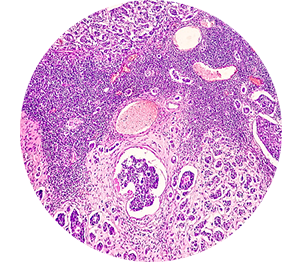
Brugge’s team of internationally recognized basic and clinical scientists is carrying out single-cell and bulk-tissue analyses of tissue from 100 women: 30 with pathogenic BRCA1 variants, 30 with pathogenic BRCA2 variants, and 40 with wild-type BRCA1 and BRCA2 genes. Age, menstruation, pregnancy, menopause, weight differences, birth control medication, hormone replacement therapy, alcohol, and many other factors cause hormonal changes in women, explains Brugge. “It’s important to collect large numbers of samples so that we can rule out confounding factors as being responsible for differences in tissues that are actually due to mutations in BRCA1 or BRCA2 and identify aberrant cells that represent precursor lesions of cancer.”
Once complete, the atlas will be shared with the broader scientific community, bolstering research into how genetic variation and other variables affect breast tissue. Exposing the vulnerabilities of cancer precursors will hopefully lead to new strategies for their detection and elimination and transform the ability to predict and prevent breast cancer in BRCA mutation carriers.
The team is building on important new findings obtained from its previous Gray Foundation-supported work. It will integrate data from several platforms to identify associations among genomic, epigenetic, and transcriptional differences in the various cell types. This integration will offer insights that would not have been revealed by any one approach alone. As the project proceeds, computational scientists will join the team to assist with the higher-level integration of data from all of the different platforms.
“This type of atlas generation involves complex orchestration that is not typically involved in academic research. Working with members of the teams from the University of Pennsylvania, Massachusetts General Hospital, and the Dana-Farber Cancer Institute, we developed and standardized the protocols that make it feasible to collect, process, and transport the samples to sites where the analyses are carried out.”
Joan Brugge
While the logistical work continues, Brugge is excited about the direction of the project and its potential for rapid translation to clinical impact. “Previous Gray Foundation funding to our team led to important new insights about cells that may represent the first precursors of tumor cells, and a manuscript we have submitted for publication that I think will be newsworthy,” she says. “I expect that the Breast Pre-Cancer Atlas will be no less significant, as it promises to identify the earliest precursors of cancer, which will be important for developing interventions to prevent cancer development in BRCA1 and BRCA2 mutation carriers.”